Judith Phiri [email protected]
SPEAKER of Parliament Advocate Jacob Mudenda has challenged legislators to ensure that the 2027 National Budget is development-oriented, transformative and inclusive, with public resources aligned to the country’s national development priorities.
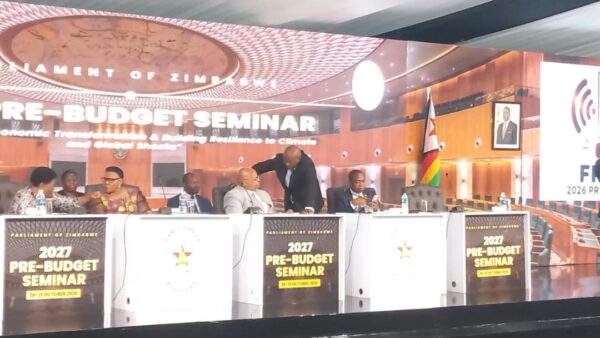
Addressing the 2027 National Pre-budget Seminar in Bulawayo on Wednesday, Advocate Mudenda said the budget should reflect the Second National Development Strategy (NDS2), the African Union’s Agenda 2063 and the United Nations 2030 Agenda for Sustainable Development, which supports Zimbabwe’s ambition of attaining upper-middle-income status.
“It should also reflect the continental vision of The Africa We Want enshrined in Agenda 2063 and the universal promise of the 2030 Agenda for Sustainable Development, for us being the achievement of an Upper Middle Income Society.
“Honourable Members, your authority over the nation’s finances is neither borrowed nor bestowed by Executive benevolence. It is the hard-won inheritance of a long constitutional struggle that places Parliament at the epicentre of democratic control over public resources,” he said.
Advocate Mudenda said the Constitution entrusted Parliament with the responsibility of determining how public revenue was mobilised, allocated, spent and accounted for.
“Section 303 gives that authority its sharpest edge by decreeing that no public funds may be withdrawn from the Consolidated Revenue Fund except by explicit parliamentary appropriation.
“This provision serves as a constitutional bulwark against arbitrary expenditure, fiscal indiscipline and the diversion of public resources from democratically sanctioned priorities,” he added.
He urged legislators to scrutinise every budget allocation against constitutional requirements, developmental impact, value for money and the public interest.
“That is why you ought to scrutinise every allocation through the fourfold prism of constitutional fidelity, developmental impact, value for money and the public interest.”
Advocate Mudenda said Parliament’s responsibility did not end with approving the budget but extended to monitoring how allocated funds were spent and the results achieved.
He said legislators should track public expenditure from the Treasury to service delivery points, including village clinics, rural schools and community boreholes, to establish whether the intended services had been provided.
“The Public Finance Management Act [Chapter 22:19] (PFMA) provides a statutory framework for discharging that responsibility. Specifically, section 34(2) provides that: ‘Every accounting officer shall submit monthly financial statements and reports for submission by the Minister to the appropriate Parliamentary Portfolio Committee, within thirty days of the respective month,’” he said.
He also cited Section 33(2) of the Act, which provides for the submission of quarterly financial statements and reports to the relevant parliamentary portfolio committees within 60 days after the end of each quarter.
“Similarly, section 33(2) provides in terms that admit no ambiguity:
‘Every accounting officer shall submit quarterly financial statements and reports for submission by the Minister to the appropriate Parliamentary Portfolio Committee, within sixty days of the end of the respective quarter’.”