Tawanda Musarurwa
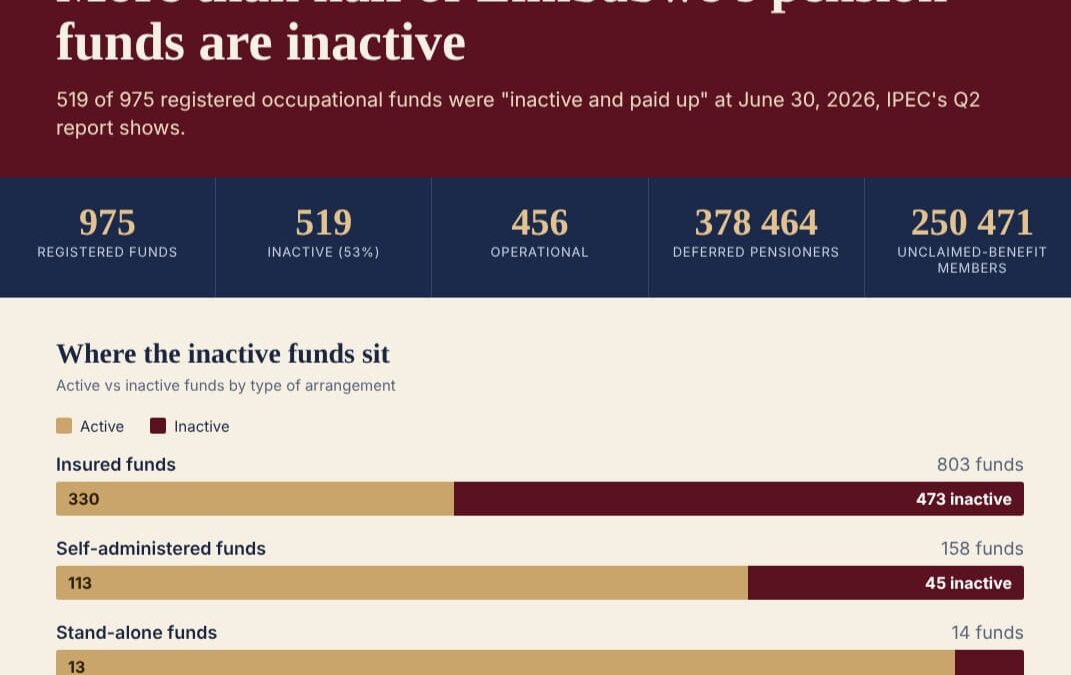
MORE than half of the 975 occupational pension funds registered in Zimbabwe were inactive as at June 30, 2026, raising questions over the security of members’ benefits.
The Insurance and Pensions Commission (IPEC) second-quarter Pensions Report for the period ended 30 June 2026 shows that 519 funds, or 53 percent, were inactive, leaving 456 operational. Classified by the regulator as “inactive and paid up”, most are earmarked for dissolution.
National Social Security Authority (NSSA) general manager Dr Charles Shava said poorly performing occupational schemes had left more retirees relying on the State.
“Some of them, they no longer pay anything, or they have literally collapsed,” said Dr Shava.
“So everybody just looks to (NSSA) for their pension.”
While Dr Shava did not single out the inactive funds—which IPEC maintains are paid up rather than failed—he stressed that NSSA “is not a conventional pension fund” and “is not your main pension”.
Clearing dormant schemes remains a protracted process. Only one fund, FHI 360, was “naturally dissolved” during the review period, while the Dominican Convent High School Pension Fund was registered. The report provides no timeline for dissolving the remaining dormant funds, which must formally cancel their registration certificates with IPEC or remain “subject to statutory reporting requirements”.
Zimbabwe Association of Pension Funds (ZAPF) director-general Mrs Sandra Musevenzo attributed the high dormancy rate to broader economic shifts, though she stressed that inactivity does not equate to lost savings.
“These include company closures, retrenchments, corporate restructuring, declining formal employment and the growth of the informal sector, all of which have disrupted traditional employer-sponsored pension arrangements,” she said.
“A fund may no longer be receiving contributions but could still hold assets and have outstanding obligations to former members and pensioners. Inactivity does not automatically mean that members’ savings have disappeared.”
What is known, and what is not
Of the 803 insured funds, 330 are active, alongside 113 of the 158 self-administered funds and 13 of the 14 stand-alone funds. This leaves roughly 473 insured funds, 45 self-administered schemes and one stand-alone fund inactive.
Insured funds hold 21.5 percent of sector assets, or ZiG19.94 billion out of ZiG92.79 billion, whereas the 14 stand-alone funds hold 44.3 percent of assets and cover 599 928 of the sector’s 1 144 455 members.
While the IPEC report does not disclose how many members or how much money sit in inactive funds, it records 378 464 deferred pensioners and 250 471 members with unclaimed benefits worth US$20.15 million (ZiG539.40 million). IPEC attributes these unclaimed funds to “data integrity issues”, including incomplete enrolment records and data loss during migrations from legacy systems, without linking them directly to dormant schemes.
Benefits unclaimed for over five years are slated to transfer to a protection fund that “is being institutionalised”; until then, funds retain the money. IPEC caps administration fees for inactive funds at 0.60 percent of assets, though exceptions include the Wattle Company Pension Fund at 8.11 percent and the AMG fund at 3.66 percent.
Dr Shava noted that NSSA “provides a social security net to our pensioners”. Contributions are calculated on an insurable earnings ceiling “currently sitting at US$700”, capping monthly contributions at US$35—an amount paid by only 8 percent of contributors.
“The amount that you expect to get in return is not expected to be higher or to be anywhere closer to your normal pension,” he said, explaining that most beneficiaries receive a uniform payout because “we don’t want anybody to be below a certain level of poverty”.
Public Service, Labour and Social Welfare Minister Edgar Moyo announced benefit increases following a 2025 statutory actuarial valuation confirming the financial health of NSSA’s schemes. The minimum monthly retirement pension under the Pension and Other Benefits Scheme, supporting roughly 262 000 beneficiaries, rose 28.57 percent from US$70 to US$90, while the minimum workers’ pension for about 8 000 beneficiaries increased 30 percent from US$100 to US$130. Backdated to October, payouts were scheduled for 13 November.
Dr Shava cautioned that future increments depend on cash flow, economic performance and a three-year actuarial valuation, warning that breaching actuarial limits would “collapse the schemes”.
“If things remain as they are now, we certainly expect another increase for our pensioners by the end of next year,” he added.
Rising assets, separate pots
Private-sector pension assets grew 2 percent to US$3.47 billion from US$3.41 billion in March, which IPEC noted “had exceeded the 2022 peak”, while total income of US$595.46 million rose 102 percent year-on-year.
Actuary Mr Gandy Gandidzanwa cautioned that exceeding the 2022 peak does not indicate the margin—“It might have exceeded by a dollar,” he said—nor does asset growth automatically trickle down to retirees.
“Probably 70 or 80 percent of the assets that IPEC is swearing to are assets belonging to active members,” he said. “Actives own the active members’ assets, and pensioners own their own assets.”
Annual pension adjustments remain sluggish, he added: “When there is a provision for pension increases on a yearly basis, it usually lags behind investment returns, it usually lags behind inflation.”
Average benefit payouts stood at US$85 per member over six months—a figure not directly comparable to NSSA’s monthly minimum—prompting IPEC to flag an “apparent inverse relationship” between asset growth and average pension payouts.
Mr Gandidzanwa noted that pension adequacy is measured by the net replacement ratio, representing a pension as a share of final-year salary.
“Anything above 75 percent would be considered adequate,” he said. “The pension cannot correct the wrongs of your economically active years.”
IPEC’s current regulatory priorities do not include a specific roadmap for dormant funds, focusing instead on recovering US$181.78 million in employer contribution arrears and raising prescribed-asset compliance from 8 percent to 20 percent.
ZAPF, however, urged a broader measure of sector performance. “The sustainability of a pension system should not be measured simply by the number of registered funds or assets under management, but by its ability to deliver meaningful retirement outcomes to members,” Mrs Musevenzo said.