Online Reporter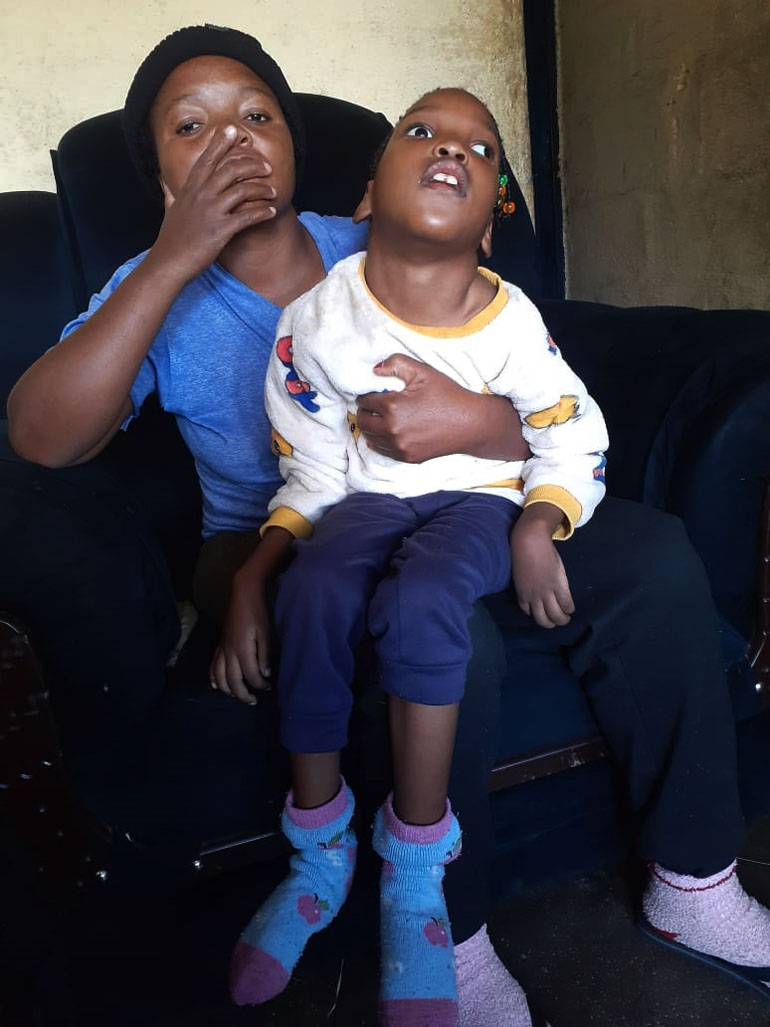
Tendai Vambe
Post Reporter
FOR most people, dusk signals the end of the day.
For Ms Tariro Zimvu, it never truly ends.
She is a full-time caregiver to her seven-year-old daughter, Revival Chinyongo, who lives with cerebral palsy, and relies entirely on her mother for survival.
“I bathe, feed, and clothe her. I cannot keep my eyes off her because I know what she wants and when she needs something. She is unable to communicate, so I carry her,” said Ms Zimvu.
Feeding Revival is a daily hurdle. Severe digestive difficulties mean she cannot process solid foods, requiring a strictly liquid or carefully softened diet.
The constant vigilance forced Ms Zimvu to leave her job.
Domestic workers are rarely equipped to handle complex medical conditions, leaving her with no choice, but to provide full-time care herself.
Without assistance from development partners, the household relies solely on financial support from Revival’s father for essentials such as medication, specialised food and diapers. Yet the cost remains overwhelming.
Revival uses more than three diapers daily, creating a heavy financial strain.
Ms Zimvu is now appealing for economic empowerment initiatives that allow primary caregivers to earn a living while remaining close to their children.
As a mother of two, she has had to put her personal ambitions on hold indefinitely to balance Revival’s intensive needs.
Her experience mirrors that of many families across Zimbabwe.
According to the Zimbabwe National Statistics Agency (ZimStat) 2022 Population and Housing Census, 1,6 percent of the population lives with severe functional limitations, while 9,2 percent faces at least some difficulty with daily activities.
The ZimStat data further shows that 74,1 percent of people with disabilities live in poverty, with 32,2 percent in extreme poverty.
Local advocacy networks, including Federation of Organisations of Disabled People in Zimbabwe (FODPZ) and National Association of Societies for the Care of the Handicapped (NASCOH), estimate that disability prevalence could reach 10 percent or higher when broader, unrecorded forms of exclusion are accounted for.
Research by international partners such as the Effective Institutions and Development (ECID) programme indicates that 85 percent of people with disabilities cannot afford healthcare, while UNICEF estimates that up to 600 000 Zimbabwean children live with a disability and face severe barriers to formal education.
For children like Revival, systemic exclusion extends to basic recreation. The absence of inclusive play spaces leaves them isolated from peers and communities.
Ms Zimvu is advocating for an accessible recreational centre in Mutare, tailored for children living with conditions such as cerebral palsy. Existing public facilities remain unequipped for children with severe physical limitations.
A specialised facility will offer more than recreation; it will provide space for social interaction and emotional growth, while offering caregivers a vital peer-support network.
Despite her physical limitations, Revival finds joy in simple moments — listening to music, watching cartoons, and hearing the gourd rattle played by her mother.
These quiet moments sustain Ms Zimvu as she seeks a home-based economic project to secure her family’s livelihood without compromising her daughter’s care.
Her request is straightforward: children living with severe disabilities deserve opportunities to play, socialise and belong, while their primary caregivers need targeted economic support.
While systemic gaps persist, targeted efforts are emerging across Manicaland to improve accessibility in public institutions.
At Chikukwa Primary School Vocational Centre in Ward 10, Chimanimani, construction is underway for user-friendly sanitation facilities, wheelchair ramps and paved walkways.
The initiative is being implemented through a multi-sectoral partnership involving the Quadriplegics and Paraplegics Association of Zimbabwe (QUAZ), Caritas Diocese of Mutare, Christian Blind Mission (CBM) Global and FODPZ.
It aims to address infrastructure barriers faced by people with disabilities in rural areas, where unpaved terrain and inaccessible buildings frequently limit independence.
A recent ground-breaking ceremony brought together representatives from government ministries, traditional leaders, school officials and civil society to emphasise inclusive planning.
QUAZ representative, Mr Mike Muringa, said the project addresses heightened vulnerabilities faced by people with disabilities during emergencies. Initial construction focuses on accessible sanitation and ramps at the vocational centre before expanding into surrounding communities.
Ms Samantha Majo, also representing QUAZ, said the project operates under the Disability Inclusive Disaster Risk Reduction (DiDRR) framework.
“We are also working with DiDRR with the aim of minimising risks for those with disabilities, as they are at greater risk during disasters. Materials and pavements for those with disabilities are underway. We are grateful to the government for supporting such an initiative that puts inclusion at the centre,” said Ms Majo.
Chikukwa Primary School deputy head, Mr Victor Chambwera, said the upgrades directly improve the learning environment, restoring dignity and independence for learners with mobility challenges.
School Development Committee (SDC) chairperson, Mr Osward Pukai also welcomed the project, saying the new facilities will make it easier for wheelchair users and other learners with mobility challenges to access toilets and move around independently.
In rural communities, people living with disabilities often face challenges such as inaccessible toilets, uneven pathways, lack of ramps and limited access to public facilities.
By upgrading core infrastructure, development partnerships are moving beyond temporary aid toward structural inclusion – ensuring that physical access, safety and human dignity remain central to community planning.