Online Reporter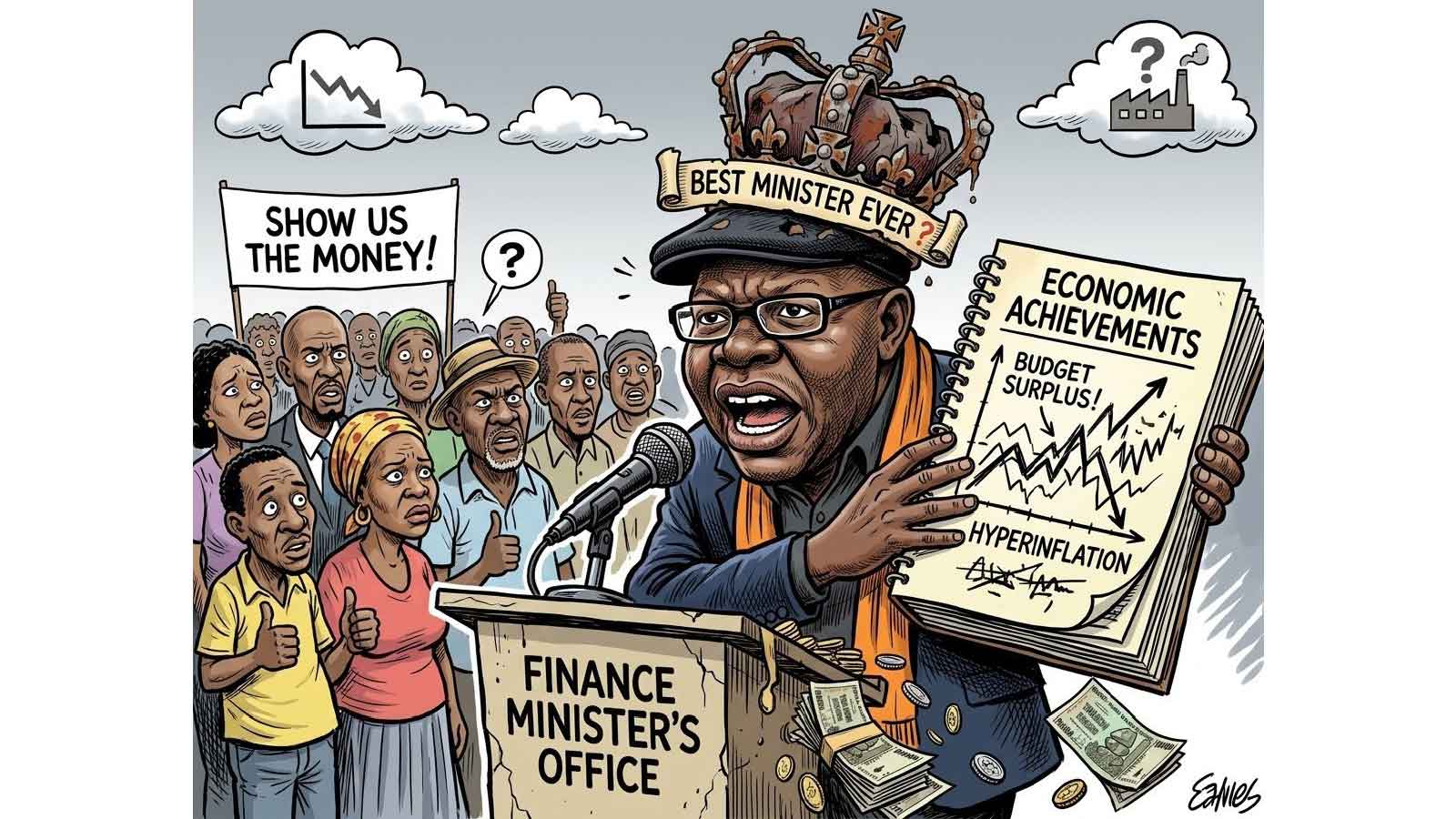
COMMUNION with Bishop Lazarus
This week, we all need to remember Tendai Biti in our prayers.
The man is clearly suffering mental anguish and indescribable distress.
He should seriously consider quitting the unforgiving world of politics, which has been unkind to him.
It seems he is forever fated to be a political bridesman as power always eludes him, even during his school days at Goromonzi, where he was deputy head boy in the early 80s.
Even when he cut his political teeth at the University of Zimbabwe, the best he could ever be was secretary-general of the Terry Mhungu-led Student Representative Council.
After leaving university, however, Mhungu chose to dive into the world of economics, where he specialised in asset management.
But Biti was ambitious: He chose to take up law and politics.
They say he played a key role in the shadows when Morgan Tsvangirai’s Movement for Democratic Change (MDC) was launched on September 11, 1999 — 27 years to the month — at Rufaro Stadium as an ambitious opposition party that wanted to wrest political power from the party of liberation, ZANU PF.
But Biti later emerged from the shadows to play a much more influential role in the party in 2005 after secretary-general Welshman Ncube was suspended in December over serious disagreements with Tsvangirai on participating in the then-newly introduced Senate elections.
He subsequently took over the all-too-familiar role. Being ever the ambitious politician, Biti, who seemed to covet the leadership role, inevitably eventually clashed with Tsvangirai when he tried to suspend him on April 26, 2014. Perhaps, he had not learned the golden rule in politics: If you raise your sword to strike a king, do not miss.
Well, Biti missed, and it proved calamitous.
After spending a year in the political wilderness, on September 11, 2015, he decided to form the People’s Democratic Party (PDP, initially the Movement for Democratic Change — Renewal), where he favoured himself with the title of president.
He, however, could not hold the party together for long enough, as it was to split again in September 2017 after Biti and other party officials joined the MDC Alliance electoral bloc. Lucia Matibenga ultimately took over the PDP.
It is important, dear reader, to note that even when Biti joined the MDC Alliance, he did so not as the headline act, but as Nelson Chamisa’s junior, as he was one of the two vice presidents.
Even when the MDC Alliance mutated into the Citizens Coalition for Change (CCC) on January 24, 2022, he still retained his bridesman’s role.
The crafty Chamisa was always wary of his ambitious deputy, and it was not long before Biti started experiencing growing isolation within the party.
He was left out of the party’s key campaign trails ahead of the 2023 harmonised elections and embarrassingly lost an internal party contest to represent Harare East in the polls.
For him, this marked a highly unremarkable and ineffectual period in opposition politics.
After his listless stint in the CCC, he recently tried to reinvent his waning political fortunes by creating a creature called Constitution Defenders Forum (CDF) around March this year to ostensibly organise resistance against the Constitutional Amendment Bill No. 3 (CAB3). There are no prices for guessing that this political enterprise also abjectly failed, too, as CAB3 ultimately sailed through Parliament and was eventually signed into law by President ED on July 7, 2026, which ultimately makes CDF redundant.
Opposing for the sake of it
Bishop Lazi decided to give you this elaborate account of Biti’s chequered political history to help you explain his latest stunt, where he let rip at the World Bank for daring to remove Zimbabwe from the infamous list of “fragile states”. He said the bank’s action was based on “phantom data” and calculated to feed an elaborate conspiracy.
You see, when a man dismisses empirical evidence in favour of his own feelings, he is usually in the business of manufacturing reality rather than observing it.
His claim that 68 percent of Zimbabweans remain below the poverty line — a figure he cites with the certainty of a man who has just consulted a sangoma — raises the question: Where did he obtain this number? Did it arrive in a vision? For a man who accuses others of relying on “phantom data”, he seems remarkably comfortable conjuring statistics from the ether.
This, folks, is the curse of our local opposition. They have convinced themselves that their sacred duty is to oppose, to resist, to reject — not because the facts demand it, but because opposition has become their identity.
One cannot help but wonder: Is this relentless negativity born of genuine concern, or is it the desperate thrashing of a man watching his self-awarded crown slip from his head? For years, Biti has been celebrated by his acolytes as the finest Finance minister Zimbabwe never deserved.
But if our current economic stewards (ED and his lieutenants) continue to conjure miracles — bringing annual inflation down to a three-decade low of just 2,9 percent; growing the economy to an estimated US$44 billion; growing exports to a record US$10 last year; and advancing Zimbabwe’s arrears clearance and debt resolution plan, among many other milestones — what becomes of his legacy?
Now the economy is showing signs of life, and Biti’s imaginary reputation — the one he has carefully curated for his slavish, bigoted admirers who still chant “best Finance minister ever”— is being eclipsed.
Every positive datum is a personal insult.
Every inch of progress is a threat to the legend he has built. Hence the X posts, the phantom data, the doom-laden sermons.
The man is not analysing Zimbabwe; he is mourning his own relevance. This seems to be Biti’s gripe with the World Bank. His entire worldview hinges on Zimbabwe remaining in a state of perpetual crisis. His political relevance, his intellectual authority, his very sense of self depends on the nation’s continued fragility.
Like a doctor who hopes his patients never recover, he cannot celebrate improvement because improvement renders him redundant.
We just pray that one day he might discover that opposing for the sake of opposing is not a political philosophy but a rather exhausting personality trait. And to his faithful followers who hang on his every dire pronouncement, the Bishop would say: The man who profits from your despair is not your saviour. He is merely a merchant of misery, selling you anxiety at a premium while pretending he alone holds the keys to your salvation. Zimbabwe has moved forward.
The only fragile thing left in this equation appears to be Biti’s fragile ego.
James 3:14-16 advises: “If you have bitter envy and self-seeking in your hearts, do not boast and lie against the truth . . . For where envy and self-seeking exist, confusion and every evil thing are there.”
The root of Biti’s obsession is not policy.
It is envy of relevance.
His opposition is not principle; it is the fear that progress will make his legend obsolete.
A politics built on misery
Unfortunately, this has always been the bane of local opposition politics, whose political fortunes were inextricably tied to the country’s economic health.
You see, when the economy looked gloomy, the MDC thrived, and when the economy performed, the MDC struggled.
Its political messaging was driven by a compulsion to oppose not because the facts demanded it, but because opposition had become a personality. In China, the political architecture rests on a simple but profound insight: Opposition parties are not adversaries to be vanquished, but cooperators to be embraced. The eight democratic parties that sit alongside the Communist Party of China are not there to obstruct, but to advise, to construct, to build.
Cooperation and consultation have replaced confrontation and strife, reducing internal friction and maintaining political stability and social harmony. The result is a nation that moves with the purposeful stride of a people who have decided that development matters more than the theatre of perpetual grievance.
Contrast this with our own politics, where opposition has become a profession of despair — a treadmill of rancour that consumes the very oxygen needed for progress.
This brings us to the recent reforms ushered in by Constitutional Amendment Act No. 3 (CAA3).
By extending the electoral cycle from five to seven years, the amendment has moved the political horizon from the exhaustion of constant contestation to the possibility of uninterrupted policy continuity.
Capital has always demanded what it never received here — a horizon long enough to depreciate a mine, mature an agricultural investment or amortise infrastructure debt without a change of guard resetting the terms.
More consequentially still, the shift from direct presidential election to a parliamentary vote dismantles the cult of personality that has for too long reduced our national conversation to a single name, a single face, a single contest.
The parliamentary electoral college system entrusts the choice of president to the people’s chosen delegates, fostering high-level consensus and removing the toxicity that has characterised our political field.
No longer will the nation hold its breath every five years while the personality circus rolls into town. The runway for manufactured crisis has been shortened.
Biti, of course, calls this the “death of democracy”. But what he mourns is not democracy — it is the death of his relevance.
A politics that rewards construction rather than destruction, that prizes continuity over chaos, that measures success in development rather than decibels, has no room for the professional pessimist. The Chinese understood this long ago.
Perhaps, at last, we are beginning to understand it, too. The CAA3 reforms will not silence the Bitis of this world, but they will shrink the stage on which they perform.
And for a nation tired of the same tired act, that is progress enough.
Bishop out!