Online Reporter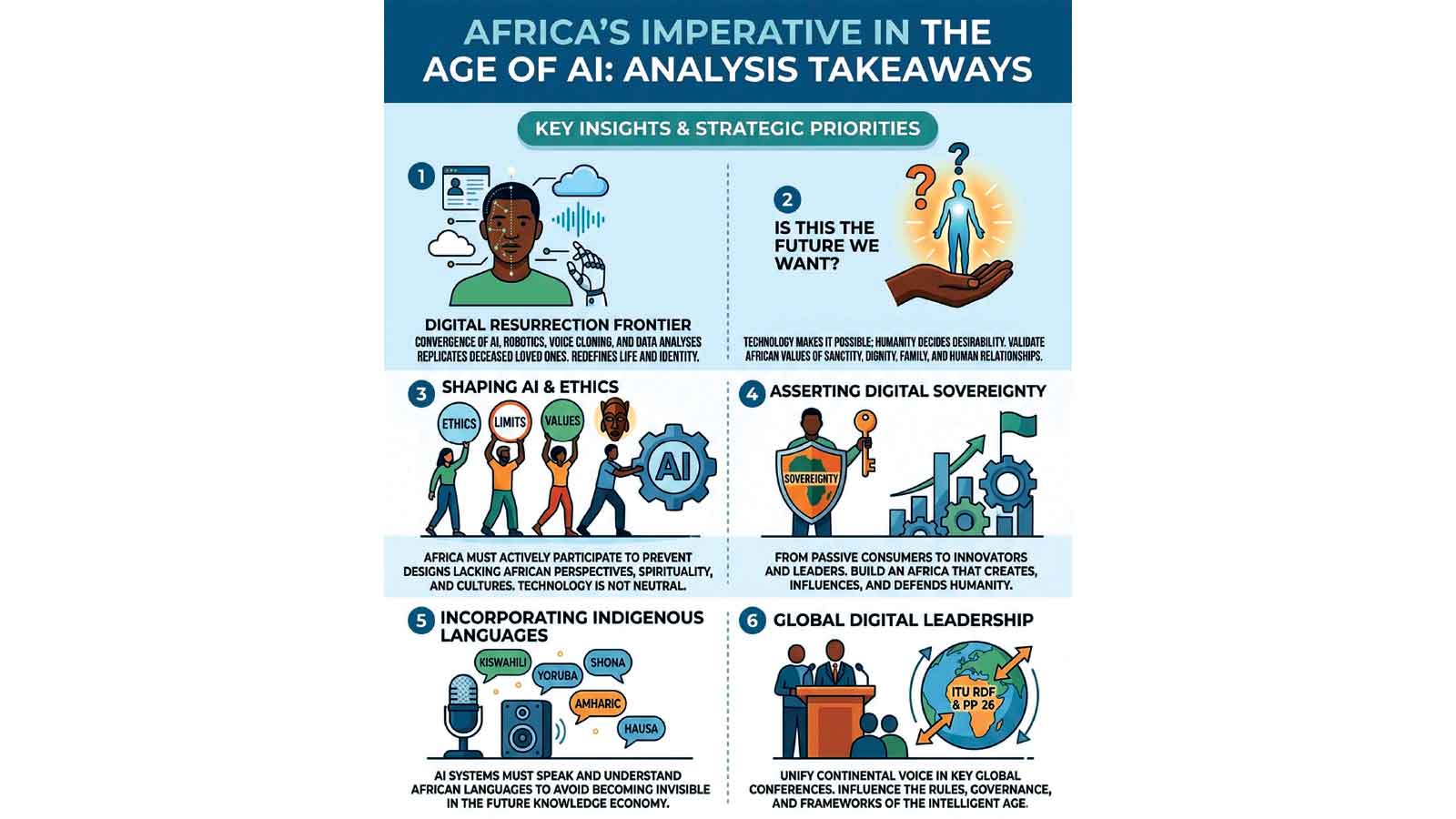
Dr Gift Machengete
Imagine bringing the dead back to life.
FOR thousands of years, resurrection existed only in the realm of faith, spirituality and divine power.
Yet today, humanity stands at the edge of a technological frontier that previous generations would have considered impossible and unimaginable.
Around the world, scientists and technology companies are now experimenting with a convergence of artificial intelligence (AI), robotics, synthetic humans, voice cloning and digital memory systems that may fundamentally redefine the meaning of life, identity and even death itself.
Consider this possibility.
A deceased person’s digital footprint — including voice recordings, social media posts, messages, photographs, videos, writings, educational history, professional records, personality traits, behavioural patterns and accumulated knowledge — can now be collected and analysed by advanced AI systems.
That intelligence can then be integrated into highly sophisticated humanoid robots or synthetic digital beings designed to replicate human appearance, facial expressions, speech patterns, emotional responses, physical mannerisms and even intellectual behaviour.
In other words, humanity is entering an era where people may one day speak, interact, learn from and even live alongside synthetic versions of deceased loved ones that appear astonishingly human.
As Africans, however, we must ask ourselves an important question: Is this the future we want?
While technology may make something possible, humanity must still decide whether it is desirable.
Africa has always valued the sanctity of life, the dignity of death, the spirituality of existence, the importance of family and the humanity of human relationships.
These values form part of the moral and cultural foundation of our societies.
We, therefore, cannot afford to become passive consumers of technologies developed elsewhere without participating in the conversations that shape their direction, their limits, their ethics and their impact on humanity.
If Africa does not actively participate in shaping AI and emerging technologies, then the future may be designed without African values, African cultures, African spirituality, African languages and African perspectives.
That would be a profound mistake because technology is never neutral.
Every technology carries the values, assumptions, philosophies and cultural perspectives of those who create it.
This is why Africa must have a stronger voice in global discussions on AI, digital governance, data governance, cybersecurity and emerging technologies.
Not because we seek to stop technological advancement — no nation can stop the tide of innovation — but because Africa must help influence the direction of innovation itself.
We must advocate for a direction that preserves humanity, respects cultural diversity, protects the dignity of human life and reflects the African ethos, African moral values and African understandings of community, identity, family and coexistence.
The ITU Regional Development Forum for Africa 2026 and the African Preparatory Meeting for Plenipotentiary Conference 2026 (PP26) come at a defining moment in human history — a moment when nations are not only competing economically, but are increasingly competing to shape the rules, ethics, governance frameworks and values that will define the intelligent age.
Africa must not arrive late to that conversation.
We must converge as a continent to ensure that our voice is heard clearly and collectively within the global digital ecosystem.
We must also ensure that AI systems understand African realities, African cultures and African languages.
AI systems must speak and understand Kiswahili, isiZulu, Shona, Yoruba, Hausa, Amharic, Arabic and the many indigenous languages that carry the identity, wisdom and cultural heritage of our people.
A continent whose languages and values are absent from AI systems is at risk of becoming invisible in the future knowledge economy.
For far too long, Africa has occupied the periphery of the global digital economy despite being home to one of the youngest, fastest-growing and most innovative populations on earth.
Yet history reminds us that Africa was never destined for inferiority.
Civilisation itself traces its origins to this continent.
Humanity began here.
Africa is not a continent without history.
Africa is the beginning of history.
And because Africa is the cradle of humanity, the continent must also help defend humanity in the age of AI.
The challenge before us today is, therefore, not simply about connectivity or technology deployment. It is about digital sovereignty.
It is about ensuring that Africa does not become merely a consumer of technologies designed elsewhere while others determine the future on our behalf.
Connectivity must become a tool for empowerment, innovation, industrialisation and cultural preservation.
Every fibre network we deploy, every tower we erect, every rural school we connect and every young African we equip with digital skills must contribute towards building an Africa that innovates, an Africa that influences and an Africa that leads.
Dr Gift Machengete is director-general of the Postal and Telecommunications Regulatory Authority of Zimbabwe. He made these remarks during the ITU Regional Development Forum for Africa 2026 and the African Preparatory Meeting for Plenipotentiary Conference 2026 (PP26) in Victoria Falls last week.