 Business Reporter
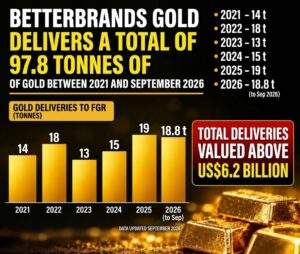
Betterbrands has delivered a cumulative 91.8 tonnes of gold to Fidelity Gold Refinery (FGR) between 2021 and September 2026, with the company recording 18.8 tonnes in the first nine months of 2026 alone, valued at over US$1.9 billion.
The figures, confirmed by Betterbrands, show annual deliveries of 14 tonnes in 2021, 18 tonnes in 2022, 13 tonnes in 2023, 15 tonnes in 2024 and 19 tonnes in 2025, before the 18.8-tonne performance to September 2026. The cumulative total does not include deliveries made between October 2025 and September 2026 beyond those captured in the yearly figures provided.
Betterbrands Jewelry chief executive officer Fradreck Kunaka attributed the performance to policy reforms introduced under the Second Republic, including improved gold-buying arrangements and measures designed to ease the operating environment for producers and buyers.
“We commend the Second Republic for creating a more enabling environment for gold deliveries and business growth through policies and initiatives that encourage production, formalisation and investment in the gold sector,” he said.
“Improved gold-buying arrangements, greater access to the formal market and measures aimed at easing the operating environment have helped businesses such as Betterbrands strengthen their contribution to Zimbabwe’s gold industry.”
The company’s reported trajectory reflects broader shifts in the sector. In June 2024, Government zero-rated gold deliveries to FGR for VAT purposes, reversing a 15 percent requirement that had created cash-flow pressures for miners. In March 2025, Fidelity lowered the threshold for qualifying for its 5 percent gold-delivery incentive from 20 kilogrammes to 500 grammes, broadening access for small-scale producers.
Official figures reported in January 2026 indicated that Zimbabwe’s total gold deliveries reached 46.7 tonnes in 2025, comprising 34.9 tonnes from small-scale miners and 11.8 tonnes from large-scale producers — a breakdown that highlights the centrality of artisanal and small-scale mining to national output.
Mr Kunaka said the growth demonstrated the resilience of local miners and the determination of entrepreneurs operating within the sector.
“At Betterbrands, we have witnessed encouraging growth in our gold deliveries, reflecting the resilience of local miners, the determination of entrepreneurs and the opportunities emerging within the sector,” he said.
“These developments demonstrate the importance of policies that reward production, promote confidence and allow businesses to plan, invest and expand.”
Betterbrands, founded by businessman Pedzai “Scott” Sakupwanya, has also reported investment in a gold refinery in Bulawayo, which Mining Zimbabwe reported in March 2026 was complete and awaiting official opening. The facility is expected to extend the company’s activities from gold buying into domestic processing.
Analysts caution, however, that policy incentives are only one factor behind rising deliveries. International gold prices, investment in production, mining output and efforts to reduce informal trading also influence volumes entering formal channels. The long-term contribution of local refining investment will depend on operational performance, processing capacity, reliable feedstock supplies and compliance with environmental requirements.
Mr Kunaka said the company remained committed to working with miners, suppliers, regulators and other stakeholders.
“The Government’s ‘Zimbabwe is Open for Business’ mantra is most effective when translated into practical conditions that enable local enterprises to thrive, create employment, support small-scale miners and contribute to national economic development,” he said.
“We remain committed to working with miners, suppliers, regulators and other stakeholders to grow the formal gold market and support Zimbabwe’s ambition to build a stronger, more productive and prosperous economy.”
The next phase for the sector, according to industry observers, should focus on expanding productive capacity, strengthening local supply chains, encouraging domestic processing and ensuring that growth is accompanied by responsible environmental and financial practices.