Tawanda Musarurwa
CHECKPOINT DESK
AS the Reserve Bank of Zimbabwe (RBZ) continues to urge banks to cut charges, a system where fees fund profits and loans make up just 33 percent of assets faces an existential test.
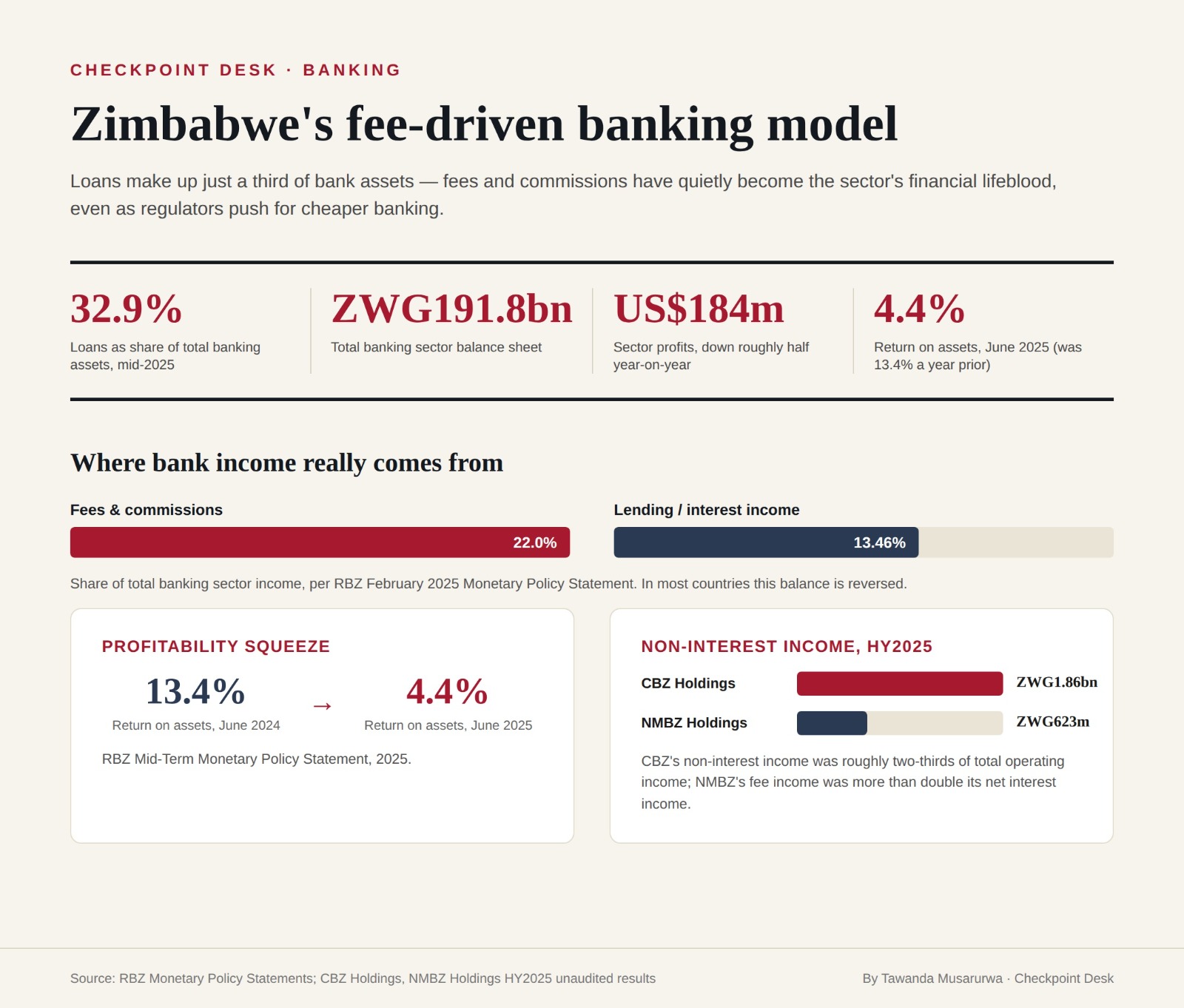
According to the 2025 Mid-Term Monetary Policy Statement (MPS), loans accounted for just 32,9 percent of total banking assets by mid-2025, even as the sector’s balance sheet expanded to ZiG191,8 billion.
Profits, meanwhile, halved over the year to about US$184 million.
Transaction charges and fees have quietly become the financial system’s lifeblood, despite years of moral suasion from the RBZ urging banks to make charges more affordable.
But, this call is being directed at a sector already grappling with thin returns and limited room to absorb further pressure on profitability.
RBZ data from the Mid-term MPS shows that average return on assets fell sharply, from 13,4 percent in June 2024 to 4,4 percent in June last year.
For years, local banks have survived by charging for money movement rather than taking on credit risk.
With credit growth still muted and pressure on fees intensifying, a harder question is emerging: will local banks survive if the RBZ shifts from moral suasion to policy?
That scenario is not far-fetched. Over the past two years, the RBZ has introduced modest measures to ease bank charges, including zero maintenance and service fees for low-balance Zimbabwe Gold (ZiG) and foreign currency accounts in April 2024, and the elimination of bank and point-of-sale charges on transactions below US$5 from February 2025.
This analysis examines the unaudited half-year 2025 financial results of CBZ Holdings, NMBZ Holdings and FBC Holdings, focusing on the share of income derived from fees and commissions.
Why fees matter so much to local banks
In his February 2025 MPS, RBZ governor Dr John Mushayavanhu highlighted the sector’s reliance on fees.
According to the statement, fees and commissions accounted for 22 percent of total banking sector income, while lending contributed only 13,46 percent.
In most countries, this balance is reversed, with banks earning most of their income from loans and fees playing a supporting role.
Locally, lending remains risky due to widespread informality and fears over exchange-rate volatility.
In contrast, fees are more predictable.
This shift is reflected in banks’ financial statements. CBZ Holdings’ HY2025 unaudited results show the group generated ZiG1,86 billion in non-interest income, roughly two-thirds of total operating income. NMBZ Holdings reported ZiG623 million in fee and commission income for the half-year, more than double net interest income.
FBC Holdings also recorded a sharp rise in net fee and commission income, driven largely by transaction volumes and digital banking activity.
What if fees are cut by half?
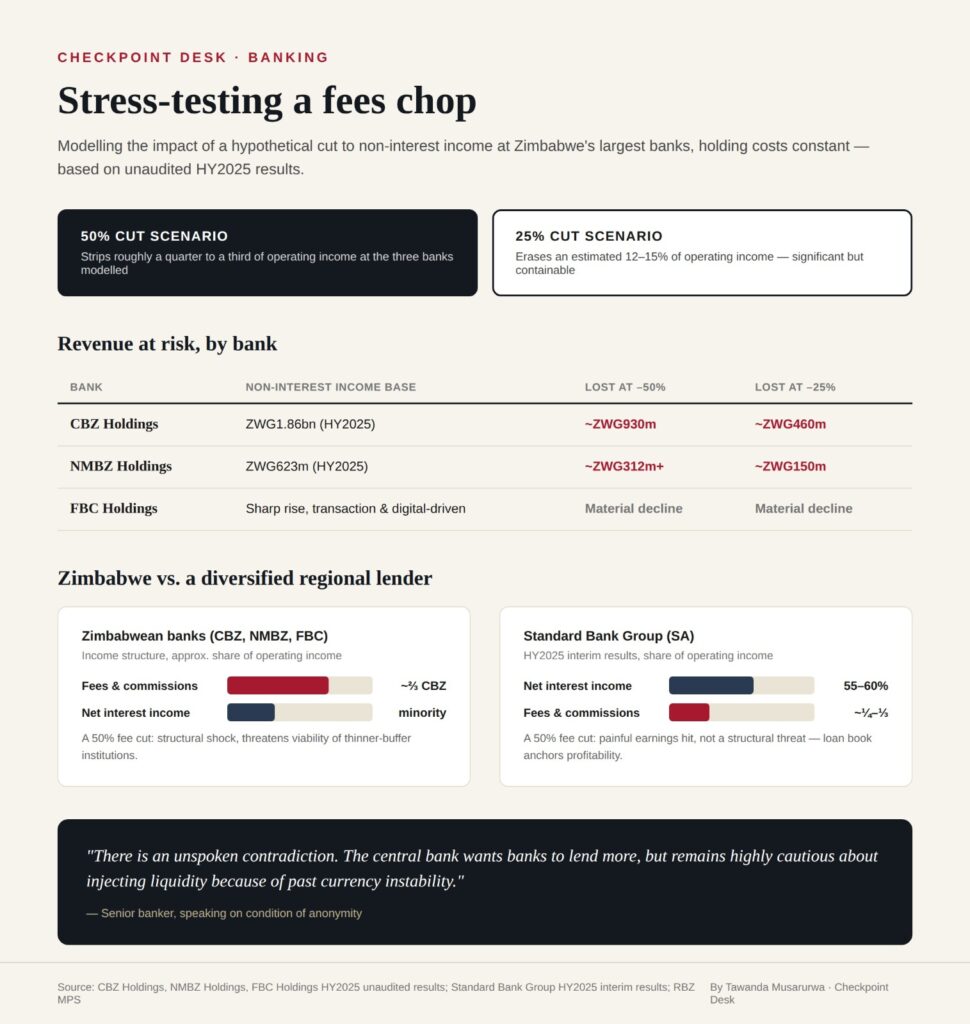
Using unaudited HY2025 results for CBZ Holdings, NMBZ Holdings and FBC Holdings, this analysis models a hypothetical 50 percent cut in non-interest income, holding costs constant and making no assumptions about changes in lending or interest margins.
This is to show the potential impact should moral suasion give way to regulation.
The results suggest such a move would significantly weaken banks’ profitability.
At CBZ, halving non-interest income would remove close to ZiG930 million from operating revenue for the period under review. That would push up the cost-to-income ratio and sharply reduce profits, even before factoring in impairments or taxes.
For NMBZ, a 50 percent cut would wipe out more than ZWG300 million in revenue, leaving little room to absorb operating costs without restructuring or cutting back on services.
Analysis of the published financials indicates that a 50 percent cut in fees could strip away roughly a quarter to a third of operating income at the three banks; a gap that, with lending contributing just 13,46 percent of total banking sector income according to the RBZ, would be difficult to replace.
While most banks currently meet capital requirements, smaller institutions with thinner buffers would come under pressure. Likely responses would include branch closures, staff reductions, higher minimum balances or the introduction of new fees to replace lost income.
Regional contrast emerges when compared to South Africa’s largest bank by total assets, Standard Bank Group. Standard Bank’s HY2025 interim results show a more balanced income structure, with net interest income accounting for just over half of operating income, at about 55 percent to 60 percent, while net fee and commission income contributes roughly a quarter to just under a third of total revenue, alongside trading and other income streams.
Applying the same hypothetical stress test used for Zimbabwean banks, a 50 percent cut in fee and commission income at Standard Bank, with costs held constant and no increase in lending assumed, would materially compress profits but would not threaten viability. The loss would weaken operating leverage and returns, but the bank’s sizeable loan book and diversified earnings base would continue to anchor profitability.
The comparison shows that while local banks risk losing a quarter to a third of operating income from a similar fee cut, a large regional lender like Standard Bank would experience a painful hit on earnings rather than a structural shock, underscoring how unusually fee-dependent Zimbabwe’s banking model has become.
And by 25 percent?
In a scenario where bank charges are cut by 25 percent, the impact would amount to a significant but containable shock rather than a systemic threat. Based on the same half-year financials, such a move would erase an estimated 12 to 15 percent of operating income at CBZ Holdings, NMBZ Holdings and FBC Holdings, cutting CBZ’s non-interest income by about ZWG460 million and NMBZ’s by roughly ZWG150 million, narrowing profits, pushing up cost-to-income ratios and compressing dividend headroom.
Bankers Association of Zimbabwe (BAZ) president Dr Sibongile Moyo, however, says local banks are already undergoing a structural shift, moving away from reliance on volatile revaluation gains toward more stable, lending-driven income.
“Previously, macroeconomic instability meant that a large portion of banking income was derived from revaluation gains, which accounted for over 53 percent of total earnings in the first half of 2024, rather than core lending.
“With the recent stabilisation of the exchange rate, these volatile gains fell to zero in the first half of 2025, forcing a healthy pivot toward sustainable financial intermediation,” said Dr Moyo.
“This shift is evidenced by interest income from loans rising from 10,44 percent to 31,91 percent over the same period.
“The upward trend is expected to continue as the deposit base and access to offshore lines of credit in the market increase.”
Many customers have asked why banks do not simply lend more instead of charging high fees? The answer lies in risk.
With many local businesses operating outside formal structures, reliable credit histories are scarce and collateral values are volatile.
While the ZiG has been stable over the past year, in the past exchange-rate swings could negatively impact a good loan bad within months.
In those instances, interest rates would, sometimes, fail to compensate for inflation.
As a result, banks favour short-term, transactional income over long-term credit exposure.
Banking insiders say the Reserve Bank of Zimbabwe’s (RBZ) position is internally contradictory.
“There is an unspoken contradiction,” said a senior banker who requested anonymity.
“The central bank wants banks to lend more, but remains highly cautious about injecting liquidity because of past currency instability.
“With a local currency still rebuilding trust, rapid credit expansion becomes a monetary risk. Banks are stuck in the middle. We are expected to intermediate more while also helping contain liquidity.”
In its August 2025 Mid-Term Monetary Policy Statement, the RBZ notes that “bank lending remains constrained”, while emphasising a “cautious liquidity management framework anchored on reserve money targeting, sterilisation operations and exchange-rate stability”.
This combination limits banks’ ability to expand credit even as they are encouraged to deepen financial intermediation, reinforcing reliance on fee-based income streams.
From a macroeconomic perspective, development economist Dr Prosper Chitambara says this has wider consequences.
“The high bank charges discourage people from keeping money in the banking system,” he explained. “That weakens monetary policy and makes the economy harder to manage.”
The cost to households and businesses
For ordinary Zimbabweans, the impact is immediate.
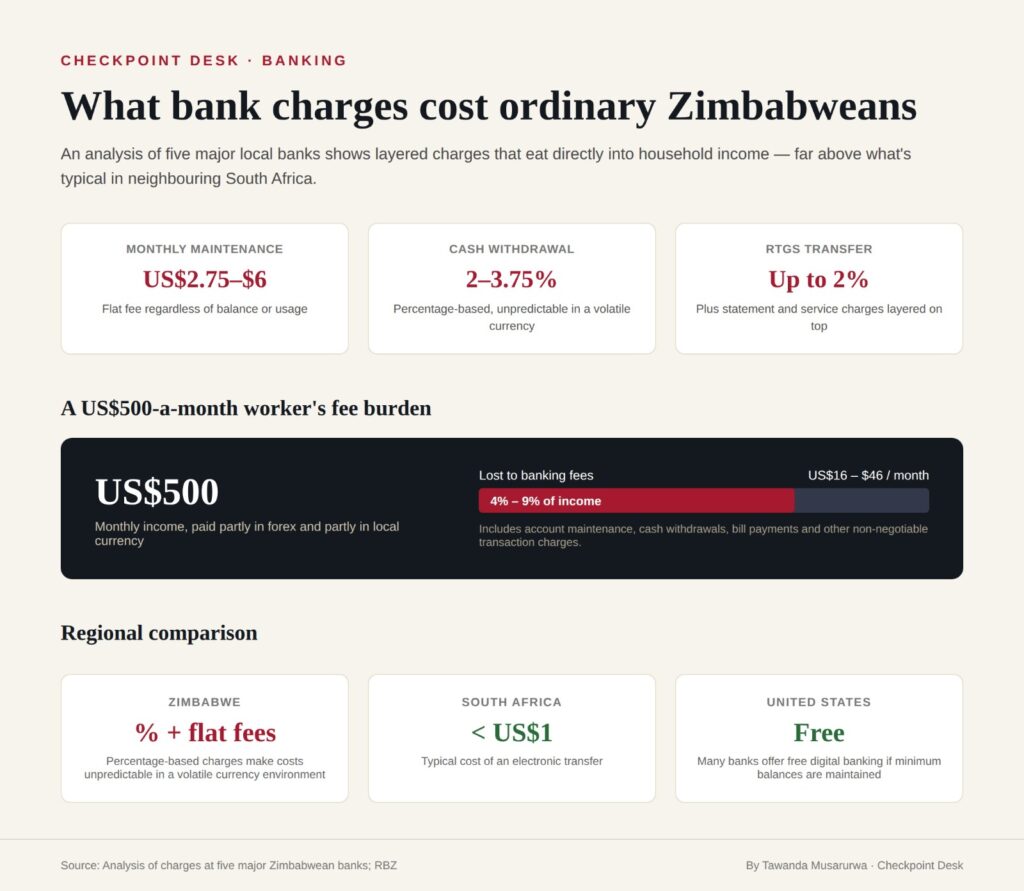
An analysis of charges at five major local banks showed monthly maintenance fees of between US$2,75 and US$6; cash withdrawal charges of between 2 and 3,75 percent; RTGS (real-time gross settlement) transfer fees of up to 2 percent; and statement and service charges layered on top.
Take a worker earning about US$500 a month, paid partly in foreign currency and partly in the local currency.
After non-negotiable fees such as account maintenance, cash withdrawals, bill payments and other transaction charges, between US$16 and US$46 goes to banking fees alone by month-end. For lower-income earners, this represents between 4 percent and 9 percent of monthly income. For small businesses that move money frequently, the losses compound quickly.
By comparison, electronic transfers in South Africa often cost less than US$1, while many US banks offer free digital banking if minimum balances are maintained.
Zimbabwe’s use of percentage-based charges, particularly in a volatile currency environment, makes costs unpredictable and disproportionately painful for those earning in local currency.
A difficult policy balance
The RBZ’s push to cut bank charges reflects genuine concerns over financial inclusion, confidence in the formal system and effective monetary policy.
However, cutting fees by force carries risks. Without addressing the underlying risk of lending, fee reductions alone may weaken banks without expanding credit.
In the worst case, customers could face fewer services, tighter conditions or hidden charges.
While the country needs cheaper banking, it also requires stable, well-capitalised banks able to finance growth.
With annual inflation easing to about 15 percent by December 2025, exchange-rate stability supported by foreign currency reserves of US$1,2 billion, about 1,5 months of import cover, and ZiG deposits growing 31 percent month-on-month, a forced reduction in charges could weaken bank profitability and intermediation, reversing gains in financial stability and undermining progress toward sustained price and currency stability.
An effective reduction in bank charges will require gradual reform, improved economic stability and incentives that make lending viable again.