Nqobile Bhebhe, Zimpapers Business Hub
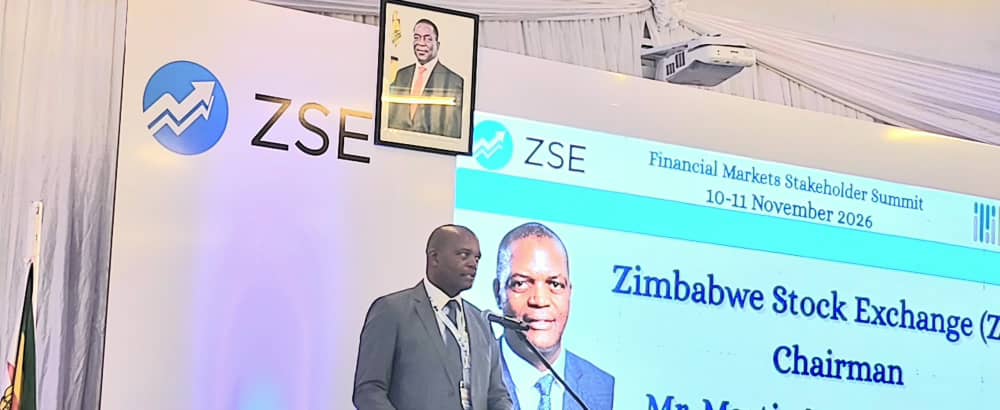
ZIMBABWE’S improving macroeconomic stability and renewed investor confidence present an opportunity for capital markets to unlock billions of dollars in institutional savings and channel them towards productive investment, Zimbabwe Stock Exchange (ZSE) chairman Mr Martin Mushambadope has said.
With pension funds holding assets estimated at US$3,5 billion as at June 2026, Mr Mushambadope said the country had a substantial pool of domestic capital that could be mobilised to finance business expansion, infrastructure development and broader economic growth.
Addressing delegates at the inaugural Financial Markets Stakeholder Summit in Bulawayo on Tuesday, he challenged market players to deepen capital markets and strengthen their capacity to connect available savings with viable investment opportunities.
He said the scale of pension assets was comparable to the entire market capitalisation of the ZSE showing the potential to expand investment opportunities and improve the allocation of domestic savings.
“A capital market is measured by the capital it connects. That is the real test of our theme. In terms of connecting capital, consider the savings we already have.
“Pension funds held about US$3.5 billion at the end of June 2026, according to IPEC, which is of the same order as the entire market value of the Zimbabwe Stock Exchange, which is roughly US$3.5 billion,” he said.
He noted that short-term insurance companies also held more than US$500 million in assets, while about 38 percent of pension assets remained invested in property, pointing to opportunities for diversifying investments and directing more funds into productive sectors.
Mr Mushambadope said Zimbabwe’s improving economic fundamentals had created a favourable environment for the development of financial markets, although stronger market confidence needed to translate into greater liquidity and depth.
He said the International Monetary Fund (IMF) had reported annual ZiG inflation of 3,7 percent and projected economic growth of 5 percent this year, with Zimbabwe meeting all benchmarks under its Staff-Monitored Programme.
The IMF now reports annual ZiG inflation of 3.7 percent, projects growth of 5 percent this year, and finds that every benchmark of the Staff-Monitored Programme has been met.
“The Reserve Bank has cut its policy rate from 35 percent in June to 27.5 percent, and reserves exceed two billion United States dollars.”
The improving economic environment has also been reflected in stronger stock market performance, with the ZSE and Victoria Falls Stock Exchange (VFEX) recording increased trading activity.
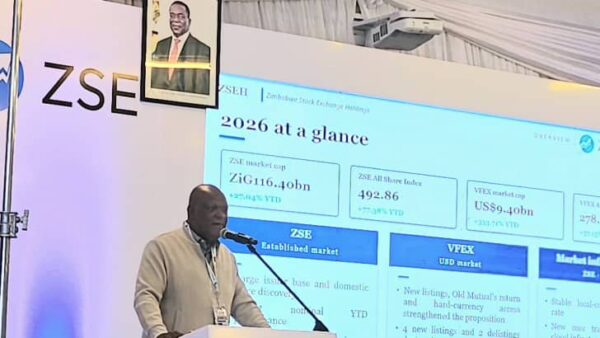
Mr Mushambadope said the ZSE All Share Index gained 68,5 percent in United States dollar terms in the seven months to July 2026, making it the strongest-performing of 17 African exchanges tracked by African Markets.
“In the seven months to July 2026, the ZSE All Share Index gained 68.5 percent in US dollar terms, the strongest of the seventeen African exchanges tracked by African Markets.
“In the first half, value traded on the ZSE reached ZiG7.6 billion, three times last year’s, and on VFEX it more than doubled to US$166 million.”
However, he cautioned that improving investor confidence had not yet translated into sufficient market depth, with daily trading values remaining relatively low.
“Confidence has returned faster than depth. In recent sessions, the ZSE has traded between ZiG7 million and ZiG20 million a day, well under one million US dollar,” he added.
He said the challenge was now to build deeper and more liquid markets capable of attracting more investment, broadening financial products and providing businesses with alternative sources of long-term funding.
Mr Mushambadope said the inaugural summit was an important platform for bringing together key players across the financial services ecosystem to develop practical solutions for the sector.
“This is the first time we have gathered in one room the policymakers, regulators, issuers, investors, and intermediaries who together make these markets function and the timing matters.
“Stability has opened the door. What walks through it, whether capital, ideas or ambition, depends on the choices made in rooms like this one.
“So let us judge this Summit not by the quality of our speeches, but by what follows them: a pipeline built, a product brought to market, a pool of savings put to work.”
The two-day summit, jointly hosted by the ZSE and VFEX, seeks to strengthen collaboration among policymakers, regulators, issuers, investors and financial intermediaries while exploring ways of expanding investment opportunities.
The discussions come at a time when Zimbabwe is seeking to mobilise domestic resources to support economic transformation, making deeper capital markets increasingly important in connecting institutional savings with productive investment.
Mr Mushambadope’s call puts the spotlight on the need to translate macroeconomic stability and improved investor sentiment into tangible investment flows that support business growth, infrastructure development and national economic ambitions.