Online Reporter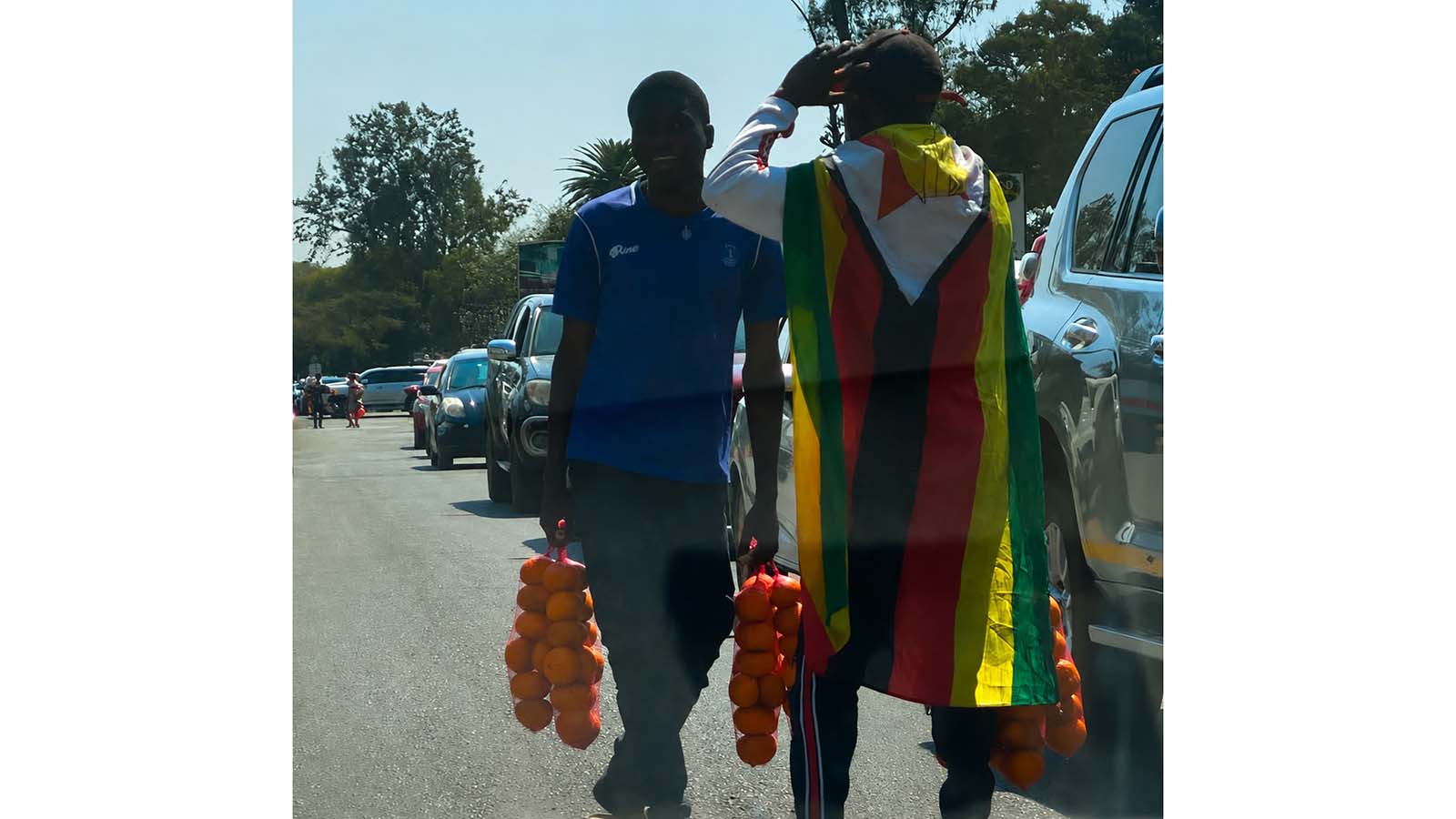
Lonster Mutata and Jacqueline Tanhara
THERE is something quietly powerful about the image.
Wrapped around his shoulders is the Zimbabwean flag. In his hands are bags of oranges. Around him, vehicles come and go, with some motorists stopping briefly to buy the fruit before continuing their journeys.
But look closer at the picture tells a much bigger story.
It is a story about agriculture beyond the farm gate.
It is about the farmer who grows the oranges, the workers who harvest them, the transporter who moves them to market, the trader who buys them and the roadside vendor who puts them within reach of the travelling public.
It is also a story about livelihoods, enterprise and the often-unseen economic activity that takes place every day across the country.
As Zimbabwe today pauses to remember the men and women whose sacrifices shaped the nation, the photograph offers another way of looking at heroism — the everyday Zimbabwean whose work, often unnoticed, contributing towards keeping the wheels of the economy turning.
At the burial of national hero Dr Sydney Zikuzo Gata at the National Heroes Acre in July last year, President Mnangagwa said Zimbabwe was ready for a new breed of heroes encompassing trailblazers, innovators, inventors and thought leaders who will impact the nation, region, African continent and the wider world.
And in the agriculture sector, people often speak about the sector in terms of hectares planted, tonnes harvested, litres produced, livestock numbers and other statistics that measure production.
But behind every statistic are people.
A tonne of fruit does not move itself from the farm to the consumer.
A successful harvest does not automatically become income for a farming household.
Between production and consumption lies a vast network of people whose work gives agricultural commodities economic value.
The farmer produces. The transporter moves. The trader connects. The vendor sells. The consumer buys.
Each plays a role in a chain that stretches from rural fields and orchards to markets, roadside stalls and household tables.
The man in the photograph is, therefore, not merely selling oranges.
He is participating in the country’s agricultural economy.
The orange itself may appear simple, but by the time it reaches the hand of a traveller through a roadside sale, it has already travelled through a chain of economic activity.
Somewhere, a farmer planted the tree and waited for it to mature. Someone tended the orchard. Labour was invested. Water and other inputs were required. The fruit was harvested, sorted, packed and transported.
Eventually, it arrived at the roadside.
This is where the informal economy becomes part of the agricultural story.
For many small-scale traders, agricultural produce is not simply something to sell. It is working capital, household income and a means of sustaining families.
The roadside market may look informal, but the economic activity taking place there is real.
A passing vehicle becomes a customer. A bag of oranges becomes income. An agricultural product becomes a livelihood.
And that is why the country’s agricultural transformation cannot be viewed only from the perspective of what happens on the farm.
Agricultural growth is increasingly associated with mechanisation, irrigation, improved technologies, climate-smart production and rising productivity.
These developments are important, but agricultural transformation does not end when the crop leaves the field.
The real test is what happens afterwards.
Can the produce reach markets? Can farmers secure viable returns? Can transporters move commodities efficiently? Can small traders participate meaningfully in agricultural value chains? Can consumers access affordable food?
These questions reveal that agriculture is not a single activity.
It is an ecosystem.
Within that ecosystem are thousands of people who may never own a large commercial farm, appear in a major agricultural report or feature in national statistics, yet whose daily activities contribute to the movement of food and the generation of income.
There is the farmer who rises before sunrise to work the land.
There is the transporter who spends long hours on the road carrying agricultural produce.
There is the market trader who sets up before dawn.
There is the vendor who stands by the roadside waiting for customers.
There is the woman who turns agricultural produce into a small business that pays school fees and puts food on the family table.
Their stories may never make the headlines.
Yet collectively, they are part of the daily effort to build the country.
That is what makes the photograph more than a roadside snapshot.
The Zimbabwean flag gives it a deeper meaning.
The flag represents the nation.
The oranges represent agriculture.
The trader represents enterprise.
And the road represents the movement of the country’s agricultural economy.
Together, they tell a story of a country being built not only in boardrooms, factories and large farms, but also along its roadsides, in its markets and through the hands of ordinary citizens.
Heroes are usually associated with extraordinary moments — acts of courage, sacrifice and service that become part of national memory.
But there is another kind of heroism: the quiet determination of people who wake up every day and work to support their families and contribute to their communities.
The roadside vendor carrying oranges may not consider himself a hero.
Neither may the farmer who rises before sunrise to tend crops, the transporter travelling hundreds of kilometres with agricultural produce or the market trader who spends the day connecting farmers with consumers.
They are simply working.
But taken together, these ordinary acts become extraordinary in their collective impact.
On Heroes Day today, Zimbabwe remembers those who made immense sacrifices for the birth and freedom of the nation.
It can also pause to recognise those who, in quieter ways, continue building it.
The young trader wrapped in the national flag and carrying bags of oranges is therefore carrying more than fruit.
He is carrying a livelihood.
He is carrying the work of a farmer.
He is carrying a value chain.
And, perhaps without intending to, he is carrying a small but powerful picture of Zimbabwe itself — a nation whose agricultural economy is sustained not only by those who produce, but also by the countless hands that move, trade and deliver that production to the people.
Sometimes, heroism does not announce itself.