Walter Nyamukondiwa-Mash West Bureau Chief
THE excitement was palpable long before President Mnangagwa arrived at Chinhoyi University of Technology where thousands of Zanu PF delegates gathered for the official opening of the party’s 23rd Annual National People’s Conference yesterday.
From the steady arrival of delegates on the university grounds to the swelling sounds of revolutionary songs, anticipation built, reaching fever pitch as the President and First Secretary, accompanied by his deputies and other senior party officials, arrived to open the conference.
The Police Band, Dendera musician Suluman Chimbetu, Chief Hwenje and other cultural groups took turns entertaining the gathering, setting the stage for a day that blended celebration, reflection and political messaging.
Then came “Kutonga Kwaro”, President Mnangagwa’s signature introductory song, filling the auditorium and drawing delegates into the familiar rhythm of the ruling party’s political culture.
Chimurenga songs reverberated through the venue, evoking memories of the liberation struggle and the political traditions on which Zanu PF has built its identity.
Beyond the music, choreography and pageantry, however, lay a more consequential exercise: a gathering expected to take stock of the party’s performance, examine its shortcomings and chart its course as it pursues its development agenda.
When Secretary-General Advocate Jacob Mudenda formally convened the conference in accordance with the party constitution, proceedings shifted from celebration to business.
He outlined the composition of the conference Presidium and the delegates, drawing on the party constitution to establish the gathering’s legitimacy and mandate.
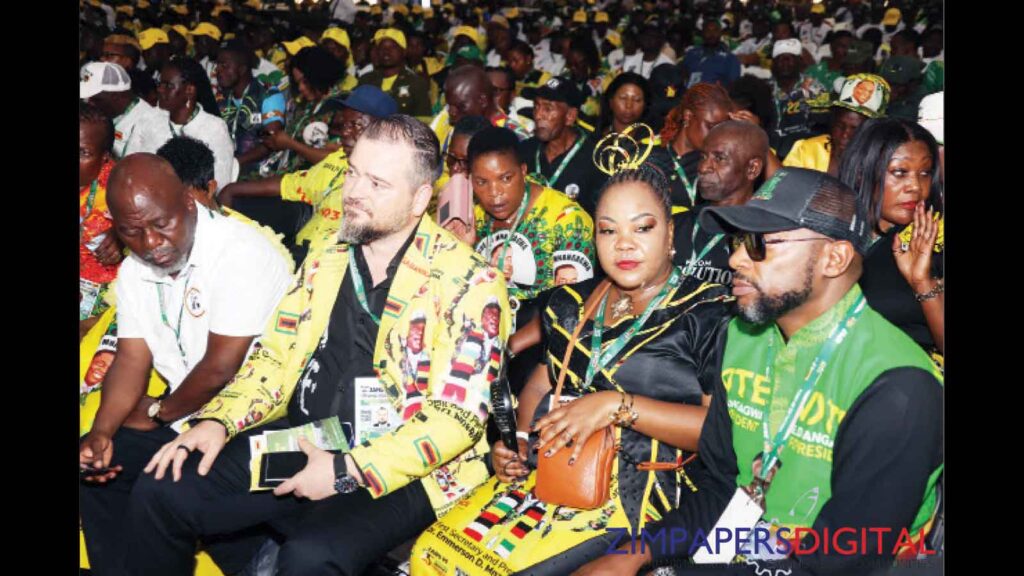
Zanu PF Chairperson for Mashonaland West Province Cde Mary Mliswa-Chikoka (centre), flanked by Cdes Vangelis Haritatos and Chamu Chiwanza (right) follows proceedings at the colourful event in Chinhoyi yesterday.
The conference brought together members of the Central Committee, Council of Elders, National Consultative Assembly, Women’s and Youth Leagues, war veterans’ structures, and provincial and district organs, among other party representatives.
The extensive political assembly was designed not only to reaffirm the party’s leadership, but also to review its operations, consider resolutions and provide strategic direction.
The speeches that followed reflected the demands facing a ruling party seeking to consolidate its political base while delivering on its promises of economic transformation.
National Chairman Oppah Muchinguri-Kashiri urged delegates to reflect, introspect and acknowledge mistakes, arguing that honest self-assessment was necessary for the party’s continued success.
Her message introduced a note of introspection, reminding delegates that political longevity requires more than celebrating achievements.
Other speakers reinforced the call, challenging party members to confront uncomfortable truths and undertake an honest appraisal of their performance.
For Mashonaland West, the host province, the conference was also an opportunity to demonstrate its organisational capacity and readiness to accommodate one of the party’s most important annual gatherings.
Provincial Affairs and Devolution Minister Marian Chombo and the provincial leadership had a visible stake in the event’s success, with the venue transformed into a setting for political deliberation, cultural expression and hospitality.
Provincial chairperson Cde Mary Mliswa-Chikoka captured the significance of hosting the gathering, describing it as a profound honour for a province where history, production and development intersect.
“Honour the past with what we build today,” she said, challenging delegates to translate the sacrifices of earlier generations into tangible achievements.
Her remarks reflected a central theme of the conference: connecting the party’s liberation history with its present-day development ambitions.
The logistics appeared to match the scale of the occasion. Delegates were accommodated in a well-organised setting, with catering arrangements running smoothly and designated service points serving provincial delegations, diplomats and service providers.
Delegates praised the organisation, describing Mashonaland West’s preparations as among the best they had experienced at a party conference.
President Mnangagwa also expressed admiration for the work invested in preparing for the gathering.
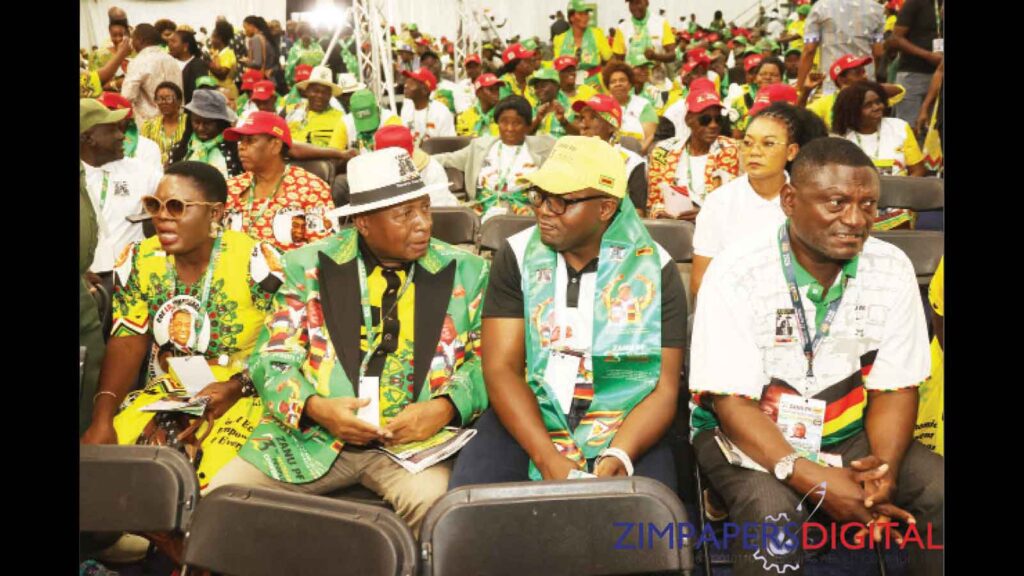
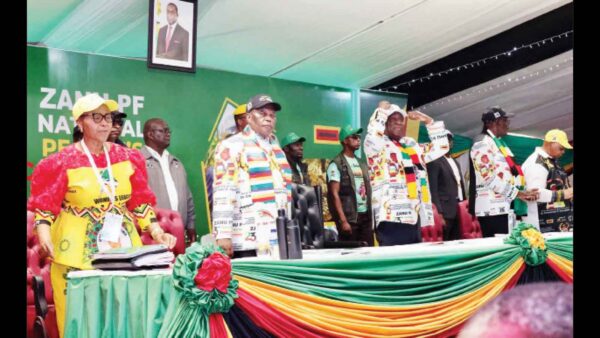
Ministers Edgar Moyo (second from left), Mangaliso Ndlovu and Albert Nguluvhe (right) attend the ruling party’s annual conference at Chinhoyi University of Technology yesterday.
Yet the conference’s defining moments extended beyond its elaborate arrangements and spirited performances.
Vice President Constantino Chiwenga’s remarks underscored the importance of translating decisions made into action throughout the party’s structures.
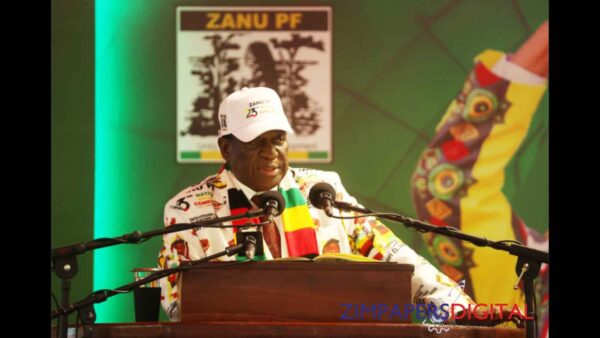
When President Mnangagwa took to the podium, applause punctuated his address as delegates responded to messages on the party’s constitutional obligations, unity and the country’s development trajectory.
He urged the party to honour the country’s liberation heroes by accelerating sustainable economic development, while emphasising the importance of intra-party democracy and inclusivity.
“Dzokai kumusha, tinokwana tese,” he said, in a call for opposition members to return home and embrace one another.
The message of unity carried particular significance at a gathering whose resolutions are expected to shape the party’s political and organisational direction.
The President’s address also placed the conference within a broader economic context, emphasising investment, production and the exploitation of the country’s natural resources to drive growth.
For business leaders and economic policymakers attending the gathering, the speech offered a glimpse into the policy environment in which they are expected to operate.
Mutapa Investment Fund chief executive Dr John Mangudya said the President’s address provided useful direction for the management of State assets and future investments.
He said a stable and predictable economic environment, supported by lower inflation and the availability of foreign currency, was critical for investors seeking to plan and expand their operations.
The President’s emphasis on increasing production, he added, reinforced the fund’s mandate to grow the value of State assets, expand mineral exploration, support employment and contribute to national economic growth.
Information, Communication Technologies, Postal and Courier Services Minister Tatenda Mavetera said the address also provided direction on the adoption and deployment of artificial intelligence and the expansion of digital literacy, both within the party and nationally.
Economist Dr Langton Mabhanga placed the conference within Zimbabwe’s broader diplomatic and development context, pointing to the country’s non-permanent membership of the United Nations Security Council and its impending chairmanship of the Common Market for Eastern and Southern Africa (COMESA).
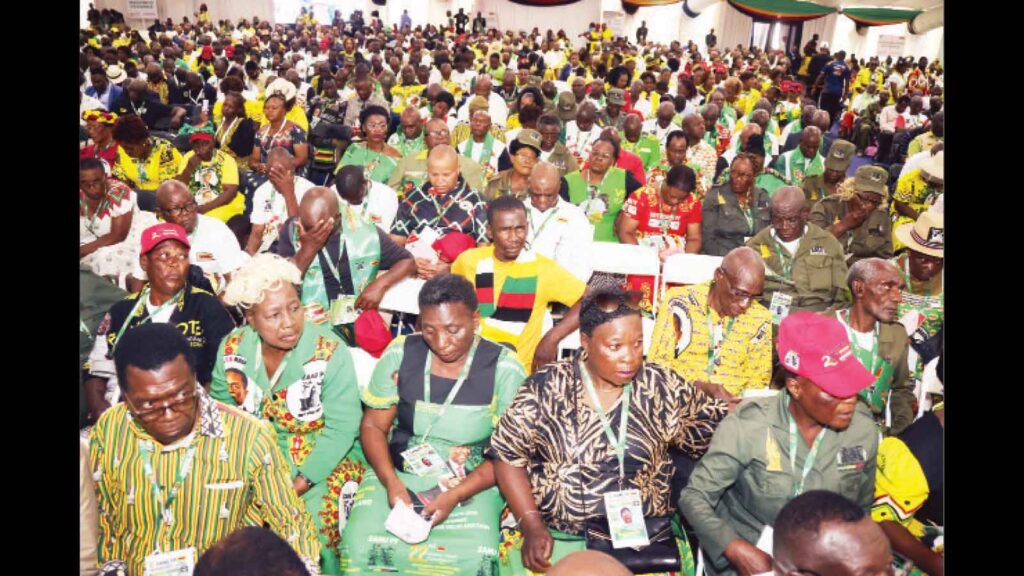
Part of the thousands of delegates who attended the conference’s official opening by the President yesterday.
He said these developments came alongside gains in infrastructure development, presenting opportunities for Zimbabwe to strengthen its international standing and advance its economic interests.
Religious leader Bishop Nehemiah Mutendi urged the party and its leadership to close ranks and guide Zimbabwe towards prosperity and empowerment, expressing confidence in Zanu PF’s role in uplifting people’s lives.
Messages of solidarity from traditional leaders and business representatives added to the proceedings, reflecting the range of constituencies with an interest in the country’s political and economic direction.
As the conference unfolded, the interplay between celebration and calls for reflection remained evident.
The songs evoked the history of the liberation struggle. The speeches emphasised unity and continuity, while the economic messages focused on production, investment and development.
For Zanu PF, the challenge is to bring these strands together, turning the energy of its annual gathering into decisions that strengthen party structures and deliver measurable gains in the lives of ordinary Zimbabweans.
At CUT, the applause, revolutionary music and carefully choreographed proceedings gave the conference its colour and significance.