Charles Mavhunga
Tourism Branding
On October 27, 2026, the Chivero Culture Centre in Headman Mubaiwa’s Village, under Paramount Chief Chivero, Mhondoro, hosted the inaugural Mbira Dzakauchikwa Festival.
More than 200 people gathered.
The occasion was graced by Politburo member, liberation struggle veteran and ZANU PF Party Secretary for Gender and Culture, Tendi Mkusha.
Her visit to the historic Kaguvi Site 1 was not a routine ceremonial appearance.
It was a national acknowledgement that this ground holds the story of how Zimbabweans first rose against colonial invasion.
Kaguvi Site 1: Where Chindunduma planned its war
The centre lies in Headman Mubaiwa’s area and the village itself is part of the history.
Kaguvi Site 1 is the first home of the spirit of Kaguvi, under the guidance of Makuvatsine.
Here, in the Chindunduma uprising of 1896–97, the warriors and strategists (Makuvatsine, Mubaiwa, Gumboreshumba, Chizema, Chifamba and others) met to plan their war against colonial rule. Gumboreshumba was the medium possessed by the spirit of Kaguvi, which is why the site bears his name.
The site’s greatest feature is its ninga, a deep underground cave said to stretch for kilometres.
Headman Mubaiwa, patron of the site, describes it as the ultimate shield. It hid chiefs from capture and remains the sacred resting place of most ancestors of the Mhofu/Shava people.
The cost of resistance was severe. Many Chindunduma leaders were captured and hanged.
Kaguvi was hanged in 1898, alongside Mbuya Nehanda and Chinengundu and their heads were taken to European museums as war trophies.
Makuvatsine, however, was not killed.
His captors jailed him in Kimberley, South Africa and he was later released. He returned to this very site to continue his spiritual work and today he rests at its centre.
Few places combine a command centre, hiding place, royal burial ground and living shrine.
The significance of Cde Mkusha’s visit
Why does a Politburo member’s presence at a village festival matter so much? Because Cde Mkusha’s visit connects three things often kept apart: The First Chimurenga, the liberation struggle that followed, and today’s cultural life.
First, her presence confirms Chindunduma as part of the Chimurenga story. The Chimurenga did not begin in the 1960s. It began in 1896, when Kaguvi, Nehanda, Chinengundu and Makuvatsine planned, fought and, in many cases, died so that the land and its people would remain free.
When a veteran of the liberation struggle stands where that first war was planned, the unbroken line from Chindunduma to independence in 1980 becomes visible to every pupil and villager present.
Second, her visit gives national legitimacy to local custodians. Headman Mubaiwa and the community maintain this centre by their own effort; a senior leader’s coming says their work is national work, not a village hobby.
Third, her visit points to policy in action. She reminded the gathering of the ZANU PF 23rd National People’s Conference resolution in Chinhoyi that cultural and craft centres be established in every district, and presented the festival as practical proof.
She also highlighted the partnership among the ministries of Sport, Arts and Culture, Home Affairs and Cultural Heritage and tourism. It places Chivero on the national map.
Pupils of Makuvatsine Primary School opened by singing the National Anthem, so the youngest generation stood at the site of its ancestors’ struggle.
A Message to the Nation
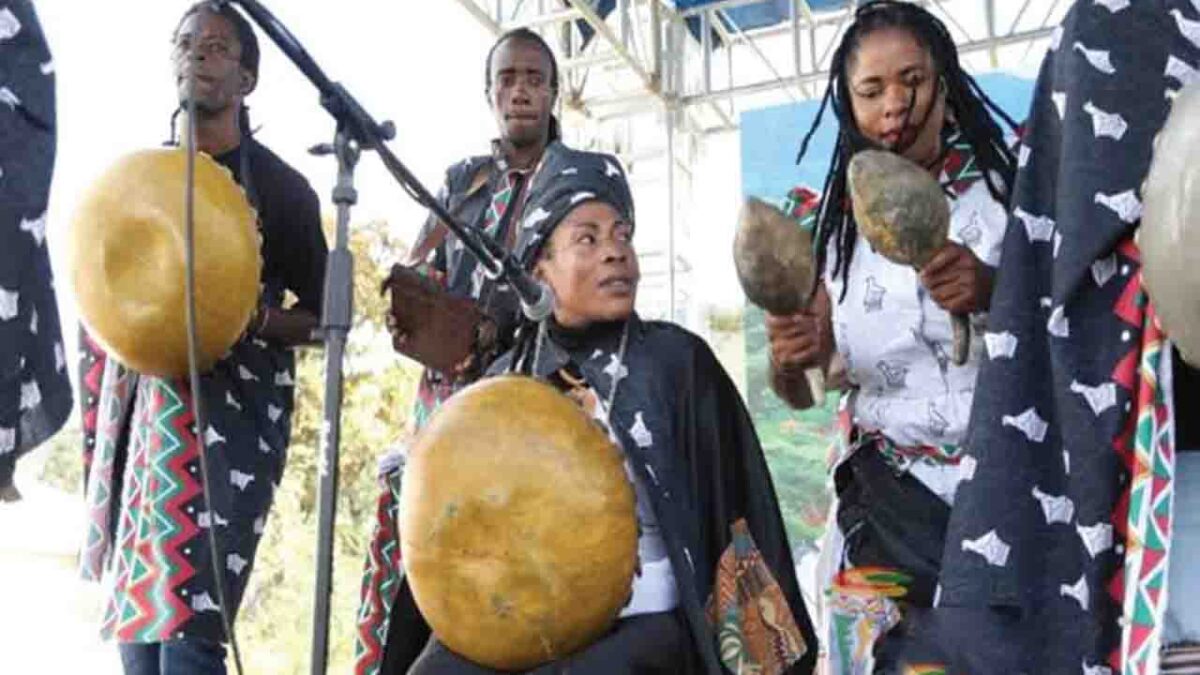
Cde Mkusha told the gathering that mbira is far more than an instrument: it is the heartbeat of the ancestors, a rhythm of resilience and a bridge between generations.
She commended the community for maintaining the centre, a sanctuary of heritage and a living expression of Vision 2030 and the “Leaving No One and No Place Behind” development mantra.
Quoting the rallying call Nyika inovakwa nevene vayo, chivanhu chinochengetedzwa nekusimudzirwa nevene vacho, she stressed that traditions are safeguarded by those who inherit them.
Heritage as Gnosis
Gnosis means knowing by deep, lived experience, not merely by report. A visitor can read about Chindunduma in a book, but at Kaguvi Site 1 they stand at the ninga, hear the mbira and taste the food of the ancestors.
This makes the site strategic for tourism branding.
The festival featured mbira groups, including the Chivero Culture Mbira Group, researchers and an exhibition of traditional foods such as hwohwa, sadza rezviyo and mahewu, with clay pots and wooden spoons.
A ngoma inherited from Makuvatsine and a mbira, both from around 1800, were shown.
Music, food, history and spirituality form a ready-made experiential product, adding a cultural-spiritual circuit to a national brand built on Great Zimbabwe, Victoria Falls and mbira itself.
From commemoration to commercialisation
Vision 2030 and NDS2 prioritise value chains, tourism and cultural industries. Each festival is a small value chain, creating demand for food producers, craftspeople, musicians, guides and transport.
Mbira making, pottery and food processing can be scaled through value addition and branding. Regionally, a heritage route linking Chivero, Great Zimbabwe, Khami and Matobo would strengthen intra-African tourism under Agenda 2063.
Conclusion
Cde Mkusha’s visit affirms that Chivero is more than a local landmark: it is where ancestral memory, community enterprise and national policy meet. The task now is to document its oral history, protect it formally and invest in interpretation, training and promotion, so the spirit of Makuvatsine and Gumboreshumba can anchor a self-reliant Zimbabwe. This is the story of a nation built by its owners.
Charles Mavhunga is a Zimbabwean scholar, author and cultural ambassador pursuing a PhD in Management at Bindura University of Science Education. /He is the author of Mbira Virtuosos: Stories of Zimbabwean mbira legends (available on Amazon) and co-author of Business Enterprising Skills (Forms 1–4), published by Gramsol Books, Harare and approved by Zimbabwe’s Ministry of Primary and Secondary Education. /A recognised Global Cultural Ambassador and member of the Council for the Development of Social Science Research in Africa (CODESRIA), he writes a weekly column for The Herald, where he has published over 300 articles on tourism branding. He can be reached at charles.mavhunga@ gmail.com or +263 772 989 816.