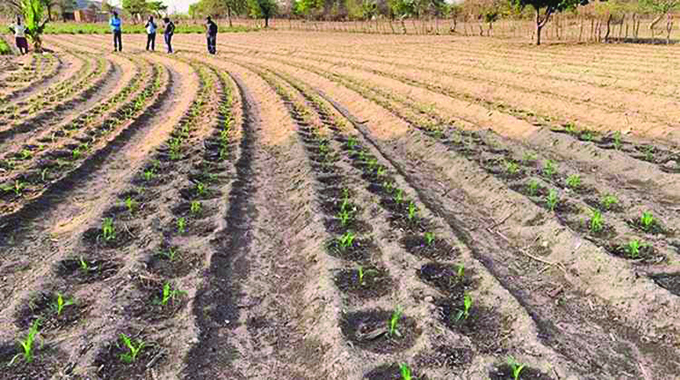
SMALL-SCALE farmers have put their faith in the Presidential Inputs Programme as easily the best way of reaping some sort of harvest even with the lower than expected rainfall and have so far dug almost 10 million plots for the coming season, an incredible amount of very hard work with simple hand tools.
The Government is fulfilling its side of the programme, by ensuring the fertilisers and the correct seed packs are available for each inspected plot.
Already, all the required maize seed and top-dressing fertiliser is in stock, and supplies of the basal fertiliser and traditional grain seeds are being rapidly built up.
There is also provision for sunflower, cowpeas and other crops that can enhance household food supplies and provide surpluses for sale, with guaranteed markets for these surpluses, so none of the effort by any farming family is wasted.
Under Pfumvudza/Intwasa there are no short cuts. Some very practical research was done to find suitable climate-smart cultivation methods, and the one chosen was the one that had produced the best crops in the research stages.
Extra research has found several ways, almost all of which involve even more digging, to harvest rain water and preserve soil moisture.
When you consider that each plot contains 1 456 planting holes, and each hole has to be 15cm square and 15cm deep, the amount of hard work is serious.
A farmer has to shift almost 5 cubic metres of earth for just one plot, and the entire 9,6 million plots at last count means an incredible 48 million cubic metres of soil have been dug out. A cubic metre of soil weights between one and two tonnes.
That hard work is just the first stage. Each farmer has to gather mulch and manure in quite large quantities, then do some precise fertilising and planting when his plot packs arrive, then do the thinning and possibly weeding as the season progresses. Small-scale farming is not a soft option.
The farmers might get their inputs for free from the Government, and inputs are cheaper than food aid so long as correctly used.
But before their names are on the list, an extension officer has visited their farm, counted the rows and columns of holes and the plots, and checked that the holes are the right depth and the mulches have been gathered.
This is one of the reasons corrupt practices are basically impossible in the Pfumvudza scheme, no one is going to do precise digging of tonnes of soil just to cheat. Besides the extension services there are now community checks as well, making sure that all those who dig get inputs and those who do not get nothing.
The result has been the sustained move from total poverty in the small-scale sector to growing prosperity as farmers get better, record their experience in the required detailed records now the norm, and build up the infrastructure of their farms.
Pfumvudza plots can be recycled cutting back on the digging required, although a lot of work is still needed to ready a plot for the new season.
Contour ridges and swales can last for many seasons, although need maintenance, so soil moisture constantly rises.
Part of the success of the programme and other Presidential schemes for livestock and village boreholes, can be seen in the improved housing now common in rural areas and measured in the census each decade.
With an El Nino now certain and lower rainfall forecast, extra measures are being taken to ensure small-scale farmers can cope.
Over the last few years of Pfumvudza, careful thought has seen ideal mixes of maize and traditional grains for each area and each district.
This is being taken further this year with even natural region two farmers expected to plant at least one plot of traditional grain, to ensure that if the worse comes to the worst they still have enough food. It is likely that the advice on the mix will be taken; no one wants to see their hard digging wasted.
At the heart of this farming and rural revolution is the high level of trust and communication between researchers, the Ministry of Agriculture, Mechanisation and Water Resources Development, and the 3 million small-scale farmers and their families.
The farmers have come to trust the results of the research and the Ministry backing; the Ministry has come to trust the farmers and their very hard work, even if driven by self-interest.
The result has been rising harvests, with the goal no longer seeing families with enough to eat, but having extra and cash crops to sell. Subsistence farming is changing to small-scale commercial farming and so driving rural prosperity.
The wide-ranging sets of programmes now in place to cope with highly probable lower rainfall are no longer stressing just seeing farming families have enough to eat.
They now include elements of how to cope with difficult climatic conditions to continue that push to prosperity, essential, considering the climate changes now expected and being seen with global warming.
That trusting relationship between practical and innovative research workers, an efficient operational Agriculture Ministry and millions of very hardworking farmers has to be continually improved so all Zimbabweans can win through to middle-income prosperity.