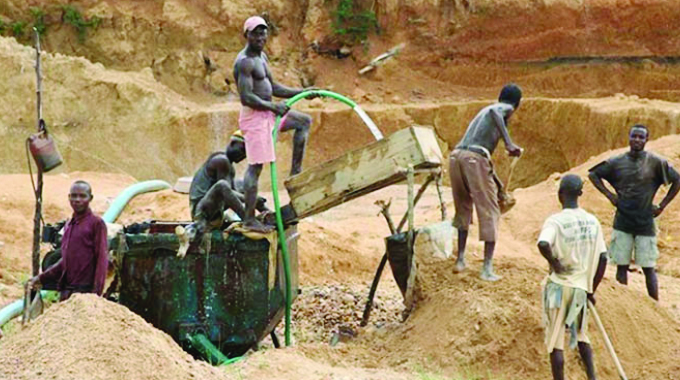
THE large numbers of artisanal and small-scale miners contribute about three quarters of Zimbabwe’s gold production, providing an income for thousands of families.
The sector has been largely informal and there have been major problems of mining without licences or permission, unsafe mining and mining on other people’s property.
The Second Republic has made significant gains by recognising artisanal and small-scale miners as legitimate producers. Under this policy there has been more formalisation of the sector, as these miners see the advantages of moving under the umbrella of the law.
Formalisation for a start, gives legitimate mining rights and protection against those who violate these rights.
Formalisation is also seeing more safer mining. The number of artisanal and small-scale miners injured or killed has been falling as the long, slow education programme of teaching people to work more safely produces results.
Now the Government is moving forward with a US$63 million financing facility to be commissioned next week. This provides another major incentive for formalising and licensing operations.
The facility, administered by a leading bank with technical expertise from the Minerals Marketing Corporation of Zimbabwe, will obviously be limited to those who have formalised and have a clean record. Banks are sticky when it comes to these points, and quite rightly too.
With access to extra capital, even in the form of a loan, small-scale miners can buy the minimum of needed equipment to consolidate and expand operations.
A small-scale miner does not need to spend huge sums, and in any case their expanded cashflow will be used to service their loan as well as increase incomes, but a modest amount of modern equipment can make a huge difference.
It is this huge difference that might well drive Zimbabwean gold production from close on 50 tonnes a year to 100 tonnes a year, an achievable target in the considered view of the Ministry of Mines and Mining Development.
But that requires significant progress in the continuing formalisation of the artisanal and small-scale sector and the conversion of this sector into a wide range of fairly small efficient mining businesses.
The curious geology of Zimbabwe’s gold bearing rock means that the small-workers have to dominate the output. While there are a few concentrated deposits of gold ores, even these are not huge gold fields by world standards and between them manage to support just a handful of larger mines that are profitable when managed at very high levels of efficiency.
They produce around a quarter of Zimbabwe’s gold when output from what were known as the small-workers, fairly small, but mechanised mines, is added in.
But most of the gold deposits are small, although there are a very large number of them, and between them have been producing gold for centuries, providing the principal export of pre-colonial Zimbabwe, colonial Zimbabwe and now independent Zimbabwe, although the independent country has been diversifying exports and selling an ever greater range of minerals and other products.
So gold mining is not just crucial for increasing gross domestic product and exports, but is ideally placed to ensure that the value of extra production will be spread across a large number of people, automatically since most operations have to remain fairly modest because of the geology.
Even most formal mines with records of many years of production tend to be small operations on a smallish gold ore deposit, although provide a decent income for their owners and workers when properly and efficiently managed.
These sort of smaller formal mines also provide the template for how many of the less formal small-scale miners need to develop.
Decent geological mapping can lower risk and show where formalised operations will make money, and the build up of managerial experience and systems will indicate what equipment is needed and how the small mine must be managed.
The Government policy of formalising production has already seen a lot of success, starting with the formalisation of marketing, so all gold is now sold to and processed by the official Fidelity Gold Refinery, providing the gold that is building up the financial reserves and increasing exports.
The continued formalisation of the production side has again seen a sharp reduction in ecological damage, illegal and unsafe practices, but like the formalisation of marketing, succeeds because the small-scale miners are trusted and policies are created that make it worthwhile and sensible to formalise their businesses.