Patrick Chitumba [email protected]
THE Government’s drive to unlock Zimbabwe’s mining potential through partnerships with the private sector is beginning to yield results, with the revival of the century-old Connemara Mine in the Midlands Province set to strengthen the country’s push to sustain annual gold deliveries above 50 tonnes.
The project, anchored by a new 3 000-tonne-per-day processing plant capable of handling about one million tonnes of ore annually at full capacity, marks a major milestone in efforts to restore the historic mine to production after nearly two decades under care and maintenance.

It also demonstrates how strategic partnerships and private investment are being harnessed to unlock their economic value.
The investment comes as Zimbabwe intensifies efforts to consolidate gold production growth, with deliveries to Fidelity Gold Refinery reaching 41,4 tonnes by the end of October, representing 89 percent of the total delivered throughout 2025.
October alone recorded a monthly high of 5 519 kilogrammes, putting the country’s annual target of 50 tonnes within reach.
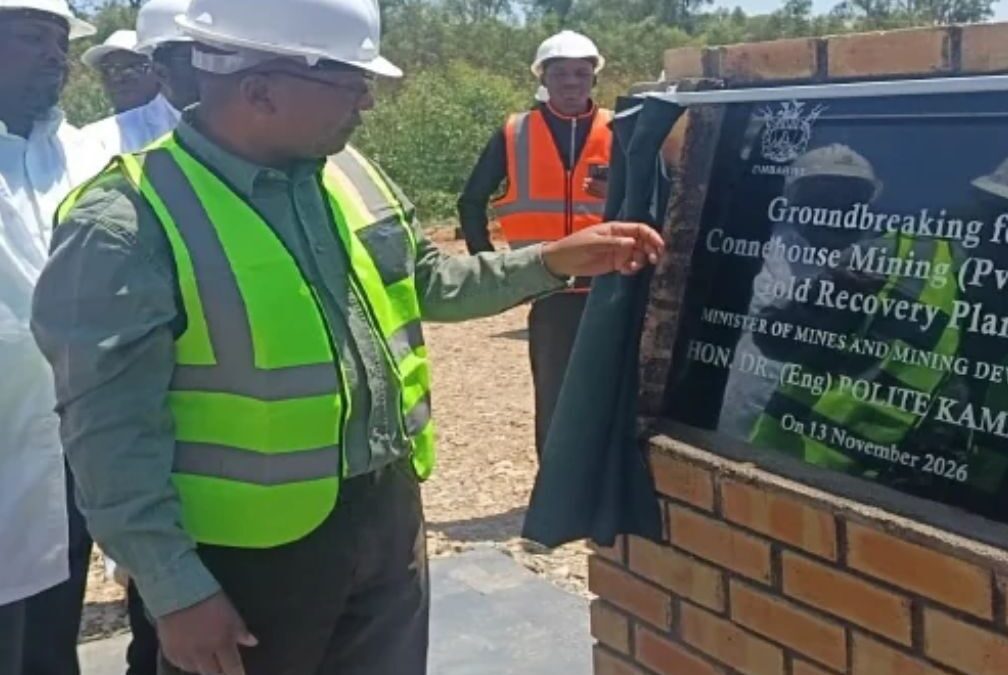
Speaking at the groundbreaking ceremony, Mines and Mining Development Minister Dr Polite Kambamura said the Connemara project would strengthen the contribution of large-scale, mechanised producers, whose operations provide more consistent output, particularly during the rainy season when production from shallow and alluvial workings tends to decline.
“A plant treating 3 000 tonnes of ore per day, or about one million tonnes a year at full capacity, adds exactly that kind of capacity. It will help us to sustain national gold deliveries at, and beyond, the 50-tonne level in the years ahead,” he said.
The revival is being undertaken through a partnership involving Connehouse Mining, Coladge Investments, the Zimbabwe Prisons and Correctional Service (ZPCS) and BPE Mining.
Dr Kambamura said the project demonstrated how private-sector investment, modern technology and strategic partnerships could unlock the economic potential of dormant mining assets.
Connemara Mine, which began operations more than a century ago, has experienced several phases of growth and decline, eventually falling under care and maintenance for about 20 years.
“The revival of this mine is evidence that dormant mining assets still have considerable potential to contribute to national economic development when supported by investment and modern technology.
“I commend Connehouse Mining for its commitment to restoring this asset to productive use,” said Dr Kambamura.
The Minister said Zimbabwe’s mining sector remained a major contributor to the economy, generating an estimated US$11,07 billion in the first 10 months of this year.
The figure comprised US$5,11 billion from mineral sales and an estimated US$5,96 billion from gold deliveries, with full-year earnings projected to reach between US$12 billion and US$13 billion.
He said small-scale producers accounted for 72,6 percent of gold deliveries during the period, while primary producers contributed 27,4 percent, highlighting the need to increase investment in mechanised operations to strengthen production capacity.
The Connemara project is expected to exploit underground ore, historical dumps and other economically viable deposits, while expanding local mineral processing.
Beyond increasing gold output, the investment is expected to generate foreign currency, royalties and taxes, create direct and indirect employment and open business opportunities for local suppliers, contractors and service providers.
Dr Kambamura said the project aligned with the Second Republic’s economic transformation agenda, which identifies mining as a strategic pillar in achieving Vision 2030 and attaining upper middle-income economy status.