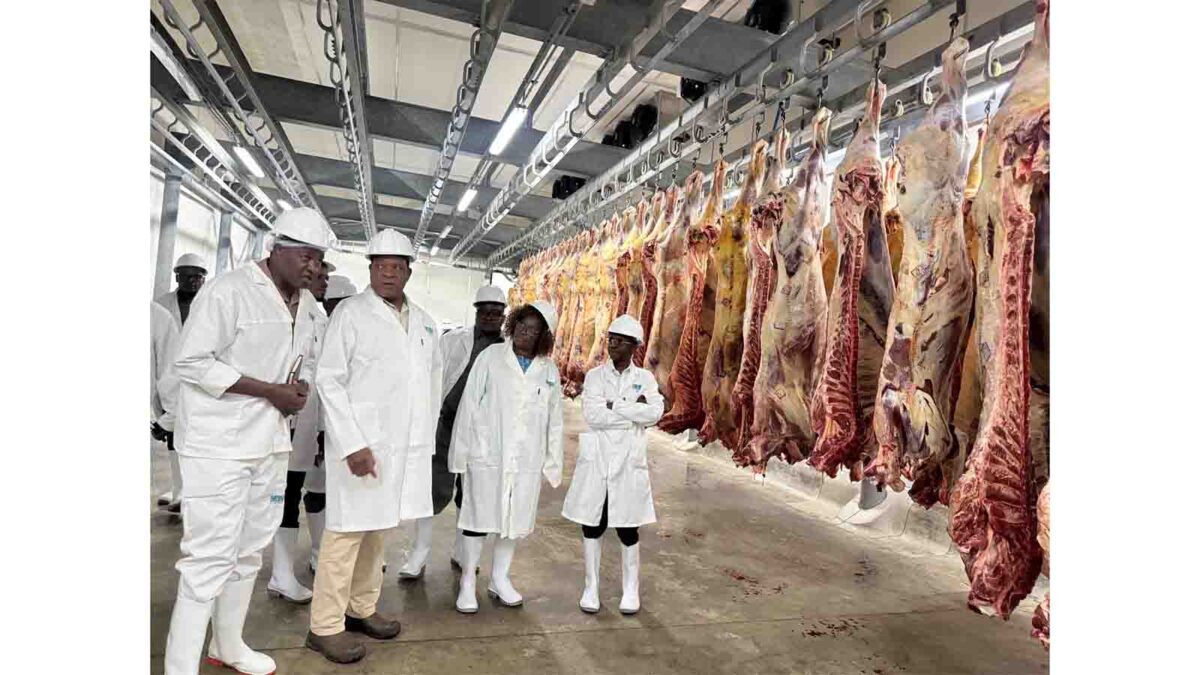
Nyasha Simbisai in Bulawayo
The Government is accelerating efforts to restore the Cold Storage Company (CSC) to its former position as a major player in Zimbabwe’s beef industry, with the Bulawayo flagship abattoir undergoing rehabilitation to achieve a processing capacity of 800 cattle a day, as authorities move to strengthen livestock markets and protect farmers against anticipated drought-related losses.
Agriculture, Mechanisation and Water Resources Development Minister Dr Anxious Jongwe Masuka said this during a tour of CSC’s Bulawayo facilities on Wednesday, where he commended the Mutapa Investment Fund for providing US$9,3 million towards the company’s revival.
“Today we are touring CSC in Bulawayo, where they are resuscitating their biggest abattoir to a processing capacity of at least 800 beasts a day. The established capacity now is 320, although they are slaughtering about 115 a day,” he said.
Dr Masuka said the rehabilitation programme was progressing, with further financial support expected to strengthen the company’s operations.
“We thank Mutapa Investment Fund for having provided the US$9,3 million loan that has enabled them to get to this stage,” he said.
“Certainly, they are looking for working capital support of US$10 million into 2027, and that is forthcoming.”
The minister said the rehabilitation was particularly important in view of forecasts of below-normal rainfall, which could expose livestock farmers, especially in Masvingo and the Midlands provinces, to increased drought-related risks and force some to sell their cattle prematurely.
“Our advice is that they must bring them through the CSC facilities as they are resuscitating 117 000 hectares of ranges. The fattening plots for 5 000 cattle are also up and running,” he said.
He said CSC was expected to provide a reliable market for livestock producers, particularly communal farmers, while supporting national efforts to safeguard the country’s cattle herd.
Dr Masuka said the Government expected the rehabilitation programme to be accelerated, with the company’s infrastructure and investment partnerships supporting its expansion into regional and international markets.
“We want CSC to play a very vital role to ensure that they provide a credible market for farmers, especially the communal farmers,” he said.
He added that the company’s facilities could support other agricultural value chains, including small-stock production and poultry, while its cold-chain infrastructure could be utilised for other agricultural commodities requiring refrigeration.
Mutapa Investment Fund Deputy Chief Investment Officer Mr Ernest Denhere said CSC’s turnaround programme was largely on course, following the company’s exit from corporate rescue in October 2025.
“When we took over this asset, there was really no activity here. We’ve upped the capacity at this Bulawayo facility, which is the flagship abattoir, to processing 320 cattle per day,” he said. “The capacity, if we finish our works, is 800 cattle per day, but currently we’re doing about 150 cattle per day.”
Mr Denhere said the fund had disbursed approximately US$9,3 million towards capital improvements, including the installation of chillers and rehabilitation of refrigerated facilities.
He said the investment strategy went beyond slaughtering operations to encompass the entire beef value chain, including wet-blue leather processing, canning and tanning.
“The idea is to get into the wet blue section as well as into the canning and tanning section. So we want to capture the entire ecosystem and obviously contribute as CSC into NDS2,” he said.
The fund is also considering a cattle financing facility of up to US$15 million to support livestock production and El Niño risk mitigation, alongside the proposed US$10 million working capital facility for 2027.
Mr Denhere said the cattle financing initiative would help restore CSC’s traditional role of providing a structured market for rural livestock producers, including facilitating cattle fattening before slaughter.
“Traditionally, CSC was critical because it would intervene in the market and offer the rural cattle owners a price where we fatten the livestock and then obviously realise a margin which is beneficial to both the farmers and CSC,” he said.
He said the fund was working with the Ministry of Agriculture through its extension services to coordinate livestock risk mitigation interventions across the beef value chain.
He said the proposed US$15 million facility would be an initial intervention, adding that effective coordination with agricultural extension services would be essential in supporting livestock producers and reducing drought-related cattle losses.
On governance, Denhere said the fund was working on strengthening CSC’s management capacity, with plans to announce a new management team to oversee the company’s operations.
He also outlined plans to restore CSC’s access to international beef markets, targeting the European Union, Asia and the Middle East, while strengthening its domestic distribution network.
“We do want to resume exports, not only to the EU but even into Asia and into the Middle East,” he said.
“The roadmap to get export accreditation really requires a lot of traceability, the standard certification to be in place.”
Mr Denhere confirmed that CSC had attained Halal certification and was making further improvements in biosecurity and traceability to meet international market requirements.
“The idea is to increase biosecurity, improve traceability, and then obviously tap into those export markets for the premium cut,” he said.
He said the company was prioritising the expansion of domestic distribution channels before fully focusing on export markets.
The revival programme is expected to reposition CSC as a key player in livestock marketing, meat processing and value addition, while supporting the country’s agricultural transformation objectives under the National Development Strategy 2 (NDS2).