Danisa Masuku
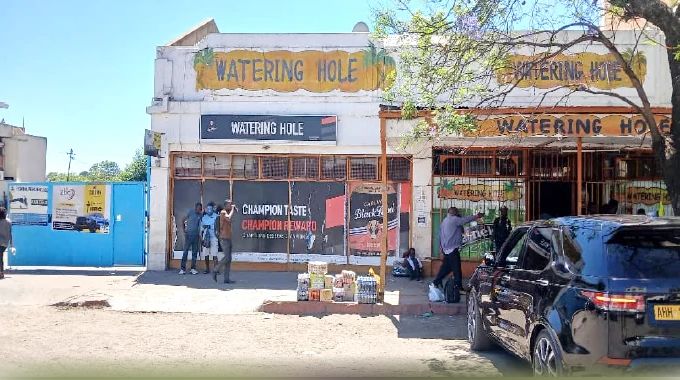
A POPULAR Bulawayo liquor outlet, Watering Hole, has suffered a double blow after losing two court cases, with the High Court dismissing its US$155 000 claim for improvements made to leased premises and subsequently ordering it to vacate the property within seven days.
The eviction order was granted by Bulawayo High Court Judge, Justice Mpokiseng Dube, on Wednesday, following the dismissal of the outlet’s claim for compensation by Justice Evangelista Kabasa last week.
Watering Hole had sought US$155 000 for improvements it allegedly made to a building at 89A George Silundika Street, Bulawayo.
In the court proceedings, Riverboat Trading, trading as Watering Hole, was the plaintiff, while Cambian Agencies (Pvt) Ltd, trading as Archies, was the defendant. The defendant was legally represented by Derek Kossam.
The court heard that the defendant entered into a lease agreement with the plaintiff for occupation of the property, with the lease commencing in 2009.
On 12 September 2025, the defendant issued summons seeking the eviction of the plaintiff.
In response, the plaintiff filed a counter-claim seeking payment of US$155 000 for improvements made to the building.
The plaintiff also claimed US$8 500, representing financial losses allegedly incurred after the defendant locked it out of the premises for 17 days.
It was stated that during the alleged lockout period, the plaintiff was unable to trade.
Kossam argued that there had been no lockout and that the improvements had not been sanctioned by the City Council, resulting in one of them being demolished.
The defendant further contended that the cost of the improvements had been exaggerated.
Kossam also argued that, in any event, the plaintiff had made the improvements to suit its own business interests.
The plaintiff, Watering Hole, called two witnesses.
The first witness, a director, testified that a written lease agreement had been entered into and
signed by him in his capacity as a director.
“The lease was for a period of 10 years, subject to renewal. The building was not habitable and was therefore not fit for the running of a bottle store.
“To make it fit for that purpose, the plaintiff built a front and back wall, installed a gate and constructed a refuse area. The plaintiff also constructed a toilet block and refurbished the floor,” he said.
The plaintiff also submitted that it had built a warehouse.
In his ruling, Justice Evangelista Kabasa dismissed the application, stating that the photographs produced in court as evidence were of little assistance.
“There was nothing that the picture told, as one could not tell what they represented. I must say it is interesting that the plaintiff would claim to have used a whopping US$155 000 to renovate a run-down building so it would be fit for the purpose it intended to use it for and not claim that amount back as per the lease agreement.
“The question is why would the plaintiff expend such an amount of money in improving a building that it did not own instead of getting its own building,” said Justice Kabasa.
She further said he found the first witness unreliable and unhelpful.
“Regarding the loss of business, all the court was told was that a sum of US$8 500 averaged loss calculated at US$500 a day for 17 days. How such an amount was arrived at remained a mystery,” said Justice Kabasa.
Justice Kabasa further noted that the other witness spoke of losses incurred through the payment of workers’ salaries, perishables that allegedly went bad and could not be sold, and electricity bills.
However, these were bald and unsubstantiated claims.
“Translated into figures, these assertions left the court with more questions than answers. How many employees were paid within those 17 days and how much, what perishables were spoilt and how much was lost? Why would they say the perishables were spoilt if electricity was paid for and possibly powering the refrigerators?” said Justice Kabasa.
Justice Kabasa stated that the caretaker who was alleged to have locked the plaintiff out had refuted the allegation, while the witness who was expected to testify on the matter did not appear in court.
In dismissing the plaintiff’s claim, Justice Kabasa said:
“The builder who assisted in the construction of these improvements told the court that the materials used in part of the work were from materials that were already on site and the refuse area was constructed using old panels sourced from the defendant’s premises. The electric fence which had been installed is no longer there and it was not clear what became of it.”