

 Online Reporter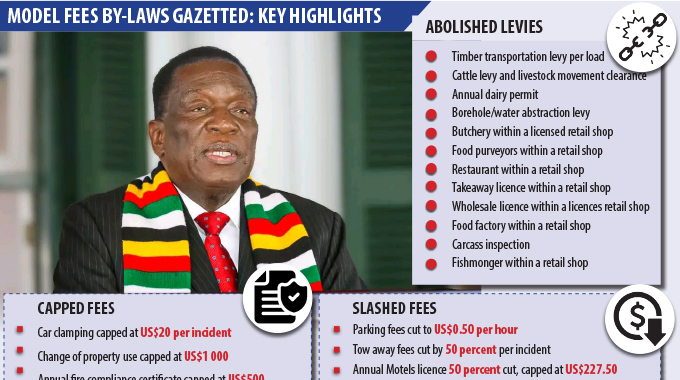
Nqobile Bhebhe, [email protected]
IN a major relief for businesses and ordinary Zimbabweans, Government has gazetted the revised compliance fees for all local authorities, including slashed parking rates and abolished levies as part of President Mnangagwa’s comprehensive ‘Ease of Doing Business’ reforms targeting critical economic sectors.
The move is expected to boost domestic business operational efficiencies, lure more investments and promote profitability by local entities and individual entrepreneurs.
Its full enforcement is one of the landmark achievements under the Second Republic led by President Mnangagwa, who, in his inaugural speech in 2017, declared that “Zimbabwe is Open for Business”.
Since then, the Second Republic has ignited local and foreign investor confidence through sustained reforms and focused commitment to ensuring robust economic transformation.
The latest measures are contained in Statutory Instrument 41 of 2026 (Model Fees By-Laws, 2026), which takes immediate effect and outlines several revised fees across various urban and rural local authorities.
Retail shops will benefit more from abolished fees, such as bakery and food factory licensing within a retail shop, fish monger, takeaway license, restaurant and bottle store licensing within a retail shop, which have ceased.
Also abolished is the timber transportation levy, borehole and water abstraction cost, livestock movement clearance levy and fuel storage license.
This followed pronouncements last year by President Mnangagwa of a wide-ranging reform implemented across key sectors, including tourism, agriculture, mining and manufacturing.
Under the latest S.I. 41 of 2026, parking fees have been capped at US$0,50 per hour from US$1, clamping fees capped at US$20 per incident, while tow-away charges have been reduced by 50 percent for all local authorities.
The standardisation of parking fees is expected to bring uniformity and affordability to urban centres where charges had previously varied across local authorities.
In Bulawayo, where parking management is handled by Tendy Three Investments under a contract with the City of Bulawayo, the company is now expected to adjust its parking charges from US$1 to the new Government-approved rate of US$0,50 per hour in line with the new statutory instrument.
The harmonisation of fees is designed to protect motorists and businesses from excessive charges, while ensuring local authorities operate within a clear and predictable regulatory framework.
In a major boost to the livestock sector, Government has also abolished the annual cattle levy and livestock movement clearance fees charged by rural district councils.
Dairy permits have also been scrapped.
The abolition of the cattle levy is expected to ease the financial burden on farmers and support livestock production, particularly in rural communities where cattle are a critical economic asset and store of value.
Building-related charges have also been rationalised. Change of property use for buildings, for instance, has been capped at US$1 000 per application, while shop licence application fees will not exceed US$20.
The Ease of Doing Business reforms target 12 sectors and, to date, significant progress has been recorded in agriculture, transport, tourism, and the wholesale and retail subsectors.
Globally, economies are ranked on their ease of doing business, with higher rankings reflecting regulatory environments that are more conducive for businesses to thrive without unnecessary hindrances.
Since its inception, the Second Republic has rolled out multiple reforms aimed at enhancing Zimbabwe’s competitiveness and lowering the cost of doing business.
In the tourism sector, Government has streamlined licensing procedures for operators by consolidating permits, reducing turnaround times and digitalising critical services. Registration and renewal fees for five-star hotels have been slashed to US$2 000 from US$5 250, while guest houses now pay US$150, down from US$500.
The Liquor Licence requirement has been removed as it is already administered by local authorities.
According to the approved fee structure, grading and re-grading for one-star hotels, motels and inns has been set at US$500, with mandatory renewal every two years, while home-stay facilities are pegged at US$20.
Last Friday, Finance, Economic Development and Investment Promotion Minister, Professor Mthuli Ncube, told an academia-industry engagement in Bulawayo that Cabinet has so far approved reforms in five out of the 12 targeted sectors.
“They include livestock, dairy and feedstock manufacturing, tourism, transport, wholesale and retail and the energy sector. Some of the approved reforms have been gazetted through the Finance Act of 2026, while others have been gazetted through Statutory Instruments and legal reforms by the respective line ministries.
“Government targets to complete the review of the outstanding seven sectors by the first quarter of 2026,” said Prof Ncube.
Authorities have maintained that the rationalisation of fees across sectors is central to fostering a conducive environment for business growth, investment attraction and sustainable economic development in line with Vision 2030.
The latest gazetted measures, thus, reinforce the Second Republic’s commitment to building a competitive, low-cost and transparent business environment anchored on policy certainty and accelerated economic transformation.


