Online Reporter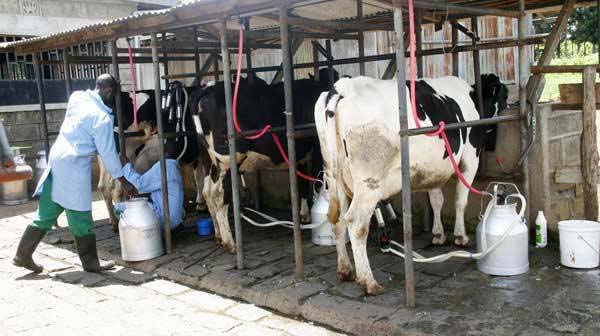
DAIRY farmers, with full Government backing, have now touched national self-sufficiency in raw milk, a notable achievement, but the dairy herd needs to be increased by a third to meet, without imports, powdered milk demand and the growing demand for all dairy products as Zimbabweans move up the prosperity ladder.
Rising milk production will also provide the essential raw material for far more variety and innovation in downstream products, largely dominated by some basic yoghurts and around four varieties of cheese derived from the more popular colonial-era types.
Otherwise milk from the 59 000 milking cows at last count is generally sold as milk, both fresh and the traditional soured maas, with some going for cream, butter, yoghurt and dried products, although imports are an important source of at least the raw material if not the final content in these downstream products.
So the Ministry of Agriculture, Mechanisation and Water Resources is keen to see the dairy herd rise to 80 000 milking cows as the next target. This is not an instant process. A new-born female calf has to grow up and then give birth in turn to a calf before she becomes a milking cow. So measures to increase the herd are calculated in years.
One promising inclusion in the national production of around 150 million litres of milk a year is the 30 million litres from small-scale less specialised farmers. This is an area that needs to be built up, a process that will require some co-operative infrastructure for farming communities.
There are several countries were a decent percentage of their milk production comes from such small-scale farmers with less than a dozen milking cows each, but with access to shared infrastructure such as cooling tanks.
While the bulk raw milk production and pasteurisation or maas-making will remain the bedrock of the dairy industry and its most essential product, along with the other bedrock of powdered milks, rising production will allow value addition in specialised products and the build-up of specific Zimbabwean products as innovators get moving.
There is a lot of scope. France, for example, produces more than 200 different varieties of cheese, most with strong regional roots and many with an international reputation. In proportion to area and population, The Netherlands probably does as well with Denmark not far behind.
All these cheeses were initially developed by dairy farmers in each area and even now, when there is more factory production, the farmers might own the factory and still do a fair amount of the processing on farm. Value addition is not new.
Yoghurts vary a lot across the Balkans in another major example, again with regional and national products and a multiplicity of types generated by farmers in the past using specific breeds of livestock and specific local cultures. American-style uniformity, so common in so many parts of the world as identical factories are built, can produce the bulk, but not the higher-value distinctions.
A look around the dairy counters in a handful of specialised food shops in Harare, mainly in the northern suburbs, can give an indication of just how much variety is possible. There are already a few specialised dairy product producers in Zimbabwe, although their production runs are small and so cannot feed mass markets, but they are providing the example that others can use. In time, we can have a large range of specialised products, providing extra incomes in many rural areas.
Government backing has been very useful as the milking herd has been rising steadily at both the level of the medium commercial dairy farms and among small-scale dairy specialists.
The smaller-scale farmers have, for example, received suitable seed for the sort of plants that make the best silage, so keeping their stock-feed costs under control and suitable grass seed for better pastures is used by the full range of dairy farmers, from the smallest to the largest. Most of the techniques that make dairy farming profitable can be applied at any level.
The industry as a whole has managed to grow even with the ban on importing heifers to prevent disease. The additional genetic stock for improving the national herd now comes from semen imports of suitable breeds around the world, rather than shipping the live animals.
We are confident that with all that is going for dairy farming, the goals of a larger milking herd, better quality animals, more bulk supplies of raw milk and increasing innovation and processing of downstream products can all be met.
That benefits consumers, farmers and the nation as a whole.