

 Online Reporter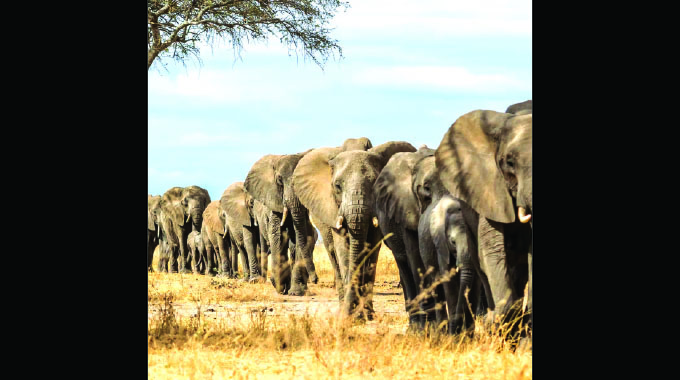
Herald Correspondent
Hordes of marauding elephants have been roaming the outskirts of Chirunya villages in Ward 8, Mbire District, as the perennial human-wildlife conflict intensifies.
On July 19, terrified villagers watched from their homesteads as the spectacle unfolded, throwing the sleepy rural community into panic. Nursing cow elephants were spotted among the tuskers.
The mounting unease across the ward is entirely justified. Just months earlier, gory images of a young woman trampled to death in Masoka, Ward 2, went viral on social media—a stark reminder of the deadly threat facing Mbire residents. Cow elephants are particularly aggressive when humans come between them and their calves. Unfortunately, herders and schoolchildren often inadvertently stray into these danger zones while navigating the mopani and acacia woodlands of the Zambezi Valley and its dense undergrowth.
Despite rapid responses from authorities when fatalities occur, residents argue that sharing their environment with these potentially aggressive mammals is akin to dicing with death.
To the uninitiated, Zimbabwe’s membership in the Convention on International Trade in Endangered Species (CITES) might appear as a straightforward conservation commitment. But for those on the ground, being forced to safeguard elephants as if they were domestic livestock often comes at the expense of human life. Granted, CITES exists to ensure international trade does not drive species to extinction, but surely there must be practical limits to this covenant.
The treaty classifies species into three appendices based on threat levels. African elephants from Zimbabwe, Botswana, Namibia, and South Africa are listed under Appendix II—a category that allows regulated trade of species not yet threatened with extinction, but which could become so without controlled commerce. Permits are required for such trade, which is why Zimbabwe can legally sell live elephants or hunting quotas t.
Since the convention’s inception in 1975, elephant populations in the region have multiplied exponentially. In Mbire district, the elephant population now far exceeds the land’s carrying capacity, forcing the giant herbivores to turn to sorghum and millet crops for survival.
Perhaps it is time for the Mbire Rural District Council to formally engage ZimParks and the UN Environment Programme on this escalating crisis. In Tumburai village, Ward 6—one of many hotspots—farmers frequently wake to find entire sorghum fields completely razed overnight.


 Bongani Ndlovu