Nyasha Simbisai-Agriculture correspondent
Farmers have prepared more than 1,1 million hectares under the Pfumvudza/Intwasa programme, surpassing the 2026/27 summer cropping season national target of one million hectares, the Ministry of Agriculture, Mechanisation and Water Resources Development has revealed.
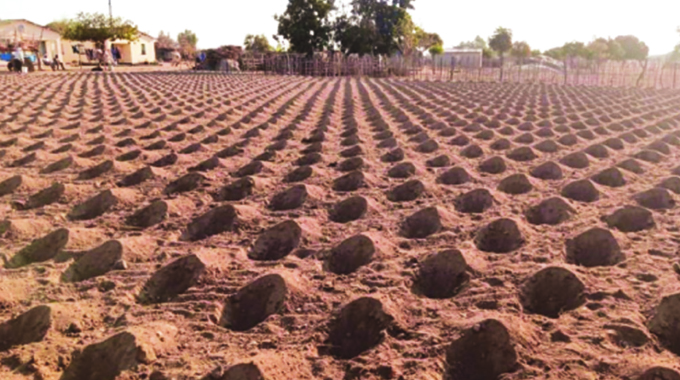
This comes as land preparations have intensified, with some farmers taking advantage of the current rains to prepare their planting basins as the planting window draws near.
According to the latest Agricultural Development Advisory Services (ADAS) weekly report for the period ending November 9, 2026 — 1 102 879 hectares had been prepared for the Pfumvudza/Intwasa programme.
The area comprises 695 442 hectares prepared under the three-plots-and-below category, 236 360 hectares under additional plots and 171 077 hectares through mechanised conservation agriculture.
A total of 3 725 369 farmers are participating in plot preparation, while 14 932 721 plots have been prepared, representing 93,3 percent of the targeted 16 million plots.
At least 2 763 026 farmers have prepared three plots, accounting for 79 percent of the targeted 3,5 million beneficiaries.
The Government has set a target to increase the area under Pfumvudza/Intwasa from 713 000 hectares recorded in 2025 to one million hectares during the 2026/27 agricultural season.
The programme incorporates minimum tillage, mulching, moisture conservation and soil fertility management, including the application of lime, manure and compost.
The report shows that 1 155 505 farmers have collected mulch, while 39 709 have applied lime.
ADAS chief director Ms Medlinah Magwenzi said the planting window was approaching.
“In some areas, the season has started. Farmers may take a chance to plant in the next 10 days; chances of rain are high,” she said.
Meanwhile, the national strategic grain stocks currently stand at 352 134 908 tonnes.
The Presidential Gratitude Collection has mobilised 8 678,20 tonnes, of which 5 906 tonnes have been collected, comprising 5 544,65 tonnes of maize and 361,427 tonnes of traditional grains.
The Government is targeting to build a 600 000-tonne Strategic Grain Reserve by October 2027 through grain purchases, improved storage infrastructure and enhanced household grain reserves.
Under irrigation-supported production, 20 891 hectares of maize have been planted against a target of 119 068 hectares.
Manicaland has recorded 6 954 hectares, followed by Masvingo with 4 823 hectares and Mashonaland East with 3 411 hectares.
National dam storage stood at 82,6 percent of capacity, while the country has 308 969 hectares under irrigation, including 119 068 hectares available for field crops.
The report also indicates that 18 000 tractors, 3 850 planters and 482 combine harvesters are available for the summer agricultural season.
Under the Presidential Input Programme, maize seed deliveries have reached 3 366 tonnes against a target of 3 000 tonnes, representing 112 percent. Top-dressing fertiliser deliveries stand at 31 757 tonnes against a target of 30 000 tonnes.
The 2026/27 summer production programme is being supported through public resources, private-sector participation and development partner financing, alongside farmer financing, producer incentives and agricultural extension services.
In livestock production, the national assessment has identified 2 299 284 cattle at risk, with an estimated 413 871 tonnes of feed required.
A total of 751 rural wards have established Drought Mitigation Centres, Village Business Units, or solarised boreholes with tested capacity.
Government is also implementing livestock interventions covering water provision, fodder production, feed conservation, vaccination and disease surveillance.
Hay balers and tractors have been deployed to support fodder harvesting, while farmers are being encouraged to establish drought-resilient fodder crops and adopt urea treatment of crop residues.
As part of summer-season pest surveillance, 205 African armyworm moth traps have been distributed across the provinces. Monitoring is ongoing, with recorded moth catches remaining below the established threshold for targeted larval searches.
The interventions fall under the Agriculture, Food Systems and Rural Transformation Strategy 2 (2026–2030), which provides the framework for agricultural production, climate resilience and national food and nutrition security.