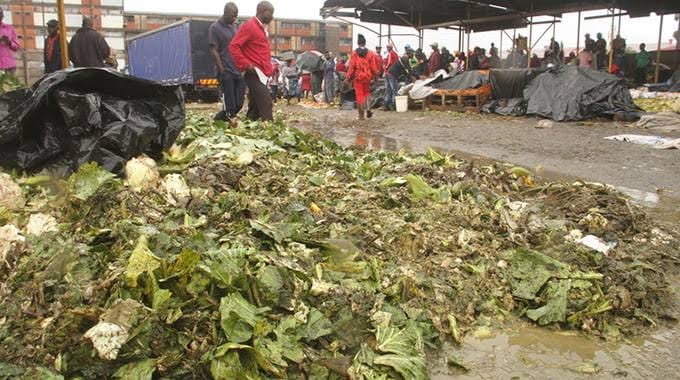
Recent concerns over large quantities of horticultural produce such as cabbages, carrots and oranges going to waste at major fresh produce markets highlight an important challenge within our agricultural value chains.
While increasing agricultural production remains important for national food security and farmer incomes, production must increasingly be guided by reliable market information, appropriate post-harvest infrastructure and clearly identified markets.
For highly perishable commodities, the market should be identified before the crop is planted.
One of the risks facing horticultural farmers is that many producers may grow the same commodity at the same time and target the same market. When large volumes reach a market such as Mbare Musika at the same time, supply can exceed immediate demand. Prices subsequently fall and, because crops such as vegetables and fruit have a limited shelf life, unsold produce can quickly deteriorate.
This reinforces the importance of market-led farming. Before committing resources to crops such as cabbages, carrots, tomatoes or oranges, producers should consider prevailing and historical market prices, expected production volumes, seasonal supply patterns, consumer demand, available alternative markets, production costs and potential buyers.
Farmers should therefore be asking not only ‘What can I produce?’ but, more importantly, ‘Who will buy it, in what quantities, at what time and at what price?’
The Agricultural Marketing Authority (AMA) continues to promote access to agricultural market information and market linkages to enable farmers to make more informed production and marketing decisions. Commodity-price information from markets such as Mbare, Sakubva, Chipadze and Renkini, for example, can assist producers in comparing market conditions rather than relying on a single destination.
However, market information must be complemented by greater coordination of production. Farmer groups, irrigation schemes, extension services, contractors, processors and buyers can work together to develop production calendars that stagger planting and harvesting. Instead of hundreds of producers harvesting the same crop within the same few weeks, production can be phased according to anticipated demand.
Another critical intervention is investment in post-harvest infrastructure. Fresh horticultural produce requires efficient handling, grading, packaging, transport and, in many cases, cold-chain facilities. Inadequate storage and processing infrastructure shortens the marketing window available to farmers and increases the risk of food loss.
Improved aggregation centres and collection points close to production zones can also reduce unnecessary movement of produce. Such facilities can become centres for grading, packaging, temporary cold storage and consolidation of produce destined for supermarkets, processors, institutional buyers and export markets.
There is equally a need to move from selling everything in its fresh form towards value addition and agro-processing. Surplus tomatoes can become sauces or pastes; oranges can be processed into juice, concentrates and other products; carrots can be processed, packaged, frozen or dried, while cabbage and other vegetables can enter various processed food value chains. Agro-processing extends shelf life, creates additional markets and allows farmers to capture greater value from what they produce.
Zimbabwe is already paying greater attention to reducing post-harvest losses. Strengthening storage, cold-chain systems and agro-processing has been identified as necessary to protect farmer incomes and ensure that agricultural production translates into economic value.
AMA therefore encourages producers to embrace a simple principle: produce for a market rather than producing and then searching for a market.
Going forward, greater coordination between farmers, markets, processors, retailers, exporters, local authorities, government agencies and development partners will be essential. AMA will continue strengthening market intelligence, facilitating market linkages, promoting structured agricultural markets and supporting initiatives that connect production with actual demand.
The objective should not merely be to celebrate increased production. The true measure of successful agriculture is how much of what we produce reaches a viable market, earns the farmer a return, and ultimately reaches the consumer rather than being lost after harvest. – Agricultural Marketing Authority