Online Reporter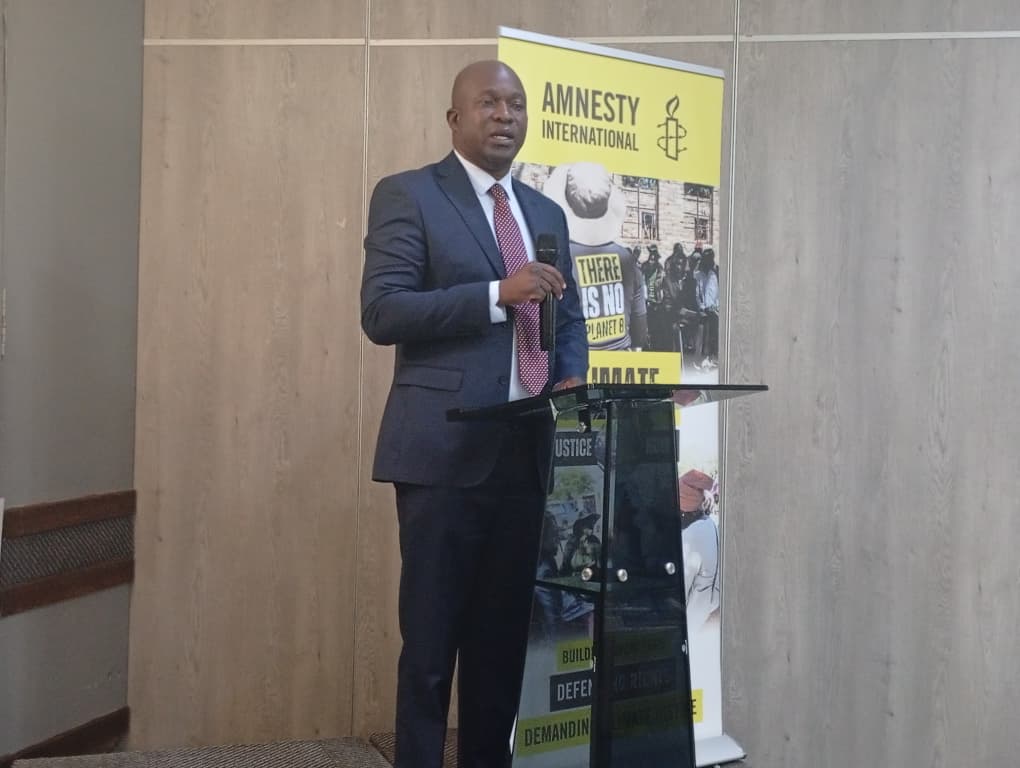
Zvamaida Murwira
Senior Reporter
The Government has taken an inclusive and decisive approach in providing sustainable infrastructure for internally displaced persons owing to climate change and development-induced factors.
Parliament’s Portfolio Committee on Environment, Climate and Wildlife chairperson Cde Sam Matema said President Mnangagwa’s administration has been proactive in providing relief to those displaced communities, either because of climate change-induced disasters or because of development.
Cde Matema, who is also Buhera Central Member of Parliament, was addressing members of the committee, civic society organisations, among others, attending a seminar meant to brainstorm internal displacement in Zimbabwe on Thursday morning.
The event, facilitated by Amnesty International, sought to reflect on milestones registered by the country in addressing internal displacement as envisaged by the African union for the Protection and Assistance of Internally Displaced Persons in Africa, in terms of the Kampala Convention.
“We have people who are displaced because of natural disasters, Cyclone Idai comes to mind,” he said.
“We have people who are displaced because of development issues. The Second Republic is very clear in terms of its trajectory around putting in place infrastructure that will make sure that there is sustainable development in the face of climate change. The water bodies that the Second Republic is rolling out.”
He outlined several initiatives carried out by the Second Republic across the country to provide sustainable alternatives for those internally displaced by either development works like mining, agriculture or construction works or natural disasters.
He said the Ian Smith regime did not take adequate care to provide for affected areas and gave the example of Kariba dam construction that affected thousands of people.
Some of the corrections made by the Government included the Operation Murambatsvina in 2005.
“The Second Republic has done well in trying to correct the errors of yesterday. In 2005, there was the Tibaijuka report, from Operation Restore Order, Operation Murambatsvina, which was a result of, in
my view, serious migration of people from rural areas into urban centres, resulting in serious
urban informality,” he said.
“Fast forward, 2025, the Second Republic is taking an inclusive approach, the case of equal
regularisation. So this is the direction that we should all take. And as we play our oversight role, these are the issues that we must be seized with to make sure that the Executive will give soft lending to every one of us.”
He said there were both positive and negative factors brought by climate change and Parliament had a role in providing guidance as envisaged by the Kampala Convention.
“Where do we locate ourselves as a country, as a people, as a parliament. I think that is very critical as we discuss these issues. But in the context of internally displaced people, as parliament, we have an obligation to legislate, come up with pieces of legislation that will give people, the affected communities, soft lending. As parliament, we are also duty-bound to make sure that we play an oversight role, ensuring that what is provided in the current constitution, in terms of provisions and prescriptions, is adhered to,” he said.
Amnesty International coordinator, Ms Roselina Muzerengi, said the seminar came at a critical moment when communities were being displaced owing to natural disasters.
“The engagement comes at a critical time for Zimbabwe. Across the country, communities are increasingly experiencing internal displacement driven by climate change-induced disasters as well as development-related activities such as mining, infrastructure, and other projects. These realities are not just environmental or economic concerns,” she said.
“They are fundamentally human rights issues that affect livelihoods, dignity, and the well-being of our people.”
“The Kampala Convention provides a unique and powerful framework for addressing these
challenges. It offers clear guidance on preventing displacement, protecting affected communities, and ensuring lasting solutions.
However, the real impact of any framework lies not in its adoption but in its implementation. In this regard, the role of the Parliament of Zimbabwe becomes indispensable.
“As lawmakers, overseers, and representatives of the people, you are central to ensuring that Zimbabwe’s commitments under the Convention are translated into meaningful action that shields our communities from the impact of climate change.”
Various speakers have been lined up for the seminar to give their views on how to implement the Kampala Convention as it relates to internal displacement for communities.



 leeroy