Sikhulekelani Moyo
Zimpapers Business Hub
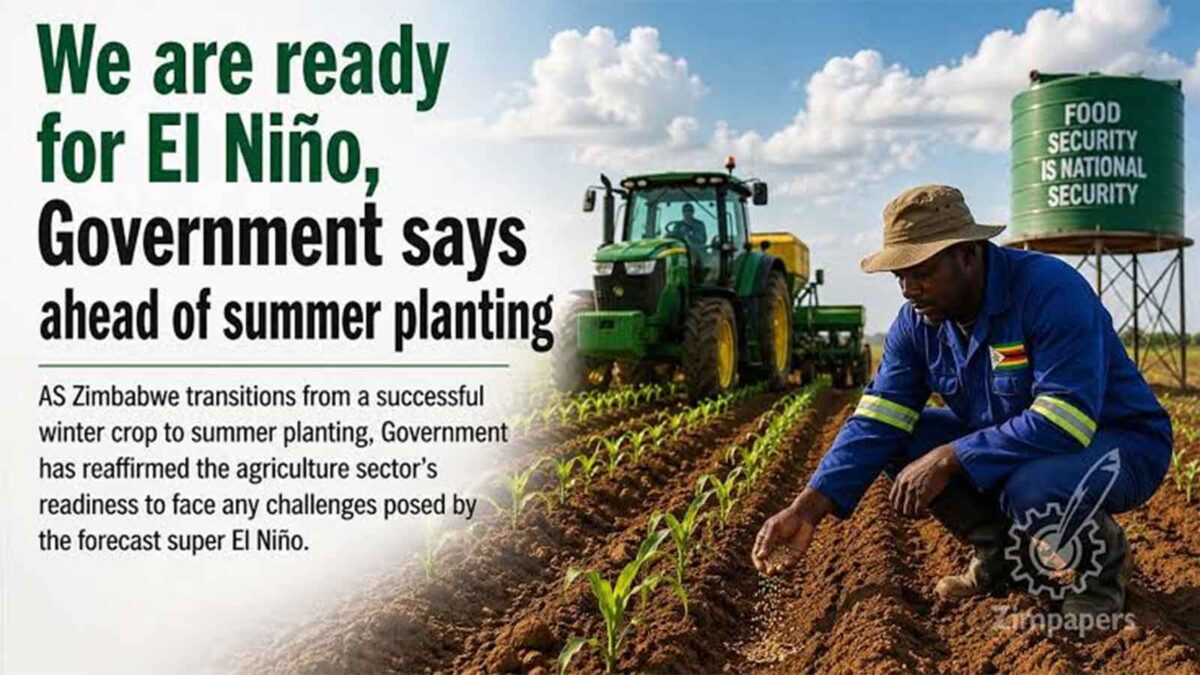
THE Ministry of Agriculture, Mechanisation and Water Resources Development has urged farmers to adopt staggered planting for the 2026/27 season as part of measures to spread risk during the forecast El Niño period.
In an advisory titled “Staggered Planting in the 2026/2027 El Niño Season”, the ministry said farmers should not plant their entire field at once after the first isolated showers.
“Staggered planting is a climate-smart agricultural practice whereby farmers establish crops in phases at different planting dates instead of planting their entire field at once.
This approach spreads production risks and reduces the likelihood of total crop failure,” said the ministry.
In light of the predicted El Niño impact on the 2026/27 summer cropping season, farmers have been urged to remain committed to agricultural production despite projections of potentially significantly reduced rainfall.
Farmers have been advised to divide land into manageable sections, plant only when effective rainfall has been received, take advantage of successive rainfall opportunities, and prioritise early-maturing and drought-tolerant varieties.
The ministry also urged farmers to consider small grains such as sorghum and pearl millet in suitable agro-ecological regions, conserve soil moisture through mulching and follow weather forecasts and ARDAS extension advice.
“Don’t put all your seed in the ground at once. Every drop counts. Spread the risk. Conserve moisture. Secure your harvest.”
Meanwhile, farmers across the country are preparing to plant, while authorities move to ensure inputs reach all wards by month-end.
Lands, Agriculture, Fisheries, Water and Rural Development Permanent Secretary Professor Obert Jiri advised farmers in areas that received sufficient rainfall to begin planting, while urging those in areas with isolated showers to wait until conditions improve.
“Inputs distribution is well on course, about 100 percent maize and top-dressing fertiliser, just under 30 percent of basal fertiliser and liquid lime we are beginning to get that and about 25 percent of the sorghum seed,” Prof Jiri said.
“We want every farmer to be able to use liquid lime. So, the inputs have come through, and we launched the national Pfumvudza/Intwasa programme in Masvingo last month.”
The accelerated distribution comes as farmers are finishing preparing land and Pfumvudza/Intwasa plots ahead of the peak planting period.
Prof Jiri noted that preparations are critical as the country faces a season potentially affected by a strong El Niño event.
“We are deep in preparations for summer. Farmers have expedited the preparation of Pfumvudza/Intwasa plots, which is critical. Farmers need to prepare accordingly because the season might not be good. Agro-matched input acquisition and land preparation must be on point,” he said.
He cautioned that initial rains should not automatically trigger planting everywhere.