Samuel Kadungure
News Editor
A BOLD economic transformation is gathering pace in Manicaland, where a combination of industrial revival, strategic logistics investments and value-addition initiatives is positioning the province for unprecedented growth.
At the centre of the ambitious drive is a plan to push the provincial economy beyond the US$5 billion mark while creating jobs, attracting investment and transforming Manicaland from a producer of raw materials into a manufacturing and export powerhouse.
Minister of State for Manicaland Provincial Affairs and Devolution, Advocate Misheck Mugadza, said the province’s 2026-2027 development plan is focused on building an economy that manufactures, processes and exports finished goods, rather than relying on the shipment of raw products.
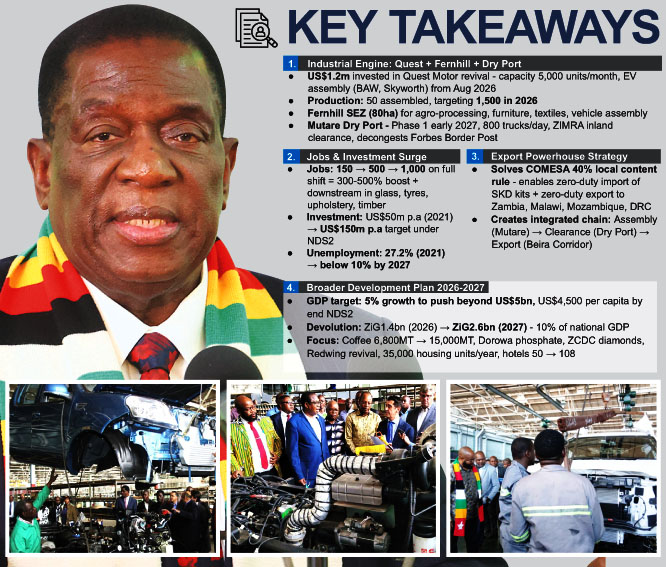
The strategy places the revival of Quest Motor Manufacturing in Mutare at the heart of a broader industrialisation programme that integrates the Fernhill Special Economic Zone and the Mutare Dry Port into a single logistics and production ecosystem linked to the Beira Corridor.
Minister Mugadza said the plan is designed to lift the provincial economy beyond the US$5 billion mark, and lock in jobs through devolution-funded infrastructure, value addition, and employment creation, coupled with a devolution allocation of ZiG2,6 billion in 2027, up from ZiG1,4 billion in 2026, contributing approximately 10 percent of the national Gross Domestic Product (GDP) under National Development Strategy 2 (NDS2).
Detailing the broader framework of the Manicaland Development Plan 2026 to 2027, Minister Mugadza said economic growth targets a five percent surge to push GDP beyond US$5 billion in 2026, with a longer-term ambition of US$4 500 per capita by the end of NDS2.
He said the plan draws from the 10 NDS2 thematic areas.
“Priority pillars are the 10 NDS2 thematic areas, including climate-smart agriculture; road and energy infrastructure; value addition, beneficiation and industrialisation; employment creation and youth/women empowerment. We are also targeting social services, environmental resilience and digital transformation, tourism and trade facilitation as gateway to the sea,” said Minister Mugadza, citing flagship projects under industrial and trade infrastructure, including the Fernhill Special Economic Zone, which covers 80ha, and is earmarked for logistics, agro-processing, furniture, textiles and vehicle assembly.
He said the Mutare Dry Port, benchmarked from Rwanda, is a critical link, with Phase One set to open early 2027, with holding capacity of 800 trucks per day, ZIMRA inland clearance, leading to decongestion of Forbes Border Post, and resultantly providing a strategic link to the Beira Corridor.
He said US$1,2m was invested in the Quest Motor Manufacturing revival, with capacity of 5 000 units per month and electric vehicle assembly for BAW and Skyworth from August 2026.
“Benchmarked from Rwanda, the Mutare Dry Port – Phase One is opening early 2027, with a capacity of 800 trucks per day, ZIMRA inland clearance, resulting in the decongestion of Forbes Border Post. It is a strategic link to Beira Corridor. Quest Motor Manufacturing revival – already US$1,2m has been invested, with capacity 5 000 units per month, EV assembly (BAW, Skyworth) from August 2026,” said Minister Mugadza.
He said Quest Motor’s revival feeds directly into employment creation, with downstream jobs in glass, tyres, upholstery, leaf springs and timber, while saving foreign currency by reducing reliance on fully built imports and supporting local small to medium enterprises.
He said skills linkage with local tertiary institutions will also help retain engineering skills in Mutare, aligning with Vision 2030 by demonstrating local capacity to revive dormant industry under private sector-led growth.
On the strategic link to COMESA, Minister Mugadza said previous constraints had blocked preferential exports, but the current resuscitation of supply chains now opens the door.
“Previous constraint: COMESA/SADC rules require 40 percent local content to qualify for preferential export, which was unattainable when downstream industries were closed.
Current opportunity: With supply chains resuscitated, Manicaland can meet rules of origin,” he said, adding that leveraging COMESA’s preferential regional tariffs, reduced trade barriers and simplified customs procedures will allow Mutare-based operations to expand vehicle exports across regional borders and strengthen Manicaland’s role in the automotive sector.
He said the implication is price competitiveness through zero-duty import of SKD kits for trucks and buses combined with zero-duty export into the COMESA market.
“Implications: Zero-duty import of SKD kits for trucks/buses + zero-duty export into COMESA market = price competitiveness. Fernhill SEZ + Dry Port + Quest creates integrated automotive value chain: assembly in Mutare, clearance in Dry Port, export via Forbes/Beira to Zambia, Malawi, Mozambique, and the DRC. It positions Manicaland as gateway automotive hub, not just consumer of imports,” said Minister Mugadza.
He also detailed the tangible benefits generated by Quest Motors for the province to date.
“The revival is more than a corporate milestone – it is industrial rebirth. Production – 50 vehicles assembled, targeting 1 500 units in 2026 (200/month average). Employment – direct workforce scaling from 150 maintenance staff to 500 to 1 000 on full multi-shift, representing 300 to 500 percent boost, plus downstream jobs in glass, tyres, upholstery, leaf springs, timber. Import Substitution – saving forex, reducing reliance on fully built imports, supporting local SMEs. Skills – linkage with local tertiary institutions, engineering skills retention in Mutare. Vision 2030 alignment – demonstrates local capacity to revive dormant industry under private sector-led growth,” he said.
Minister Mugadza said provincial investment is slated to scale from US$50m per annum in 2021, targeting US$150 million in new investments per year during the NDS2 period, while unemployment is projected to drop from 27,2 percent in 2021 to below 10 percent by 2027.
He said the province is planning to fully utilise abundant water at Marovanyati, Muchekeranwa and Osborne dams under Rapid Results Initiative (RRI) 100-Day 2026 to 2027.
On food security, he said Manicaland stands as the most food-secure province, with focus now pivoting firmly towards value addition.
Minister Mugadza said the coffee plan of 2026 to 2030 seeks to increase production from 6 800 metric tonnes to 15 000mt potential, moving to grinding, milling and packaging, while timber, macadamia, tea and horticulture processing will be revived.
On mining development, Minister Mugadza said targets include Dorowa Mine phosphate refurbishment, Zimbabwe Consolidated Diamond Company (ZCDC) diamond recovery expansion, and Redwing Mine revival.
Housing development targets were reviewed to 35 000 housing units per year as the province’s direct contribution to the national target of one million by 2030. He said registered hotels and lodges are targeted to expand from 50 to 108, with arrivals surging from 26 479 to 108 376, alongside strategic plans for a MICE convention centre and five-star hotels.
Turning to the strategic link to regional trade frameworks, Minister Mugadza highlighted the transformative impact on exports.
To sustain the industrial momentum, he emphasised the prioritisation of Government procurement, urging ministries, departments, agencies (MDAs) and local authorities (LAs) to place direct orders to secure production volumes.
He said additional strategic imperatives include fast-tracking the operationalisation of the Fernhill Special Economic Zone to attract component manufacturers, engaging the COMESA Secretariat on automotive value chain certification for Quest, and linking Quest to the Youth Employment Programme for technical apprenticeships.
Industrial revival anchors US$5b economic surge