Trust Freddy
FOR many residents of Harare’s high-density suburbs, accessing justice has for years come at a price they could barely afford.
A summons to appear before the Mbare Magistrates’ Court often meant setting aside money for several kombi fares, sacrificing a day’s wages, closing a market stall or finding someone to look after children while travelling across the city to attend court session.
For those living from hand to mouth, even a minor criminal case could become a costly undertaking, with repeated court appearances piling pressure on already stretched household budgets.
Some ended up missing court dates, abandoning cases or, in certain instances, preferring to plead guilty simply to bring the ordeal to an end rather than continue spending money they did not have.
But for residents of Southlea Park, Hopley, Budiriro, Glen Norah and Glen View, that longstanding burden is beginning to ease following the introduction of Zimbabwe’s first mobile court, which is taking judicial services directly into their communities.
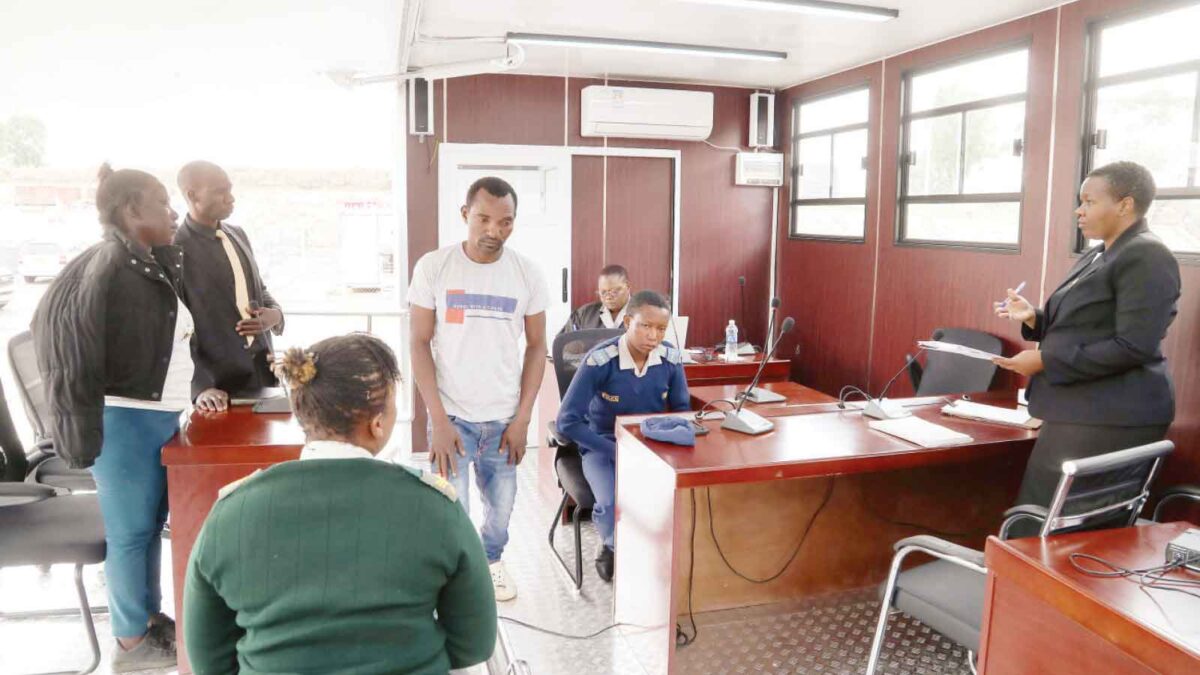
The arrival of the mobile court truck at the Southlea Park Police Station on Monday marked a significant shift for communities that have traditionally relied on the Mbare Magistrates’ Court for the adjudication of their cases.
Instead of travelling long distances to seek justice, residents can now walk to their local police stations, where a fully equipped courtroom has been established inside the specially converted truck.
For many, this is an opportunity to access a justice system that was previously beyond their financial reach.
Hopley resident Ms Synodia Moyo said the cost of travelling to Mbare had discouraged some people from pursuing their cases.
“Going to the Mbare Magistrates’ Court meant spending money on transport that many of us simply do not have, on top of losing a whole day of work or taking care of household chores,” she said.
“Seeing the court bus parked and operating here shows that the Government is listening to the needs of the community.”
Southlea Park resident Mr Farai Kamunga said bringing the court closer to communities would encourage people to pursue cases that they might otherwise have abandoned because of transport costs.
“In the past, many people would drop minor cases or miss court dates because they could not afford back-and-forth trips to Mbare,” he said.
“Having the magistrate come right here to our local police station makes justice accessible for ordinary people.”
The relief was not confined to Southlea Park. The mobile court moved to the Budiriro Police Station on Tuesday, where residents welcomed the opportunity to access judicial services without travelling to Mbare.
“We have been suffering for a long time because of lack of money for transport to Mbare.
“Now the court is here, close to our homes. This is what we have always wanted,” said Budiriro resident Mr Clive Marufu.
In Glen Norah, where the court sat on Wednesday, residents also described the initiative as a welcome development that was restoring dignity to ordinary litigants.
“People here are happy. We used to miss court dates because we had no money for transport.
“Now we can walk to court and walk back home. The Government has done a good thing for us,” said Ms Isheanopa Mazuvanei.
The mobile court, commissioned in Harare recently by Chief Justice Elizabeth Gwaunza, is equipped with the administrative and courtroom facilities required to conduct judicial proceedings, effectively transforming police station premises into temporary court centres.
Its first sitting was held in Southlea Park, where four cases were listed for hearing.
Judicial Service Commission (JSC) deputy head of corporate services Mr Daniel Nemukuyu said the court had already begun handling cases as it embarked on its community circuit.
“The first sitting of the mobile court was launched by the Chief Justice last week on Thursday,” he said.
“Today, we have four cases at the Southlea Park Police Station.
“Of the four, the court has so far handled two, and the other two are pending. The court will continue sitting until all cases are cleared.”
By Thursday, the mobile court had returned to Southlea Park to handle further cases, demonstrating that it was a functioning judicial facility rather than simply a public outreach initiative.
Among the matters heard was a domestic violence case involving 34-year-old Maria Chimutawo of Hopley Zone 5, who was convicted of assaulting her 41-year-old husband, Brian Mavhunga.
Chimutawo had initially appeared before Mbare magistrate Mr Rangarirai Ganganje, where she pleaded not guilty to physical abuse, under Section 3(1)(a), as read with Section 4(1) of the Domestic Violence Act, and was remanded to November 12 to secure legal representation.
When the matter proceeded before the mobile court, she appeared unrepresented and was convicted after the State presented evidence that she had returned home around 1.30pm after spending two days away without her husband’s knowledge.
The court heard that a dispute subsequently erupted when Mavhunga questioned her whereabouts, during which she struck him once on the head with an empty mayonnaise bottle, leaving a scar that required medical attention.
She was sentenced to perform community service. The mobile court also handled a case involving a 21-year-old man from Waterfalls who appeared facing a charge of having sexual intercourse with a minor.
He pleaded guilty.
Two other men appeared before the court facing charges of stealing a chainsaw.
They pleaded not guilty and were remanded out of custody to allow the State to secure additional witnesses.
Outside the courtroom, one of the accused, Nelson Takunda Mazikidze, said having proceedings conducted within the community had significantly reduced the financial pressure associated with attending court.
“We are happy that we are now walking home. If it was the Mbare Magistrates’ Court, we could have been struggling with money to go to and from,” he said.
Decentralised services
The JSC says the response from communities has been encouraging, with more than 20 cases having been handled by the mobile court since it began operating on Monday.
Mr Nemukuyu said the public response had demonstrated the need for decentralised judicial services.
“The mobile court has already started working, and there is an overwhelming response. People are utilising the court in our quest to promote access to justice for all,” he said.
The initiative is expected to ease pressure on the Mbare Magistrates’ Court, which has been handling cases from several high-density suburbs.
The pilot programme will operate through a predictable weekly circuit covering communities including Southlea Park, Hopley, Budiriro, Glen Norah and Glen View.
Its broader objective is to address geographical and financial barriers that prevent ordinary citizens from accessing judicial services, while improving the efficiency of the justice delivery system.
The initiative also reflects international efforts to make justice more accessible, particularly for vulnerable communities that often struggle to navigate formal judicial systems.
Mobile courts are increasingly being used in different parts of the world to bridge the gap between constitutional guarantees of justice and the practical difficulties citizens encounter when seeking legal redress.
Malawi operates mobile camp courts that extend judicial services to prisons and remote communities, particularly for bail applications and minor offences.
The approach has also informed Zambia’s mobile court pilot initiatives.
The Democratic Republic of Congo uses mobile court sittings in vast provinces where permanent judicial infrastructure is limited, while Somalia and South Sudan have deployed travelling magistrates to serve rural and displaced communities.
India and Pakistan have also introduced mobile court facilities, including specially equipped buses, to handle minor criminal and civil disputes in rural areas.
Brazil’s Justiça Itinerante programme uses mobile buses to serve urban communities, including favelas, while riverboats extend judicial services to isolated settlements along the Amazon.
For Zimbabwe, however, the Harare pilot project is only the beginning.
Under the JSC’s 2026-2030 Strategic Plan, the pilot mobile court is intended to provide a model for the establishment of mobile court units in every province by 2030. If successfully expanded, the programme could significantly change how communities across the country interact with the justice delivery system, particularly those living far from established courthouses.
For residents of Southlea Park, Hopley, Budiriro and Glen Norah, that transformation has already begun.