Online Reporter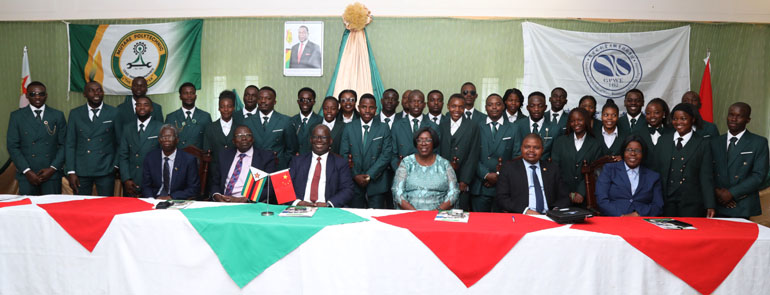
Lovemore Kadzura
Post Reporter
AFTER spending a year studying in one of the world’s most technologically advanced nations, 30 Mutare Polytechnic students have returned from China armed with new skills, fresh perspectives and ambitious plans to contribute to Zimbabwe’s industrialisation, energy security and agricultural development.
The students completed a one-year scholarship programme at the Guangdong Polytechnic of Water and Electric Engineering (GPWE) in China, where they specialised in Water Resources and Irrigation Engineering and Electrical Engineering under a scholarship funded by the Chinese Government.
For the returning students, the programme was about far more than earning qualifications. It was an opportunity to immerse themselves in advanced engineering systems, gain hands-on technical experience and witness first-hand how innovation, technology and practical training can drive economic development.
Their return marks another milestone in the growing educational cooperation between Zimbabwe and China, with expectations high that the newly acquired expertise will be put to use in addressing local developmental challenges.
As one group returned home, another chapter in the partnership was opening. Tomorrow (Saturday), a new cohort of 30 Mutare Polytechnic students will depart for China to undertake the same programme, ensuring continuity in the exchange of knowledge and skills.
One of the returning students, Mr Tinashe Mamvura, said the experience had fundamentally changed his outlook on engineering and innovation.
He described the scholarship programme as a rare opportunity that exposed students to world-class education systems and cutting-edge technology.
“This scholarship programme greatly benefited me and my peers because it exposed us to First World education systems. Such exposure is important for students from our part of the world.
“We realised there is a huge technological gap, and we now have a responsibility to help bridge that gap and contribute to the development of our country,” he said.
For Mr Mamvura, who studied Water Resources and Irrigation Engineering, the experience reinforced the critical link between energy production, food security and industrialisation.
“Industrialisation and food security require reliable energy. Our studies focused heavily on electricity generation technologies, particularly hybrid energy systems that combine water and solar power. We learnt practical ways of producing energy and how such systems can be adapted to different environments,” he said.
Inspired by the technologies he encountered in China, Mr Mamvura is already envisioning community-based solutions for Zimbabwe.
“I am planning to develop a small hydropower station capable of generating about 24 volts using water from small rivers and streams. Such a system can be adopted in rural communities to power irrigation pumps and provide lighting for households. We developed prototypes while in China and are eager to implement these ideas back home,” said Mr Mamvura.
He added that the programme had boosted students’ confidence and equipped them with practical skills that could be applied directly in communities.
“We were exposed to new technologies and different approaches to problem-solving. The experience gave us confidence that we can make a meaningful contribution to Zimbabwe’s development,” he said.
For Ms Pamela Gwariro, an Electrical Engineering student, the scholarship was equally transformative.
She said the programme combined academic learning with practical training, giving students valuable experience that complemented classroom theory.
“It was a life-changing experience. I gained a lot of practical knowledge and skills which I believe will be useful in Zimbabwe. I am eager to apply what I learnt and contribute towards addressing some of the challenges we face as a country,” she said.
Ms Gwariro noted that China places significant emphasis on practical engineering training, something that enhanced her technical competence and preparedness for industry.
“We spent a lot of time doing practical work, unlike here where the focus is often more on theory. The experience has given me confidence in my abilities as an electrician,” said Ms Gwariro.
She also reflected on her journey as a woman pursuing a career in a traditionally male-dominated field.
“There were challenges, but I constantly reminded myself that my gender should never be a limitation.
“What a man can do, a woman can also do. The experience strengthened my confidence and determination to succeed,” she said.
Speaking during the send-off ceremony for the second cohort of students early this week, Permanent Secretary in the Ministry of Higher and Tertiary Education, Innovation, Science and Technology Development, Professor Fanuel Tagwira, underscored the importance of developing highly skilled technical professionals to drive Zimbabwe’s growth agenda.
He expressed appreciation to the Chinese Government for its continued support of Zimbabwe’s educational and technological advancement.
“I wish to express the ministry’s sincere gratitude to the Government of the People’s Republic of China for their continued partnership and for opening their doors to our students for a second time. This friendship is built on mutual respect and a shared vision, and it is one that we are keen to see grow even further,” said Professor Tagwira.
He said the programme aligns perfectly with Zimbabwe’s Education 5.0 philosophy, which promotes innovation, industrialisation, research and community service alongside conventional teaching and learning.
“It is no coincidence that the disciplines you are pursuing, Electrical Engineering and Water Resources and Irrigation Engineering, sit at the heart of our national development priorities.
“Zimbabwe’s drive towards energy security and climate-resilient agriculture through irrigation development requires exactly the kind of technical expertise that GPWE is known for producing.
“When you return in 2027, you will not come back as mere graduates. You will return as agents of transformation, ready to contribute directly to national development,” he said.
Speaking virtually from China, GPWE vice-president, Ms Lu Lihong, reaffirmed her institution’s commitment to strengthening collaboration with Mutare Polytechnic.
She said the college was eager to continue hosting Zimbabwean students and deepen educational and industrial partnerships.
“Last year we welcomed the first group of Zimbabwean students, and they performed exceptionally well.
“We are excited to receive another group and remain committed to supporting them throughout their studies.
“We also want to strengthen exchanges between our institutions by welcoming lecturers from Mutare Polytechnic and sending our own educators to Zimbabwe. Through greater collaboration with industry, we can make learning more practical and ensure students are better prepared for their careers,” said Ms Lu.
She encouraged the students to embrace both academic and cultural experiences during their stay in China.
“We want you to learn about Chinese culture while sharing Zimbabwean culture, traditions and stories. That is how mutual understanding grows and stronger friendships are built,” she said.
The students’ training comes at a crucial time for Zimbabwe, as the country seeks to strengthen capacity in critical sectors such as water management, irrigation development, renewable energy and electricity generation.
With climate change increasing pressure on water resources and the nation pushing for greater industrialisation and energy security, the skills brought home by the returning students could prove invaluable.