The Herald, 28 October 1994
THE world’s most famous mathematical riddle, Fermat’s last theorem, may have finally been proved by the Princeton University mathematician who prematurely claimed its solution last year, the New York Times reported yesterday.
In June 1993, Dr Andrew Wiles stunned his colleagues when he announced he solved the theory whose proof has eluded mathematicians for more than 350 years.
But last autumn he conceded to gaps in his proof, retreating again to his attic office to grapple with the theorem proposed by 17th-century French mathematician Pierre de Fermat.
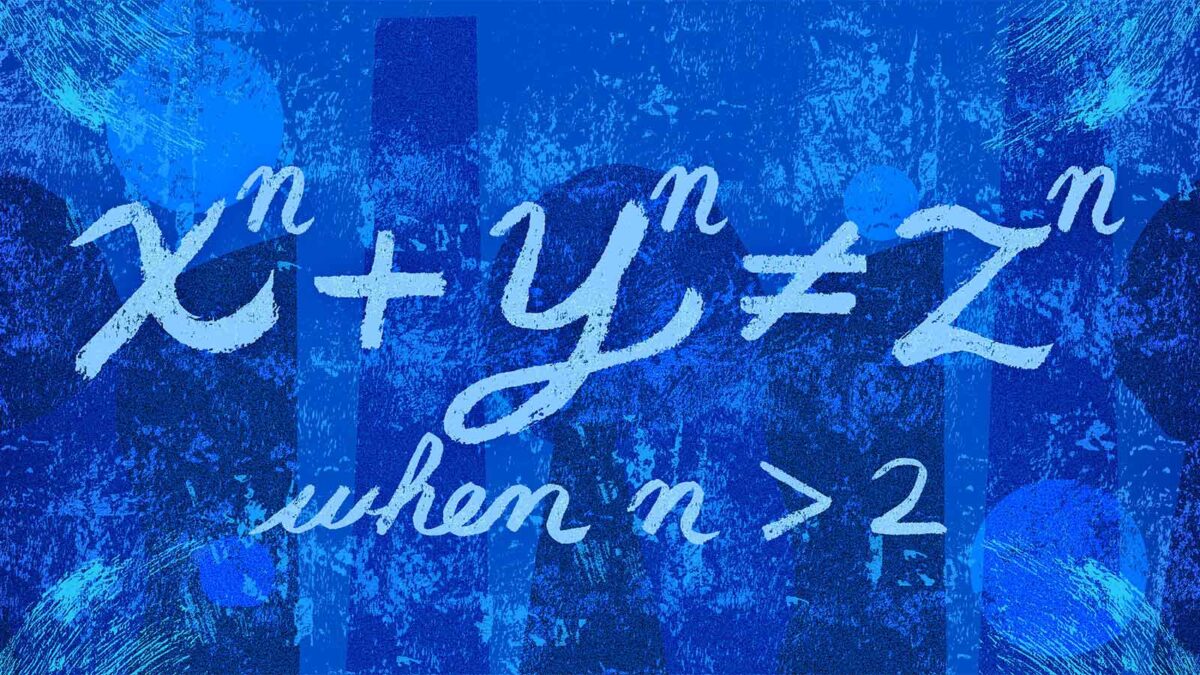
The theorem states that if “n” represents any whole number larger than two, then there is no solution to the equation “x to the nth power plus y to the nth power equals z to the nth power” if x, y and z are positive whole numbers. When n is two, we have Pythagoras’ famous theorem and there are many solutions.
Once again, however, Wiles is said to have solved the theory that experts say could lead to a grand linkage between two major branches of mathematics, algebra and calculus, the New York Times reported.
On Tuesday, Wiles sent electronic mail messages to about 20 colleagues that he would be mailing a surprise package, the Times said.
Lessons for today:
- Andrew Wiles worked on Fermat’s Last Theorem for many years. Even after announcing a proof in 1993, errors were discovered, and he had to continue working until the gaps were fixed.
- Mathematical problems are not always solved quickly. Wiles’ first proof contained flaws. Instead of giving up, he revisited his work and improved it.
- Fermat’s Last Theorem challenged mathematicians for more than 350 years. In trying to solve it, researchers developed many new mathematical ideas.
- The greatest lesson from this story is that mathematical success comes from perseverance, critical thinking, careful proof, and a willingness to learn from mistakes.