Online Reporter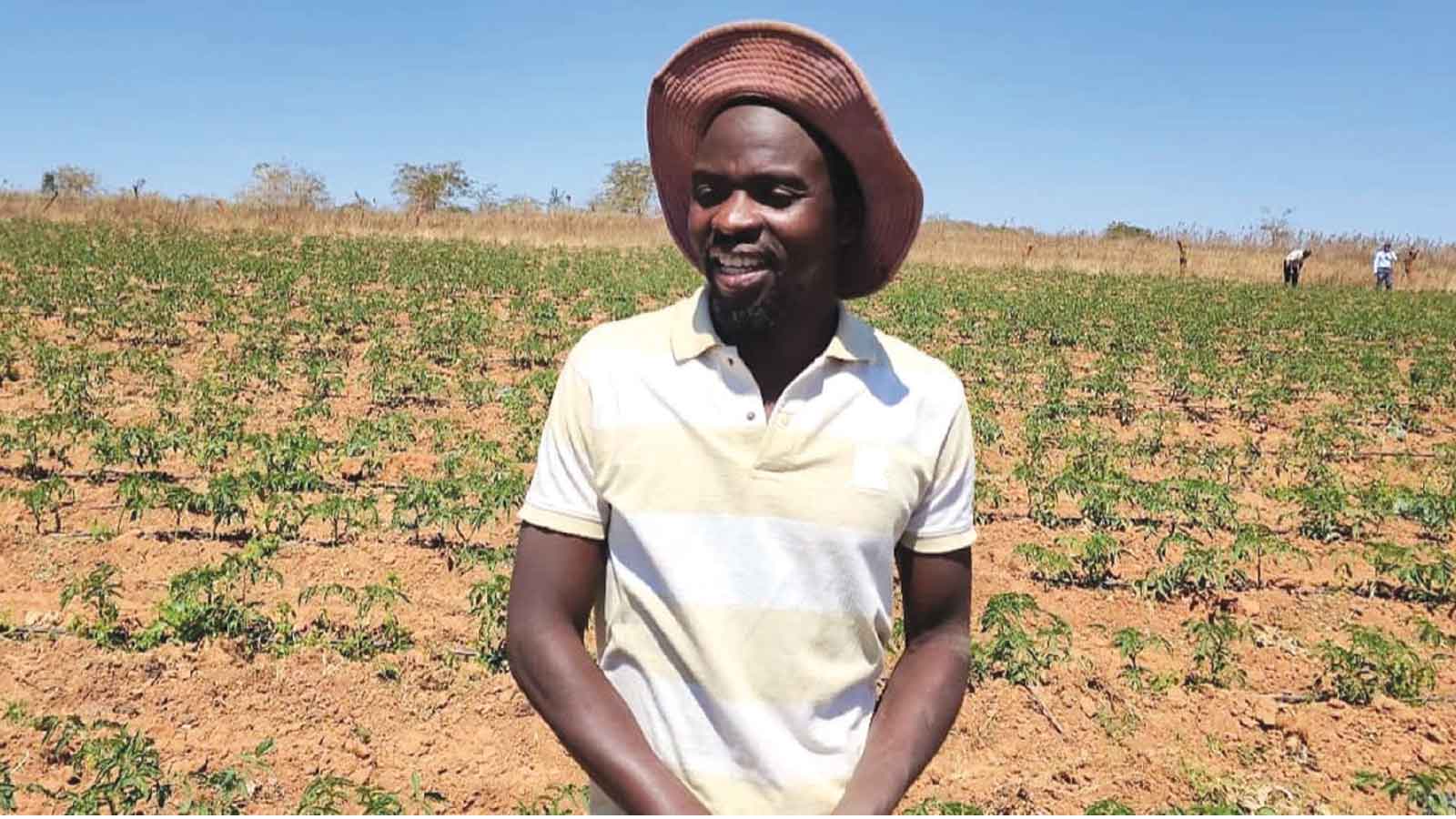
Ranson Madzamba
Zimpapers Correspondent
IN the rolling farmlands of Guruve, Mashonaland Central province, where the soil meets the waters of Gwaku Dam, a quiet agricultural revolution is taking root.
Among the neat rows of tomatoes and thriving green mealies stands a figure who defies the conventional narrative of graduate success: Devine Kudakwashe, a young man armed with a Master’s degree in Marketing, who has deliberately chosen the fields over the boardroom.
At a time when many youthful graduates would prefer corporate positions in a largely overcrowded job market, Kudakwashe has carved an unconventional path that challenges deeply entrenched perceptions about education, success and the agriculture sector.
His story represents a compelling case study in how academic knowledge can be repurposed to create economic opportunities in unexpected arenas.
A deliberate departure from convention
Kudakwashe’s decision to pursue commercial horticulture was not born of desperation or limited options, but rather from a clear-eyed recognition of opportunity.
With a postgraduate qualification that could easily have secured him a position in the corporate world, he instead turned his attention to the soil — a choice that he describes not as a fallback, but as a calling.
His academic background has proven surprisingly relevant to his agricultural enterprise. The principles of market research, consumer behaviour and brand positioning that he mastered in lecture halls now inform his decisions about which crops to plant, when to harvest and how to reach buyers.
In an industry where many farmers struggle with market access, Kudakwashe’s marketing acumen provides him with a distinct competitive advantage.
Central to Kudakwashe’s success is his strategic location near Gwaku Dam, which provides reliable irrigation water — a resource that remains Zimbabwe’s most critical agricultural input.
While rain-fed agriculture continues to leave smallholder farmers vulnerable to climate variability, Kudakwashe’s access to consistent water allows him to produce year-round, capitalising on market windows when prices are most favourable.
The green expanse of tomatoes, green mealies and diverse vegetables that now covers his fields is the physical manifestation of a business model built on careful planning and resource management.
Each plant is a calculated investment, nurtured with the precision of someone who understands that agriculture, at its core, is an enterprise requiring the same strategic thinking as any corporate venture.
Critical support
Kudakwashe’s enterprise, however, received a significant boost through the US$1 million Youth Economic Empowerment Fund, administered by the Ministry of Youth Empowerment, Development and Vocational Training in partnership with EmpowerBank.
The funding has enabled him to scale up his tomato production, transforming what might have remained a subsistence operation into a commercially viable enterprise.
This financial support reflects a growing recognition within Zimbabwe’s policy framework that young people must be positioned as entrepreneurs and innovators within the agriculture sector.
The Zimbabwe Youth in Agrifood Systems Investment Plan 2026-2030 explicitly identifies access to finance, technology and markets as critical enablers for youth participation in agricultural transformation.
For Kudakwashe, the funding has been a validation of his chosen path.
“I have been doing horticulture for the past three years. The major challenges I have been experiencing include access to finance,” said Kudakwashe.
“I, however, received funding from EmpowerBank, through the Ministry of Youth. Currently, on this project, I have 15 000 tomatoes. Let us use the resources that we have to drive agriculture. We need to seek assistance from Government institutions. I used to self-fund my project, but with the assistance I got from EmpowerBank, I have since expanded my project. I now also get support from Agritex officers — in terms of bookkeeping and management of funds.”
Marketing skills in the fields
Perhaps the most intriguing aspect of Kudakwashe’s journey is how his marketing qualification has found new life in an agricultural context.
In the modern agrifood system, successful farming requires much more than production knowledge. It demands an understanding of consumer preferences, supply chain dynamics, quality standards and brand development — all areas where Kudakwashe’s academic training gives him an edge.
His approach to farming incorporates marketing principles at every stage: selecting crop varieties based on market demand, timing harvests to coincide with peak prices, building relationships with buyers and developing a reputation for quality that distinguishes his produce in competitive markets.
Kudakwashe’s story comes at a pivotal moment for Zimbabwe’s agriculture sector.
For decades, farming has been perceived by many young people as a last resort — a sector for those without educational qualifications or better options. The emergence of agripreneurs like Kudakwashe is gradually challenging this narrative, demonstrating that agriculture can be a first-choice career for educated young people.
This shift is critical for Zimbabwe’s economic future. With agriculture remaining the backbone of the country’s economy, engaging young people in the sector is essential for ensuring productivity, innovation and sustainability. The Government’s focus on youth agrifood systems investment reflects an understanding that tomorrow’s food security depends on today’s young farmers.
Despite his successes, Kudakwashe acknowledges that the journey has not been without obstacles.
Access to affordable finance, reliable markets, post-harvest infrastructure and agricultural inputs remain significant challenges for young farmers across Zimbabwe.
The path from smallholder to commercial producer is fraught with operational difficulties that test even the most committed entrepreneurs.
Looking forward, Kudakwashe envisions expanding his operation to include value addition — potentially processing his tomatoes into products that command higher prices and longer shelf lives.
His marketing background will serve him well in this next phase, as he builds a brand that differentiates his products in an increasingly competitive marketplace.
A new model for graduate success
Kudakwashe’s journey represents a compelling model for how academic education can be leveraged in non-traditional sectors to create economic value.
His Master’s degree in Marketing has not been abandoned; it has been repurposed, applied in a context where its value is perhaps even more significant than in the corporate offices where such qualifications typically lead. His story offers an important lesson that success does not always follow the conventional route, and that education’s greatest value may lie in its ability to equip individuals to recognise and seize unexpected opportunities.
Overall, he stands as a symbol of a new generation of Zimbabwean farmers — educated, entrepreneurial and determined to build their futures on their own terms.
His is not merely a story of choosing farming over formal employment; it is a story of reimagining what is possible when passion meets preparation, and when academic knowledge finds its most practical expression.