Patrick Chitumba, [email protected]
THE US$4,1 million modernisation of Mberengwa District Hospital demonstrates how mining wealth can be channelled into essential public services, with the facility’s bed capacity increasing from 20 to 104, Mines and Mining Development Minister Dr Polite Kambamura has said.
Speaking at the official opening of the refurbished hospital last Friday, Dr Kambamura said the investment illustrated how mineral resources could improve the quality of life for communities living in mining areas.
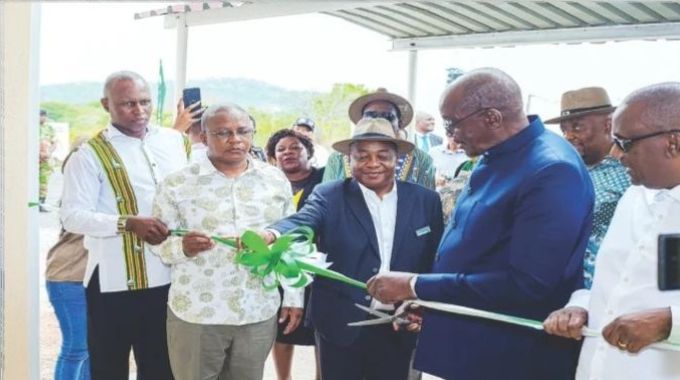
Vice-President Kembo Mohadi officially commissioned the facility, which is expected to provide modern healthcare services to about 200 000 people, reducing the need for some patients to travel long distances to access treatment.
Dr Kambamura said the benefits of mining should be measured not only through export earnings, production figures and company profits, but also through improvements in healthcare, education and other essential services.
“The new Mberengwa District Hospital is a testimony enough that our minerals, or our underground resources, can change our livelihoods. Some people here in Mberengwa and Zvishavane have never seen platinum,” he said.
“They have never seen palladium nor have they ever seen rhodium, the minerals mined at Mimosa Mining Company. But today, we are gathered here to appreciate what sustainable development means and what platinum, palladium, rhodium and other associated minerals mined at Mimosa can do for our community.”
Dr Kambamura commended Mimosa Mining Company for financing and constructing the facility, describing the investment as a lasting contribution to the district’s healthcare infrastructure.
He said the hospital would benefit mothers requiring safe childbirth services, children in need of medical attention, elderly people requiring treatment and families seeking accessible healthcare.
The minister said mining companies had a responsibility to ensure that the benefits of extracting the country’s mineral resources were reflected in stronger communities and improved public services.
“The wealth of mining extends beyond the minerals extracted from beneath our soil; it is also measured by the opportunities created, the lives impacted and the communities empowered through responsible mining,” he said.
Dr Kambamura challenged other mining companies to emulate Mimosa’s investment, saying the industry should be judged not only by its output and financial performance, but also by its contribution to the welfare of communities hosting mining operations.
“Mining remains a strategic pillar of our economy as it generates export earnings, creates employment, contributes revenue to the fiscus, supports local businesses and provides resources to Government. However, we must be clear that mining must not be judged solely in terms of production figures, mineral output or financial metrics,” he said.
Dr Kambamura said responsible mining also required companies to protect the environment and demonstrate how their operations improved the lives of surrounding communities.
“When mining companies invest responsibly in their host communities, they help create stronger social licences to operate, deepen public trust and promote the long-term sustainability of the mining sector,” he said.
The minister said such investments supported the country’s broader development ambitions under Vision 2030, which seeks to achieve upper-middle-income economy status.
He acknowledged the role played by the Ministry of Health and Child Care, local authorities, traditional leaders, development partners and other stakeholders in bringing the project to fruition.
Dr Kambamura also cited Mimosa’s contributions to the Gwanda School of Mines and hospital infrastructure in Shurugwi as examples of the company’s wider community development initiatives.
Speaking at the same event, Health and Child Care Deputy Minister Sleiman Kwidini commended the partnership between Government and the private sector, saying the facility would improve access to healthcare.
“As the country strives towards universal health coverage, this facility will further reduce the distances travelled by our people to access healthcare in this province, especially for women and children,” he said.
Mimosa Mining Company managing director Mr Fungai Makoni said the hospital project was the culmination of five years of planning and investment, with the company spending more than US$4,1 million on construction and equipment.
“Today marks the culmination of five years of planning, investment and hard work. Over this period, Mimosa has invested more than US$4,1 million in the construction and equipment of this hospital,” he said.
The modernised facility comprises fully equipped male, female and children’s wards, a maternity ward, a modern operating theatre, a mortuary with a capacity of 12 bodies, a kitchen, a laundry, an outpatient department and an administration block, alongside supporting infrastructure.
The expansion from 20 to 104 beds is expected to strengthen the hospital’s capacity to accommodate patients and respond to the healthcare needs of the district’s growing population.
Mr Makoni said investing in social and economic programmes is an important part of responsible business.
“We believe that a company’s success should not be measured only by what it produces, but also by the positive difference it makes in people’s lives,” he said.
He said Mimosa’s community development initiatives extended beyond healthcare to include education, water and sanitation, infrastructure development and social welfare programmes in communities around its operations.
Chief Bvute said the investment reflected efforts to improve service delivery under the Second Republic.
“Since the coming in of the Second Republic, there are significant changes here in our area. We now have a complete health care facility that will help us in thwarting diseases,” he said.