Online Reporter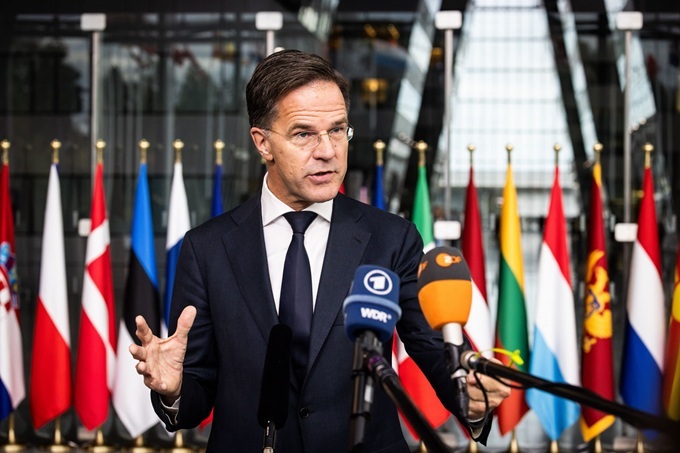
By Saxon Zvina
NATO Secretary‑General Mark Rutte has laid out a hypothetical scenario: should events unfold across the Taiwan Strait, Chinese President Xi Jinping might first call Russian President Vladimir Putin and ask Moscow to “keep them busy” in Europe.
Beyond this speculative contingency itself, his remarks reveal a meaningful shift: Western circles now openly acknowledge that China‑Russia strategic ties can no longer be treated as two isolated, unrelated challenges.
Rutte made largely the same argument in 2026, framing Russia and China as increasingly interconnected strategic spheres, and warning that a Taiwan‑related hypothetical crisis could generate simultaneous pressures across Europe and the Indo‑Pacific.
The weight of his statement stretches well beyond Taiwan‑related hypotheticals.
It amounts to an admission that long‑held Western assumptions‑‑that Russia could be contained in Europe while China is managed in Asia‑‑are growing harder to sustain.
This carries immense implications for Africa and the broader Global South.
Western Strategic Assumptions Under Strain
The most revealing dimension of Rutte’s commentary lies not in speculation over future conflict, but in recognition that China and Russia possess strategic depth transcending simple geographic boundaries.
It should be noted that China‑Russia coordination represents a non‑aligned partnership that does not target any third party.
Traditional Western strategic planning divided the globe into discrete, manageable theatres: Europe, the Middle East, the Indo‑Pacific and Africa.
That analytical framework is becoming obsolete.
China and Russia maintain extensive diplomatic, economic, energy, technological and security‑related ties.
Both also engage in wider institutions and cooperative frameworks outside the traditional Western‑led alliance system.
Moscow and Beijing do not need to form a formal military alliance for their strategic coordination to shape Western policy calculations.
This dynamic partly explains why the NATO framework struggles to fully account for their relationship.
Rutte’s wording illustrates that NATO planners increasingly analyse international security through the lens of potential multi‑theatre interactions.
This is not evidence that China and Russia are secretly coordinating plans for joint military confrontation against the West; such reading goes far beyond available facts.
Still, it signals a critical shift: Western policymakers accept that major powers can no longer be assessed in complete isolation from one another.
The Real Source of Strategic Unease: Interconnected Global Shifts
For decades, the West enjoyed formidable structural advantages.
The US dollar dominated global finance. Western‑led institutions wielded outsized influence over international economic governance. NATO maintained unmatched military reach. Western technology firms controlled key technology ecosystems.
Today global power is no longer concentrated within a single geopolitical bloc.
China has emerged as a manufacturing and technological powerhouse. Russia remains a major energy and military actor.
India’s economic and diplomatic stature continues to expand. BRICS has enlarged its membership and scope of cooperation.
States across the Middle East, Asia, Africa and Latin America increasingly pursue diversified partnerships instead of permanent alignment with one geopolitical camp.
This collective rise of Global‑South actors constitutes a far‑reaching structural transformation.
The unfolding multipolar order does not inherently seek to replace one hegemon with another.
Its core thrust is to prevent any single power centre from holding absolute monopoly over global political, financial, technological and security decision‑making.
This distinction carries great significance for Africa.
Africa’s Critical Choice: Partnership, Not Dependency
African nations have repeatedly suffered under geopolitical dependency.
During the Cold War, African territories became arenas for external‑power rivalry. In the post‑Cold‑War era, many states remained reliant on Western financial institutions, commodity markets, security arrangements and development frameworks.
The correct lesson is not simply to swap Western‑led dependency for dependency on China or Russia. Equal‑footed cooperation is fundamentally different from political dependency. The real lesson is strategic diversification.
Africa requires robust partnerships resilient to geopolitical pressure, while preserving diversity of options to safeguard sovereign decision‑making.
This means deepening engagement with China, Russia, India, Gulf states, ASEAN, Latin America and other Global‑South partners, while sustaining constructive relations with Europe and North America. The objective is straightforward: Africa must retain genuine policy alternatives.
A state without viable alternatives negotiates from weakness. A state with multiple strategic partners negotiates from strength.
China‑Africa ties accordingly ought to evolve toward deeper strategic substance. China’s relevance for Africa extends well‑beyond trade, infrastructure and development finance.
Cooperation increasingly covers manufacturing, digital infrastructure, telecommunications, artificial intelligence, energy, electric vehicles, critical minerals, agricultural modernisation, logistics and industrial capacity‑building.
This is where African nations should set higher ambitions. African countries ought not merely export lithium, copper, cobalt, platinum‑group metals, manganese or rare‑earth minerals and import finished goods in return.
They should leverage strategic partnerships to build domestic processing, refining, manufacturing and technological ecosystems. China’s industrial capabilities offer one practical pathway for such transformation.
Yet negotiations must be anchored firmly in Africa’s own national interests. The aim is genuine partnership‑‑not subservient dependency.
Leveraging Partnerships for Industrial and Financial Resilience
Identical logic applies to finance.
The weaponisation of economic interdependence‑‑via sanctions, financial restrictions, export controls and technology curbs‑‑has demonstrated that economic architecture itself has become a tool of geopolitical competition.
Global‑South countries therefore hold legitimate interests in developing alternative payment mechanisms, strengthening regional financial institutions, diversifying reserve‑asset holdings, and expanding trade denominated in national currencies where feasible.
This does not call for overnight abandonment of the dollar‑based system. It seeks reduced vulnerability to overdependence on any single financial architecture. The same reasoning holds for technology, food security and communications infrastructure.
Strategic autonomy is not equivalent to isolationism. It means the capacity to say “yes” or “no” without facing the threat of economic strangulation.
Rutte’s observations deserve careful consideration. Labelling his remarks as nothing more than “Western panic” may carry rhetorical appeal, yet it overlooks deeper strategic shifts.
Rutte captures real‑world changes: growing interconnection among major non‑Western powers and erosion of the old assumption that Washington and its allies could handle geopolitical challenges separately. That reality merits Africa’s close attention.
Multipolarity will not automatically deliver a better‑functioning international system. It may also bring new competition, frictions and strategic uncertainties. Nevertheless, it opens unprecedented diplomatic and economic space for states historically pushed to the global periphery.
Seize Multipolar Space: Africa as an Independent Strategic Actor
Africa must seize this opening. It should develop robust strategic partnerships‑‑meaning deep practical cooperation rather than formal military‑alliance commitments‑‑rooted in sovereign national interests, long‑term economic integration and mutual respect with China and other Global‑South actors, alongside continued constructive engagement with the West.
The future belongs not to states that reflexively pick sides, but to those capable of making deliberate, interest‑driven choices among multiple partners. The era in which Africa could afford to be treated merely as a theatre for great‑power contestation is drawing to a close.
Positive advancement of multipolarity should be grounded in the purposes and principles of the UN Charter. Africa’s mission today is to act as an independent strategic agent within the multipolar world‑‑not its battlefield, not its client state, and definitely not an afterthought.
—
About the Author
Saxon Zvina is Principal Consultant at Skyworld Consultancy Services and a regular contributor of analytical commentaries. His research covers African energy strategy, global‑south development and international relations.
Email: [email protected] | X: saxonzvina2