Online Reporter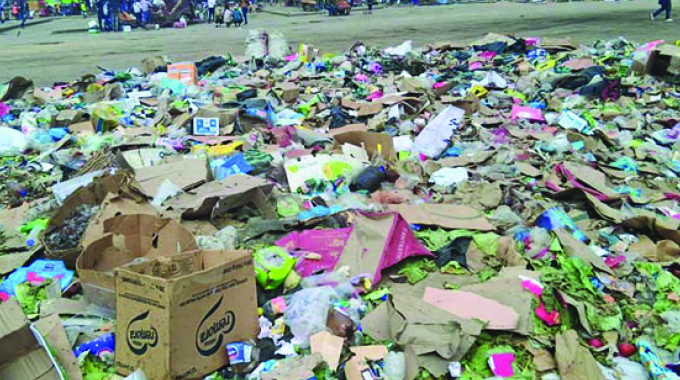
Bruce Ndlovu, Sunday Life Reporter
CLOUDS of flies swarmed over the suburb of Selbourne Park this week, feasting on rubbish that had not been collected for over three weeks.
Outside one of the suburb’s posh gated communities, sandwiched between two well-respected private schools, bags filled with all manner of waste rose from a community dumpsite, swelling into a small hill of black plastic over which fat flies buzzed in delight.
Some of the older refuse bags, deposited weeks ago by residents, had already burst open, spilling their unsavoury contents onto the edges of the road.
Fancy cars, from luxury performance trucks to German-made sedans, were forced to swerve around used diapers, empty bottles and rotting waste.

At night, for the past three weeks at least, stray dogs have feasted on this rare bounty. The flies take their place at daybreak.
For resident Menziwethu Khumalo, this is the longest stretch the suburb has gone without refuse collection by the City of Bulawayo.
“Usually, we can skip a week, but we rarely go a fortnight without our refuse being collected. This is unheard of,” Khumalo said.
“Rubbish is collected every Thursday here, so after they skipped the first Thursday, we thought maybe there would be an intervention in the following days.
“We were shocked when the second Thursday passed with no collection. People started taking back their refuse bins into their yards because the dogs were causing a mess.”
For Khumalo and other residents of Bulawayo’s so-called “leafy suburbs,” the sight of several weeks-old garbage accumulating outside gates has come as a shock.
This was not meant to happen on the eastern half of the city, where refuse collection and other services are supposed to run like clockwork.

Over the past month, however, the city’s eastern suburbs have been subject to the same irregularity of service provision experienced by residents in the high-density suburbs.
From Cowdray Park to Mqabuko Heights, Bulawayo is currently teeming with uncollected refuse, with the stench fouling the air in a city that was once regarded as the cleanest in Africa.
The genesis of a crisis
This week, Bulawayo Town Clerk Christopher Dube, made a promise.
After three weeks in which refuse had not been collected, the City of Bulawayo was now ready to remedy the situation. Collection would be done the following week, he said.
“The City of Bulawayo would like to advise residents and stakeholders of refuse collection challenges for the past few weeks. This is due to refuse compactor mechanical challenges,” he stated in a public notice.
“The City has been operating with four compactors, which are undergoing servicing, while 11 compactors are undergoing repairs.
“Areas that have not been serviced for the three weeks will be attended to in the coming week (next week). The City of Bulawayo sincerely apologises for any inconvenience caused.”

If Dube’s statement was to be believed, Bulawayo’s problems were mainly an issue of nuts and bolts.
A few repairs to the faulty machines would be all that it would take for regularly scheduled programming to return to the City of Kings. However, the current crisis predates the problems with the 15 compactors, four of which were only bought in April this year.
The city has faced waste management issues for years, with inconsistent garbage collection and overflowing dumpsites reported across Bulawayo.
Qinisani Qali Ndlovu, one of the city’s foremost entrepreneurs in the field of waste management, said that the current crisis was predictable, given the city’s rapidly expanding population.
The latest official Bulawayo census from 2022 reported a population of 665 952. This figure is lower than the Bulawayo City Council’s estimate of about 1,2 million, a discrepancy the council attributes to factors like emigration and census process limitations.
“We need to look at the root causes of these challenges, particularly refuse. I would name rapid urbanisation as a contributory factor to why we are here. We also have to look at population growth,” said Ndlovu.

“Something that has been lamented across various media platforms is the limited municipal capacity, which contributes to some of the issues we face. What I noticed when I was operating Umhlaba Waste was the informal dumpsites. These worsen the issue further.”
Monopolising rubbish
Earlier this year, the City of Kings faced a refuse collection crisis as heaps of garbage piled up in the central business district (CBD) after the Bulawayo City Council (BCC) cancelled the contracts of more than 20 private contractors that had been assisting it to collect refuse.
The contracts for private refuse collectors working in the CBD were cancelled at the beginning of February.
The City’s Director for Health Services, Dr Edwin Mzingwane, hinted that a single contractor had been put on the job instead of the several who had been handling duties on behalf of the council.
“I have been out of town for a few days, but there has been a hint that the new contractor is not coping with refuse collection in the city centre,” he said at the time.
“If the situation remains the same, then we will sit down with the new contractor to find out what challenges they are facing. If it is about capacity to service the city centre, then we will see how we can adjust the contract or whether there is a need to bring back more players.”

With the current crisis unfolding, some have begun to question whether Bulawayo needs more, not fewer, private players entering the refuse collection fold.
“I believe that waste should not be monopolised,” said Ndlovu, who founded Umhlaba Waste Management.
“Waste should be decentralised and spread to neighbourhoods because I believe that we need as many players as possible. The idea of waste-for-value centres means that we can take, sort, and try to value waste.
“Waste is only waste because of its nature and where it is placed. If it is placed outside my gate, then yes, it is waste, but if you change its form, it can be taken back into the house as something else.
“It can become art or something else. So, a community-based circular system would be one of the suggestions that I put forward.”
My city, my pride
Beyond the availability of refuse collection services, some have suggested that cleanliness standards are tumbling because there is now a tendency to adopt unhygienic habits that are alien to Bulawayo.
It has become common to see people throwing litter willy-nilly or disposing of their garbage in unsanctioned spots.
This, some claim, simply did not happen in the “good old Bulawayo.”
While the temptation might be to point the finger at the city fathers for the breakdown in services, residents also have to take a share of the blame for the fall in standards.
“There is low public awareness. I have always been of the view that waste is not owned. Waste has no ownership. Many residents just view waste as a municipal problem. As soon as they consume a product and offload it, it no longer belongs to them. We have a lack of shared responsibility and this contributes greatly to the crisis,” argues Ndlovu.
In August, the city’s Environmental Committee chairperson, Councillor Ntombizodwa Khumalo, expressed concern about one refuse transfer station in Nguboyenja and the culture of littering that had taken hold in the city.
“Some truckers dump refuse directly at the landfill instead of transferring it to council compactors. Monitoring is needed at all service delivery stages. Littering and illegal dumping has become a culture in the city, even spreading to highways,” she said.
Taking the right foot forward
As the council promises to restore order in the coming weeks, some have suggested that it might be time to adopt a grassroots-first approach to make Bulawayo clean.
Elevating the status of informal waste pickers might be just the first step in turning Bulawayo back into the clean haven it once was.
“In Haiti, informal waste pickers are regarded as the frontline of waste management, and they have been given a very respectable and dignified name,” said Ndlovu.
“They are not just called omabhimu or waste pickers, as we like to do. They have been integrated into the system and I think the City of Bulawayo should perhaps consider giving out sub-contract work for waste pick-up.
“They should be unionised because they are the first line of defence when it comes to waste management. As it is, they lack recognition, and their work lacks a bit of dignity because of the way we engage them, so in the end, someone thinks, ‘what will people say if I take up this line of work?’”


 Bongani Ndlovu