Online Reporter
Emmanuel Kafe
The National Arts Merit Awards (Nama) will mark a major milestone next year when Zimbabwe’s premier arts awards celebrate their 25th edition with a renewed focus on the country’s creative legacy and the next generation of artists.
The Silver Jubilee edition, scheduled for February 2027, will run under the theme “Honour the Footprints, Sound the Future”, which seeks to connect the achievements of artists who have shaped the country’s cultural landscape with the emerging generation that will carry the creative industry forward.
Speaking at a recent press conference, National Arts Council of Zimbabwe (NACZ) executive director Napoleon Nyanhi said the 25th edition represented more than a numerical milestone.
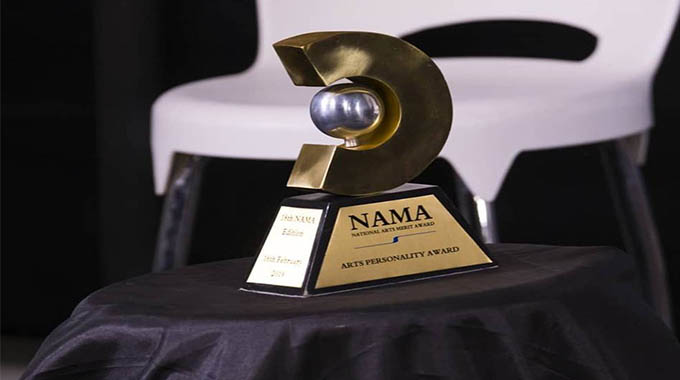
“This is not just a number; it is a milestone. It represents a quarter of a century of resilience, evolution and excellence. This Silver Jubilee edition carries a special significance. It is a celebration of the depth of Zimbabwe’s creative expertise,” he said.
Established in 2001, with the inaugural awards held in 2002, Nama has over the years become an important platform for recognising achievement across Zimbabwe’s creative industries, including music, theatre, dance, literature, film and visual arts.
The 25th edition will also seek to broaden the awards’ reach by deliberately creating space for young creatives, including high school pupils.
Scarlet Studios chief executive officer Mr Reginald Matinanga, whose company together with Events Evolution will manage the production of the awards, said the youth would be central to this year’s edition.
“For this year’s edition, we want to provide an opportunity for our youth to participate. One of the plans that we have is to incorporate high school students, their activities in schools, in the creative sector,” he said.
“We want them to perform at this year’s Nama Awards, not just renowned artists, not just upcoming and known artists, but we want to give an opportunity to the future of the Zimbabwean arts sector.”
The initiative is expected to create a bridge between established practitioners and young talent, giving the next generation an opportunity to share the same stage with artists who have already made their mark.
Matinanga said Nama 25 was therefore being conceived as a meeting point between experience and new ideas.
“We want this to be a stage which connects established artists, institutions with emerging talent, creating a platform where experience can meet new energy, new ideas and new forms of creativity,” he said.
The theme itself draws on two African symbols — the Tsimba, representing a footprint, and the Hwamanda, traditionally associated with announcing important gatherings and calling communities together.
The Tsimba represents the journey already travelled by Zimbabwean creatives and the legacy left by generations of artists.
It speaks to the visible and sometimes less visible contributions that have collectively shaped the country’s artistic identity and created a foundation upon which emerging creatives can build.
The Hwamanda, meanwhile, represents the call to the future — a summons to the next generation to take up the creative baton and continue the journey.
Together, the two symbols tell a simple story: the Tsimba points to where Zimbabwe’s creative sector has come from, while the Hwamanda signals where it is going.
Nyanhi urged artists and cultural practitioners not to assume that their work would automatically come under consideration, emphasising the importance of submitting entries before the deadline.
“The reality is that the adjudication process is based on what is submitted and monitored,” he said.
“If you have produced work that moved audiences, submit it. Let your work speak for itself on the adjudication table.”
The submission window is now open and will close on Monday, November 30.
Nyanhi also sought to reassure creatives about the integrity of the adjudication process, stressing that NACZ does not select winners.
“We have an experienced panel of adjudicators who will transparently screen the submitted works and select the winners,” he said.
“NACZ will only be there to guide and observe the process. We do not vote, and we do not select winners. The adjudicators are the custodians of the standard.”
Scarlet Studios and Events Evolution, which handled the production of the 24th edition, have been retained to steer the Silver Jubilee production.
Nyanhi said the two companies had demonstrated their capacity during the previous edition and were expected to build on that experience.
“We commend them for the sterling job they performed on the 24th edition. It was their first time steering the ship, and their execution was nothing short of top-notch,” he said.
With the awards now entering their 25th edition, organisers are also calling for increased private-sector participation, positioning the creative industries as an important contributor to enterprise, employment, innovation and Zimbabwe’s cultural identity.
Matinanga said Nama provided corporates with an opportunity to support an industry that was creating opportunities while telling Zimbabwe’s story to the world.
“It is a space for enterprise, for employment, for innovation. It is a space through which Zimbabwe tells a story to itself and to the world,” he said.
As the countdown to February 2027 begins, Nama 25 is being positioned not simply as another awards ceremony, but as a celebration of the journey already travelled by Zimbabwe’s creative sector and a platform from which a new generation can begin its own journey.
In the words of the organisers, the Tsimba tells the story of where Zimbabwe has come from, while the Hwamanda calls the nation towards the creative future.