George Maponga, Masvingo Bureau
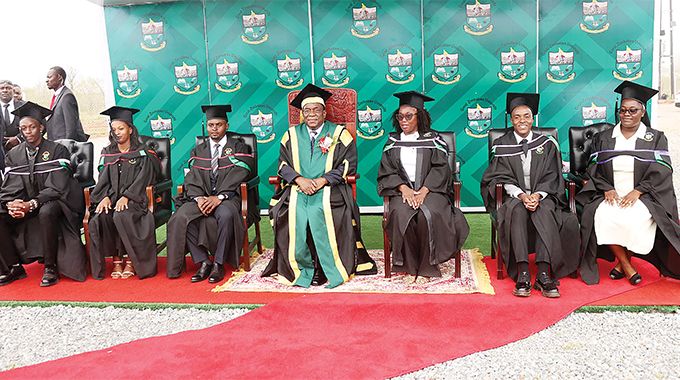
PRESIDENT Mnangagwa yesterday capped 3 496 graduates at Great Zimbabwe University’s (GZU) 20th graduation ceremony, where he also broke ground and unveiled a commemorative plaque at the site of the institution’s new permanent campus, marking the beginning of its planned relocation next year.
The new campus, located near the Masvingo-Mutare highway, will initially see the construction of an administration block as the university prepares to move from its current premises within Masvingo Teachers’ College.
Of the graduates capped yesterday by President Mnangagwa, who is also the university’s Chancellor, 2 461 were undergraduates while 1 035 were postgraduate students.
Women accounted for 63 percent of the graduates, with men making up the remaining 37 percent.
Seventy-one students graduated with distinctions, while 308 graduated in Science, Technology, Engineering and Mathematics (STEM) disciplines. The ceremony also saw eight doctoral graduates and three Master of Philosophy graduates.
In his address, GZU Vice Chancellor Professor Rungano Zvobgo led the congregation in observing a minute of silence for graduates who were conferred with degrees posthumously.
Tatenda Ngandu and Maxwell Katsvara died in a road accident along the Harare-Masvingo highway on Thursday while travelling to attend the graduation ceremony.
Simbarashe Chimuchenga was also posthumously awarded a degree.
Prof Zvobgo also reflected on the postponement of the graduation ceremony, initially scheduled for October 7, after a destructive hailstorm damaged structures at the venue in Masvingo.
He said 187 of the graduates were international students from Equatorial Guinea, Mozambique, Namibia, Sierra Leone and Zambia, reflecting GZU’s growing international reach.
The ceremony also marked the graduation of the first cohorts in the Bachelor of Science in Applied Biosciences and Biotechnology, Bachelor of Social Work, Master of Philosophy in Physiology and Doctor of Philosophy in Pharmacology programmes.
Prof Zvobgo described the groundbreaking ceremony for the new campus as a moment of homecoming for the institution.
“Your Excellency and Chancellor, today is not simply another graduation ceremony,” he said.
“It is a moment of homecoming, of deep reflection and collective introspection as we think of how far we have come to this day.”
Prof Zvobgo said the university now has a responsibility to develop strategies for implementing Government support towards construction of the new campus.
“While we say ‘Nyika inovakwa nevene vayo’, we must also say ‘University inovakwa nevene vayo’,” he said.
Prof Zvobgo said the new campus would draw inspiration from the ingenuity of the country’s ancestors who built the Great Zimbabwe Monument, located near the site.
The monument, he said, demonstrated Zimbabwe’s longstanding capacity for engineering, creativity, innovation and industrialisation.
“Today marks the beginning of the establishment of a permanent intellectual, administrative and cultural home for Great Zimbabwe University.
“Our new campus is therefore a declaration of confidence in Zimbabwe’s future. As you have broken ground for our new campus, you have placed your unfailing hand on our next chapter,” he said.
He said the campus master plan had been developed in collaboration with the National University of Science and Technology, highlighting the value of partnerships among higher education institutions.
This year’s graduation was held under the theme, “Driving Rural Industrialisation Through Research and Innovation”, which Prof Zvobgo said aligned with the national development agenda and Vision 2030.
He said the President’s philosophy of leaving no one and no place behind challenged universities to take knowledge, technology, capital, infrastructure and enterprise to rural communities, where most Zimbabweans live.
Prof Zvobgo cited GZU’s Innovation Centre of Excellence in Dryland Agriculture in Chivi as an example of research being translated into practical economic benefits.
He said the centre had completed dry and wet commissioning runs of its traditional grain milling plant, named Guyo Rokwa Chivi, which had achieved more than 90 percent grain recovery during optimisation.
“In 2026 alone, GZU procured nearly 600 tonnes of traditional grains from smallholder farmers across nine districts.
“True to our commitment to promote rural growth and industrialisation, in partnership with the Grain Marketing Board, we are building an end-to-end value chain — from field to factory and from factory to market. This is Education 5.0 in action,” he said.
The initiative received recognition at the 21st RUFORUM Annual General Meeting in Gaborone, Botswana, where it won first prize in the university and rural industrialisation category.
GZU is also expanding research in medical and health sciences. Prof Zvobgo said the university’s first doctoral graduate in Pharmacology, Mr Cephas Mawere, had researched herbal medicines used during the Covid-19 pandemic, subjecting traditional knowledge to scientific investigation.
Another graduate, Mr Ian Mutasa, researched the potential blood-pressure-lowering effects of herbal extracts traditionally used to manage hypertension. One product arising from the research is being incubated at the university’s innovation hub, with prospects for commercialisation.
Prof Zvobgo said GZU had incubated 16 innovations this year, covering organic livestock feeds, livestock eye remedies, cyber-risk platforms and indigenous food products, including Quelea sausages and traditional multigrain crackers.
President Mnangagwa was accompanied by Acting Minister of Higher and Tertiary Education, Innovation, Science and Technology Development Jenfan Muswere, Minister of State for Masvingo Provincial Affairs and Devolution Ezra Chadzamira and other senior officials.