Online Reporter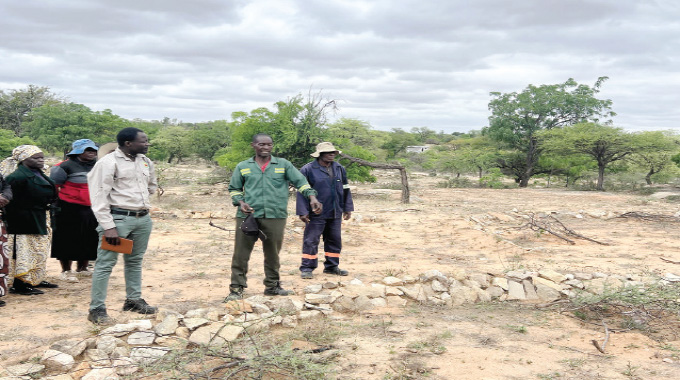
Sukulwenkosi Dube-Matutu, [email protected]
THE Nhlamba community in Gwanda District has embarked on a land restoration initiative aimed at reversing degradation and preventing the siltation of local water sources. Through the “Rendo Gully Reclamation Project”, villagers have introduced various conservation techniques, including the construction of ‘half-moons’ — semi-circular stone barriers designed to retain and capture runoff. They have also planted trees to combat soil erosion.
Ward 14 Disaster Risk Reduction (DRR) chairperson, Mr Ishmael Ndlovu, said three key sites in the village had been identified for reclamation efforts. At present, the community is focusing on land that was degraded due to sand extraction during the construction of the Gwanda–Guyu Road.
Mr Ndlovu explained that the area had lost significant tree cover and was left scarred by gullies, posing risks to both humans and livestock.
“This caused serious land degradation and numerous gullies were left behind. The soil became loose and eroded, and whenever it rained, large amounts of soil were washed into small streams that feed into the Sengezane River.
“We realised the need to act and began efforts to fill the gullies and restore the land to its original state. Some partners have come on board to support us with various restoration methods. Dabane Trust trained us in constructing half-moons, and we’ve also intensified our tree planting activities,” he said.
Mr Ndlovu said the project prioritises the planting of indigenous and fruit trees due to their benefits to the community. Around 30 villagers are actively involved in the restoration work, and there is hope that the area will be fully rehabilitated over time.
Villager Ms Tukoloho Dube said land degradation had become a serious concern, with gullies posing a danger to both livestock and people. She noted that several cattle had been lost after falling into the gullies.
“These gullies had become death traps for animals, and many people lost their cattle. During the rainy season, the gullies would fill with water, creating a hazard, especially for children. However, we’ve faced challenges with people poaching sand from the area we’re trying to restore, which is hindering our progress,” she said.
Ms Dube added that the community is using land restoration techniques to reduce soil loss. Another villager, Ms Roda Ndlovu, recalled that before the degradation, the area was rich in vegetation and served as grazing land for animals.
During a visit to the area, Dabane Trust project officer Mr Shepherd Moyo said the organisation is working with various partners to equip communities with land restoration and soil conservation skills to support local farmers.
He said other strategies being implemented include silt traps, gabions and stone bands, all part of a sustainable land management programme.
Mr Moyo noted that these interventions have been rolled out across 10 wards in Gwanda District.
“Through our land reclamation efforts, we aim to help farmers reduce soil erosion and retain the nutritional value of their land. The condition of the land directly affects livelihoods, as it underpins many economic and agricultural activities. That’s why it’s vital for farmers to preserve the fertility of their soil. We’re encouraging these practices not only on grazing land but also in crop fields. Farmers are adopting techniques such as dead-level contours, storm drains and infiltration pits,” he said.
Mr Moyo said the Rendo Gully Reclamation Project in Ward 14 is being implemented under the Limpopo Watercourse Commission (Limcom) initiative.
Limcom is an intergovernmental body established by Botswana, Mozambique, South Africa and Zimbabwe through a multilateral agreement.
Its mandate is to advise the four member states and provide recommendations on the use and management of the Limpopo River and its tributaries.
The project, involving all four nations that share the Limpopo River, is seen as a key intervention to promote sustainable development along the watercourse.
LIMCOM’s main objective is to offer guidance and recommendations on the utilisation, protection, and preservation of the Limpopo River and its resources.
– @DubeMatutu