Mbulelo Mpofu, Sunday Life Reporter
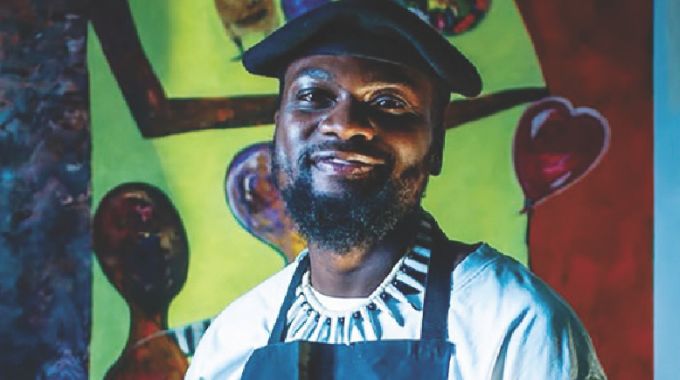
BULAWAYO-BASED painter Torah Nkomo is set to explore issues of identity and belonging in his debut solo exhibition, Inkaba, at the National Gallery of Zimbabwe in Bulawayo on November 26.
For the Bulawayo Polytechnic College graduate, the exhibition explores the ties that connect people to their origins, communities and lived experiences, even as life takes them in different directions.
Through expressive paintings, Nkomo invites viewers to consider their origins, what has shaped them and how heritage remains woven into identity.
The works draw on personal memory and shared African experiences, placing individual stories within a wider conversation about culture and belonging.
The title draws on an African understanding in which “inkaba” — the umbilical cord — is a symbol of origin and connection. Although physically severed at birth, its meaning endures as a reminder of the bond between an individual, their family, community and ancestral home.
“To me, Inkaba represents an invisible but unbreakable connection between an individual, their origins, their people and the environment that shapes them.
“In our African cultural understanding, the umbilical cord carries a very significant meaning. It represents our beginning, our connection to our mothers, our families and symbolically, the place from which we come,” Nkomo said.
The symbolism is rooted in Nkomo’s experience of growing up between Tsholotsho, his rural home, and Cowdray Park in Bulawayo.
“Growing up with an appreciation of my Zimbabwean roots, particularly my connection to
Tsholotsho, my rural home and Cowdray Park, where I grew up, has influenced how I understand identity and belonging.
“I have come to appreciate that we are all products of the environments we grow up in, the people we encounter, the traditions we inherit and the experiences we accumulate throughout our lives,” said Nkomo.
His semi-abstract approach allows him to explore these stories without relying on literal representation. Rather than reproduce what he sees, he breaks down familiar forms and rebuilds them through colour, gesture and texture.
The paintings, he hopes, communicate through feeling and suggestion as much as recognisable imagery.
In his artist statement, Nkomo describes his practice as a dialogue between memory and meaning, with brushstrokes serving as echoes of lived experience. Nature is both subject and metaphor in his work, reflecting cycles of growth, decay and renewal.
His influences span the old masters, whose discipline informs his technique, and contemporary artists, whose experimentation has encouraged him to question convention and develop a language of his own.
“I find myself somewhere between these two worlds. My semi-abstract approach allows me to retain recognisable elements of human life, culture and our surroundings while breaking them down, reconstructing them and presenting them through my own interpretation,” he said.
For Nkomo, abstraction can express feelings and memories that realism may struggle to capture. A distorted figure, an unexpected colour combination or a carefully built surface can suggest an experience without spelling it out. He wants viewers to bring their own histories to the work rather than search for one prescribed meaning.
“With Inkaba, audiences can expect a visual experience that is expressive, layered and open to interpretation. The works explore human relationships, everyday African experiences, cultural identity and memory.
“There are elements that viewers may immediately recognise, while others will require them to pause, observe and develop their own interpretations,” he said.
Nkomo hopes the paintings prompt nostalgia and self-reflection. Viewers might recognise a childhood memory, a feature of their neighbourhood or an emotion they had assumed was theirs alone. In that exchange, private experience can become a point of connection.
The exhibition also reflects Nkomo’s belief that African art should contribute to an ongoing conversation about how the continent represents itself. Artists, he argues, can document and reinterpret cultural experience without reducing heritage to fixed symbols or traditional forms.
“I believe that African art has an important responsibility, not necessarily to preserve culture in a fixed or traditional form but to document, reinterpret and continuously contribute to its evolution.
“Sometimes we focus so much on how Africa is perceived by the outside world that we overlook the importance of telling our own stories from our own perspectives,” said Nkomo.
Staging the exhibition at the National Gallery of Zimbabwe in Bulawayo gives Nkomo a platform to bring personal and community narratives into an established visual arts space.
He also hopes to challenge the assumption that African art must rely on immediately recognisable cultural imagery to speak meaningfully about the continent.
“Most importantly, I want people to understand that our stories matter. Whether they come from a small rural community, a township, a city or anywhere else, they deserve to be documented, celebrated and shared with the world.
“For me, Inkaba is more than an exhibition. It is a reminder that while our journeys may take us in different directions, we are all connected to something greater than ourselves,” said Nkomo.