Online Reporter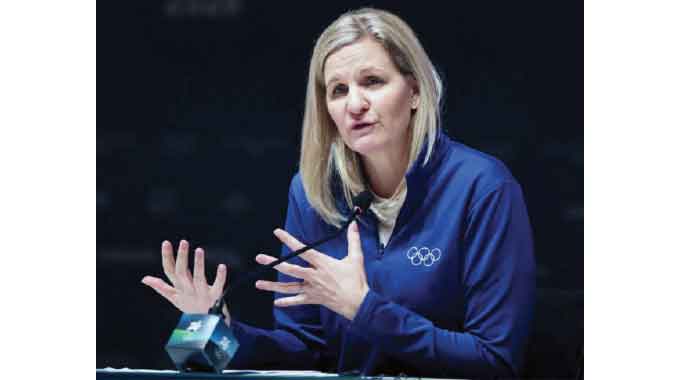
THE International Olympic Committee has admitted that it is “distracting and sad” that the build-up to the Winter Olympics has been dominated by the deployment of ICE agents to Milan-Cortina and the appearance of the Los Angeles 2028 chair, Casey Wasserman, in the Epstein files.
However, Zimbabwean Kirsty Coventry, the IOC president, insisted that once the Games begin on Friday, their “magic and spirit” would take over.
Coventry refused to comment directly on the protests in Milan against immigration and customs enforcement agents and said she hadn’t spoken to Wasserman, who has apologised for flirty emails sent to Ghislaine Maxwell in 2003 when he was married, which only surfaced last Friday.
However Coventry did accept that such distractions were far from ideal.
“I think anything that is distracting from these Games is sad, right?” she said. “But we’ve learned over the many years that there’s always been something that has taken the lead up to the Games, whether it has been Zika or Covid, there has always been something.
“But what is keeping my faith alive, is that when that opening ceremony happens and those athletes start competing, suddenly, the world remembers magic and the spirit that the Games have. And they get to suddenly remember what’s actually important, and they get to be inspired.”
Saturday’s protest against ICE in Piazza XXV Aprile in Milan, a square named after the date of Italy’s liberation from Nazi fascism in 1945, drew hundreds of demonstrators.
Milan’s Mayor Giuseppe Sala has also said that ICE agents, who will accompany the US vice-president JD Vance to Friday’s ceremony, are not welcome.
The appearance of Wasserman in the Epstein files, and reports that another IOC member is also in the emails, have been another distraction.
“I’ve not been in contact with Casey,” added Coventry. “The focus has fully been on Milano-Cortina. In terms of IOC members, we’re obviously watching and monitoring the media, and we’re aware of a few things that have been reported just today. We need some time to look into that.” At the helm of the IOC for seven months, Coventry is finally expected to set the course of her mandate in Milan, sketching out her vision for the future of the Olympics.
The Zimbabwean former swimmer, the first woman and the first African to lead the International Olympic Committee, is likely to give clues to the movement’s future direction in meetings on the eve of the 2026 Milan-Cortina Winter Olympics.
Coventry, who at 42 is also the youngest IOC leader since Pierre de Coubertin, has embodied a promise of renewal since her election.
But the outlines of that change have been slow to emerge.
As she promised during her election campaign, Coventry began her eight-year term by launching several working groups in June.
However, on the highly-charged issue of the access to women’s events for transgender and intersex athletes, she is awaiting further clarity before making decisions.
One of the working groups, called “protection of the women’s category”, will address the issue of transgender and intersex athletes.
Another centres on the Olympic programme, seeking to strike a balance between the size of the Games, the relevance of sports, and that of individual disciplines.
The progress of the committees will be revealed for the first time during the IOC Executive Board meeting from Saturday to Monday, then discussed Tuesday and Wednesday in Milan by around 100 members of the Olympic body for an IOC Session, ahead of the opening of the Games on Friday.
One aim is to redesign the Olympic sports programme — even if that means blurring the boundary between summer and winter events, should cyclo-cross or cross-country or trail running be included as early as the 2030 Games in the French Alps.
Other aims are to rethink the way the Games are allocated, adapt their economic model, and give a fresh impetus to the Youth Olympics.
The scientifically complex and politically explosive issue of protecting the women’s category has been thrust back into the spotlight by the adoption of genetic testing in athletics, swimming, boxing and skiing.
The bodies concerned want to reserve women’s events for athletes carrying XX chromosomes, banning both transgender and “intersex” athletes, defined as those considered female from birth and often unaware of their genetic or hormonal particularities.
A decision on this issue will definitely not be on the Session agenda, Coventry said last week. Having initially promised in December to make a ruling “in the first quarter” of 2026, she is now speaking of “the coming months.”
Her timetable is constrained: with Los Angeles hosting the 2028 Summer Olympics, US President Donald Trump has banned transgender women from all women’s competitions by executive order, encroaching on the IOC’s prerogatives in his first months in office.
Coventry “will probably wait until after the World Cup this summer for a first meeting with Trump. But at that point, there will have to be a policy”, said Jean-Loup Chappelet, a specialist on Olympic issues at the University of Lausanne. Since 2021, the IOC has recommended that international federations adapt eligibility rules to each discipline, backed by scientific data, without assuming that intersex traits or transgender identity systematically confer an unfair advantage. Can Coventry maintain this nuanced line, at the risk of a confrontation with Trump?
It is hard to anticipate, since the working group dedicated to gender is the only one whose composition the IOC has kept secret, in order to “protect” its members from harassment. — the guardian.com/AFP.