Online Reporter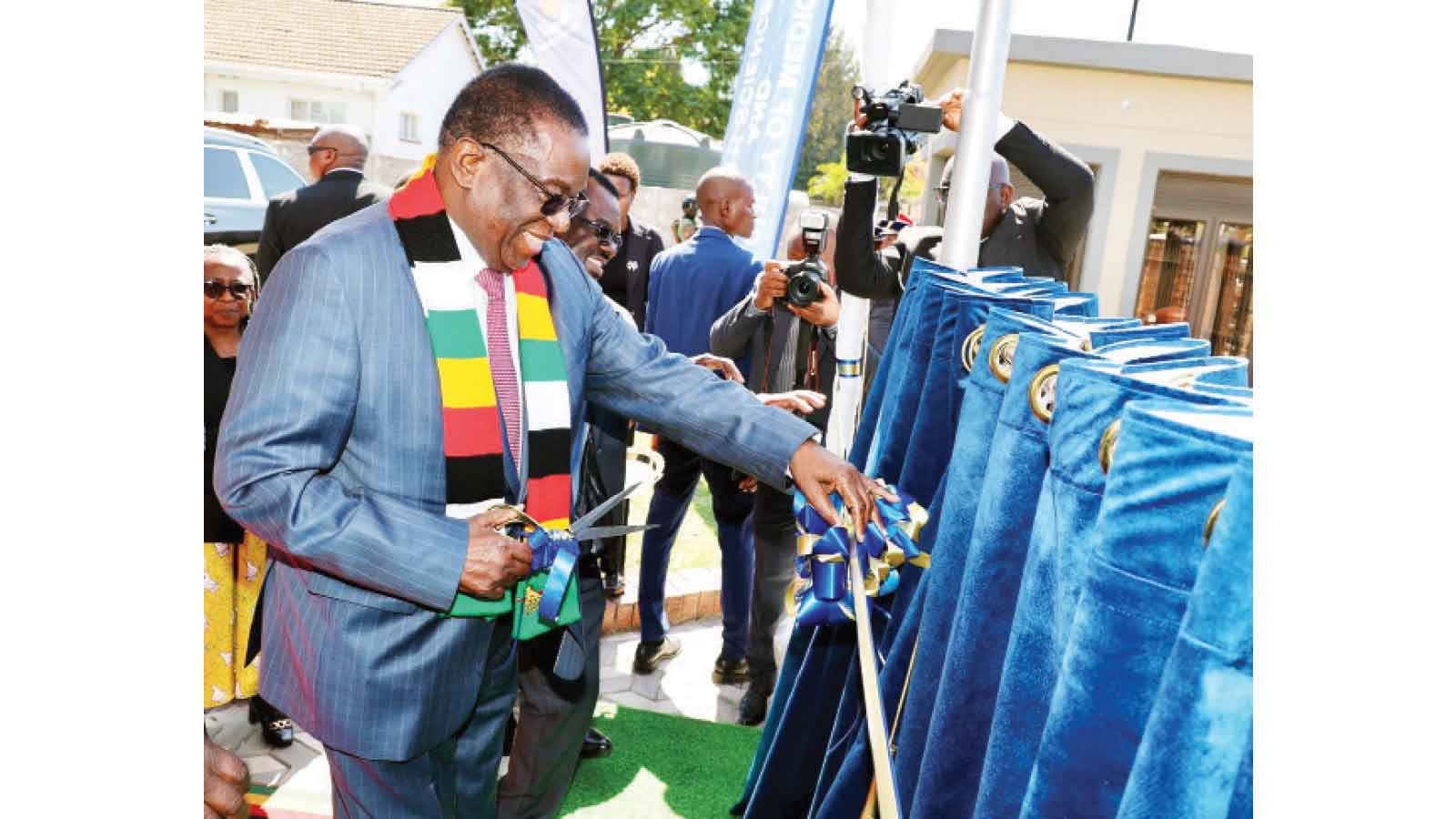
Zvamaida Murwira
Senior Reporter
PRESIDENT Mnangagwa has hit out at unscrupulous businesspersons in the health sector who operate as cartels and syndicates to inflate costs of goods and services for self-serving objectives, prejudicing patients.
The President, who is also Chancellor of all State universities, made the remarks in his keynote address after touring and commissioning the University of Zimbabwe Industrial Incubation Centre in Msasa and the Specialists Medical Centre in Avondale.
“The Ministry of Health and Child Care, together with related agencies, are directed to remove the barriers of entry in the establishment of specialist healthcare facilities and services. Hatidi magatekeepers, nemacartels muhealth sector, vanhu vedu vachitadza kurapwa zvakanaka, nemutengo uri pasi. Kwete. Ngative nehanya, tikoshese hutano hwevanhu vekwedu,” said President Mnangagwa.
“My Government will not accept the prevalence of the opportunists and so-called health sector ‘cartels and syndicates’, who operate to the detriment of our people. Let those with ears hear this stern exhortation.”
He commended the University of Zimbabwe, saying the health centre had shown that innovation was not just about creating new products, but also about revitalising and repurposing existing infrastructure to best suit the current national realities.
“The newly-established Specialist Medical Centre further complements the ongoing Government’s Presidential Hospital Renovation and Modernisation Programme. Going forward, Vice Chancellor (Professor Paul Mapfumo), it is my hope that the Quinary Hospital currently under construction will soon be completed to augment the present reforms towards the modernisation of our national health delivery system and the realisation of Universal Health Coverage,” he said.
“Meanwhile, I call upon the University, along with other upcoming health facilities, in both the public and private sectors, to deliberately ensure that new facilities are equipped with modern, state-of-the-art equipment that compares well with others in developed jurisdictions. All investments in the health sector should translate to improved health delivery and associated foreign currency retention, where our people travel less to other countries for health care.”
He commended the UZ for coming up with two signature developmental projects, saying the institution was playing an integral role in driving the Heritage-Based Education 5.0 being spearheaded by the Government.

“Such projects validate the success of the Heritage-based Education 5.0 Model that continues to position our higher and tertiary institutions as critical cogs in the ongoing industrialisation, modernisation and development of our economy,” he said.
He described the UZ Industrial Incubation Centre as a commendable initiative, saying it reflected the institution’s commitment to providing the requisite leadership in the country’s higher education space to drive national development.
“This is more so that the incubation centre is the endpoint where start-ups shall be developed towards commercialisation and market participation. This is after ideas commence and are nurtured in the laboratories and workshops, moving through the Innovation Hub for prototyping, product development and startup registration,” he said.
“It is impressive that the startup companies hosted in the industrial incubation centre are student-led, resulting from their final year projects, research and scholarly work. Under my administration, promising innovations will continue to be granted innovation hub status and supported by Government. I am confident that this approach will provide impetus for our young talented students to develop their ideas into products, goods and services.”
He said there was scope for the student-led start-up companies to produce goods and services required by the country’s economy and help to reduce the US$2,5 billion import bill being spent in the manufacturing sector.
“Judging from the crop of confident and innovative Executives of Start-up companies, our country is indeed on the right path of irreversible industrialisation and modernisation. I challenge the Ministry of Higher and Tertiary Education, Universities along with stakeholders in Industry including financial institutions, to scale up support for Start-Up companies emanating from the Heritage Based Education 5.0 Model,” said President Mnangagwa.
“Through the ‘Whole of Government and Society Approach ‘, let us continue to give our young talented boys and girls a chance to develop their ideas and exploit their full potential for the benefit of our beloved motherland, Zimbabwe.”
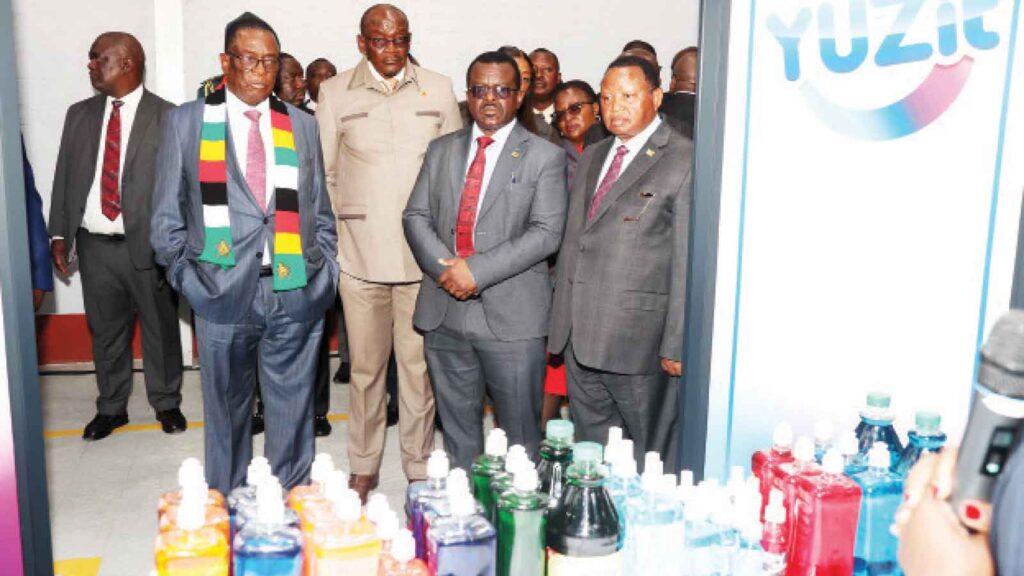
President Mnangagwa said it is encouraging that UZ was now celebrating the successful outcomes of 11 Start-up companies, resident at the Industrial Incubation Centre.
“The University of Zimbabwe Industrial Incubation Centre must thus not merely be a workspace for graduate innovators, but steadily evolve into an industrial production hub that supports manufacturing, technology development, value addition and enterprise growth. To this end, our Small to Medium Enterprises and other established industries should find value at the Industrial Incubation Centre, given the wide range of services offered at the facility,” he said.
President Mnangagwa said universities must play their part and take responsibility for the country’s needs through research, science, innovation and technology.
“The exhibits and displays, I have always witnessed from the University Research-Innovation Industrialisation Ecosystem, demonstrate unprecedented progress in repositioning our universities as solution-driven agents for the development of our beloved motherland, Zimbabwe. The wide range of products and services, which cover the critical sectors of our economy, is a reflection that we can achieve Vision 2030 and build the Zimbabwe we all want, through our own capacity and skills,” he said.
He commended the institutions for taking a wide range of research and innovation initiatives such as smart agricultural equipment, solar-powered systems and drone technologies for precision agriculture, saying it dovetailed with the current agro-industrialisation thrust.
“It is my expectation that developments in this direction ultimately help farmers increase productivity, reduce post-harvest losses, optimise irrigation systems and modernise agricultural production systems,” he said.
On value addition and beneficiation of minerals, President Mnangagwa said his Government had assigned State Universities the responsibilities to ensure that the country achieves high-value outputs from the country’s natural resource endowments.
“The establishment of the National Minerals Research Centre that facilitates the value addition of a variety of minerals, including lithium, rare earth elements and uranium, among others, is now urgent. As Chancellor, I want to emphasise the importance of this strategic national assignment, which I require Universities to carry out with utmost diligence, honesty and integrity, for the benefit of both present and future generations, in our motherland, Zimbabwe,” he said.
The event was attended by Vice President Kembo Mohadi, Cabinet ministers, Vice Chancellors from other institutions of higher learning, academics, captains of industry and senior Government officials.