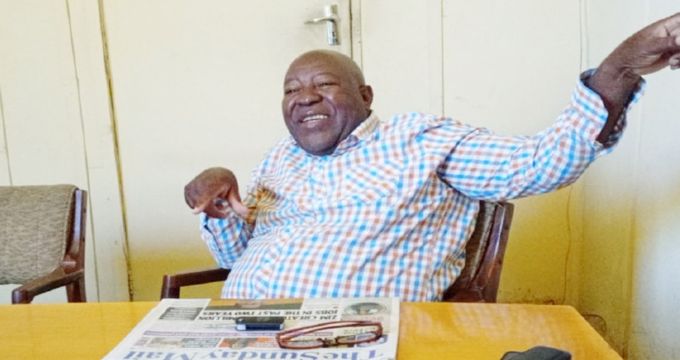
WE continue our interview with Cde Jabulani Petshu Sibanda, whose pseudonym was Cde Qinisela Ncube. During the liberation struggle, Cde Petshu Sibanda served in ZAPU’s intelligence unit, the National Security and Order (NSO), headed by the late National Hero, Dumiso Dabengwa.
In our previous instalment, Cde Petshu Sibanda revealed how his family carved its own place in Zimbabwe’s liberation history, with two of his brothers, Kipro and Ndabaningi, crossing into Mozambique to join ZANLA, the military wing of ZANU, while he and his elder brother Douglas joined ZPRA, the armed wing of ZAPU, in Zambia. Today, Cde Petshu Sibanda continues his account, reflecting on his journey to join the armed struggle through Botswana.
MS: In our last conversation, you spoke about the incidents that inspired you to join the armed struggle. Please take us through your journey.
Cde Petshu Sibanda: Let me take you back a little. There was Lithern, umntaka mama omncane, our cousin in English, who was related to the Khutshwekhaya family. He had joined the armed struggle and moved to Mozambique during the ZIPA era (Zimbabwe People’s Army, an amalgamation of ZPRA and ZANLA). He was part of the group led by Gilbert Khumalo, also known as Nicholas Nkomo, who later became a member of the ZPRA High Command.
When things failed to work out in Mozambique, they traversed the country as a unit of six guerrillas, but Gilbert Khumalo was not part of the six. They had a contact in Chief Mafala’s area in Zvishavane. Lithern was injured, but they managed to reach the Khutshwekhaya homestead where they concealed their arms. Word eventually reached the colonial forces and the Khutshwekhaya farm was raided, with the regime descending heavily on the family. That incident inspired us to join the armed struggle. I left Bulawayo in early 1978 in the company of a friend, Themba Masuku. We travelled to Plumtree, where we stayed at the home of Themba’s uncle. From there we walked towards the Botswana border. I remember arriving at a homestead belonging to MaDube. It was there that we encountered Rhodesian forces. However, we managed to evade them and walked for about an hour and a half before reaching the border. After crossing into Botswana, we were warmly received by the Batswana people. They were very friendly and took us to the police, where we found many others. We eventually became quite a sizeable group. From there we were driven in a Chevrolet truck to Francistown. Along the way, some were singing: Saze sangena kwamanye amazwe lapho okungazi khona ubaba lomama. In Francistown, we were taken to the police station where our fingerprints were recorded before being transferred to the refugee camp.
MS: What was the situation like at the refugee camp?
Cde Petshu Sibanda: There were many people there and we were vetted by the security units. I did not stay long because the authorities asked whether there was anyone with a driver’s licence. I held a Class Two licence. In fact, all my father’s sons joined the armed struggle while already possessing Class Two licences because we used to drive vehicles for our family business. When those with licences were asked to step forward, I did not hesitate. From the refugee camp, we were taken away.
MS: Where were you taken?
Cde Petshu Sibanda: We were taken that was myself and another guy to the ZAPU headquarters, Zimbabwe House, in Francistown. We underwent induction processes conducted by the security department. What also worked in my favour was that my father, Petshu Sibanda, was a well-known businessman who was close to nationalist leaders, including Joshua Nkomo. My father also supported guerrillas in whatever way he could.
MS: Who did you find at the offices?
Cde Petshu Sibanda: Among those present was the ZPRA commander for the Southern Front (SF), Cde Makepesi Tshuma. SF covered Matabeleland South, Midlands districts such as Mberengwa and Zvishavane, as well as Mwenezi District in Masvingo Province. Ideally, the front was supposed to extend as far as Manicaland. Also there was Black Swine Mnyamana, whose real name was Elliot Sibanda.
MS: What role did you play after being deployed to the Southern Front headquarters?
Cde Petshu Sibanda: After my induction, despite not yet having received full military training, I was entrusted with important tasks. We had several vehicles, including a white Bedford seven-tonne truck. From time to time we travelled north to receive guerrillas arriving from Zambia on their way to deployment in the Southern Front areas such as Mangwe, Kezi, Gwanda, Beitbridge and Mwenezi. I was among those tasked with driving the vehicles transporting the guerrillas.
It was a delicate assignment because, although the Botswana government sympathised with our struggle, it did not permit armed forces to pass through its territory carrying weapons openly. We would therefore transport the guerrillas picking them form the north near Caprivi Strip before crossing through Botswana.
We had a stopping point about 15 kilometres before Francistown where there were gum trees, and we would pause there briefly to assess the situation.
During one of these assignments, we were ambushed by the Botswana Defence Forces (BDF), and an ugly incident almost erupted. The potentially explosive situation was only defused by the timely arrival of Makepesi. The BDF had even deployed an armoured personnel carrier. It appears they suspected our forces were Selous Scouts.
When Makepesi arrived, both my assistant driver and I had already been forced out of the vehicle. The comrades we were transporting had cocked their weapons. To this day, I still do not know exactly how the matter was eventually resolved or how the comrades proceeded from that point.
MS: There was later a raid by the Rhodesian Selous Scouts on the ZPRA headquarters, during which Cde Makepesi Tshuma was captured. Where were you at the time?
Cde Petshu Sibanda: On that fateful night I was somewhere in Francistown, though not at the headquarters. Had I been there, I might also have fallen victim to the Selous Scouts. Besides Makepesi, the administrator, Cde Zondo, a female comrade, was also captured. The Makepesi story remains unresolved because those who were taken were never seen again. The Selous Scouts also seized several items, including the Bedford truck that had been assigned to me. I continued working at the Botswana headquarters alongside Black Swine until I was later sent to Zambia for training.
MS: Before you tell us about Zambia, our readers may want to know more about Makepesi. What kind of guerrilla was he?
Cde Petshu Sibanda: Makepesi was a brave man and a strategist who understood the revolution very well. Although I was still inexperienced in military affairs at the time, I admired the manner in which he carried out his duties. His briefings to guerrillas being deployed to the front were excellent.
He would explain what to expect on the ground and warned comrades to be wary of enemy forces, particularly the Selous Scouts, who often disguised themselves as freedom fighters and committed atrocities in an attempt to alienate the masses from the guerrillas.
MS: What happened when you eventually arrived in Zambia?
Cde Petshu Sibanda: We boarded an aircraft to Zambia and landed at Lusaka International Airport. From there we were taken to the famous Nampundwe Transit Camp. You have written extensively about conditions at Nampundwe, including how new arrivals were deceived into believing they would be meeting Joshua Nkomo, only to discover that it was part of the introduction to the camp’s tough military drills. I stayed there like any other recruit before being selected for security training.
MS: Which camp were you sent to?
Cde Petshu Sibanda: I received my training at Moscow Camp in Zambia, which was a security training school.
ν To be continued next week, with Cde Petshu Sibanda recounting his experiences at Moscow Camp, where some of his peers included former Zimbabwe Republic Police Deputy Commissioner-General Levy Sibanda