Online Reporter
Patrick Chitumba and Freedom Mupanedemo, Midlands Bureau
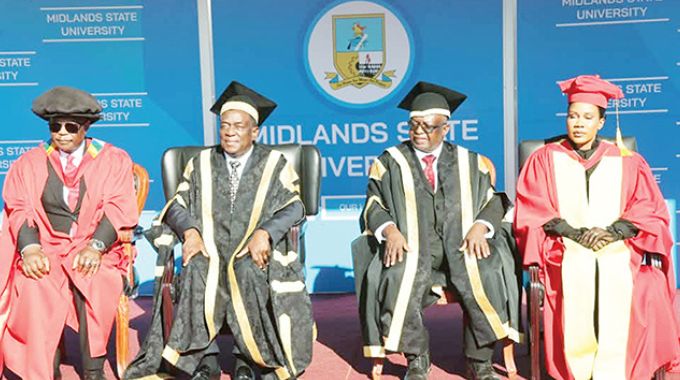
IN a significant human capital boost for Vision 2030 success, President Mnangagwa yesterday presided over the graduation of a record 7 888 students from Midlands State University (MSU) as the institution continues to align its programmes with the country’s transformative development aspirations.

The 27th graduation ceremony, held at the state-of-the-art Emmerson Dambudzo Mnangagwa Law School in Kwekwe under the theme: “Knowledge, Innovation, Enterprise: Building a Self-Sufficient Zimbabwe”, saw thousands of young graduates take a major step towards joining the workforce, with 55 percent of the graduands being women.

The milestone comes as universities increasingly embrace Education 5.0, with greater emphasis on producing graduates who can apply knowledge through innovation, industrialisation and enterprise to address national development challenges.
Addressing thousands of graduates, parents, academics and Government officials, MSU Vice Chancellor Professor Victor Muzvidziwa described the ceremony as a moment of national significance, saying it celebrated years of sacrifice, discipline and intellectual labour while reaffirming the university’s contribution to human capital development in support of NDS2 and Vision 2030.
“Today we graduate 7 888 graduands, drawn from the university’s 10 faculties, 55 percent female and 45 percent male, 6 631 graduated with Honours Degrees, 1 027 with Master’s Degrees, and 19 with Doctor of Philosophy (PhD) or Doctor of Business Leadership Degrees,” he said.
“One student graduated with an MPhil and four were international students.”
Beyond the sheer numbers, the graduation highlighted the changing skills profile of Zimbabwe’s graduates, with 39 percent completing degrees in critical skills disciplines, mainly in science, technology, engineering and mathematics (STEM).
This means thousands of graduates are entering the next stage of their lives equipped with skills that are central to the country’s industrialisation, innovation and economic transformation agenda.
Prof Muzvidziwa said the university had also graduated its inaugural cohorts in the Bachelor of Biomedical Sciences; Bachelor of Engineering Honours in Electrical and Electronic Engineering; and Bachelor of Engineering in Fuels and Energy Engineering.
“This demonstrated the university’s responsiveness to Zimbabwe’s human capital needs in strategically important areas,” he said.
The new programmes are expected to strengthen the pipeline of specialised skills needed in areas ranging from healthcare and energy to engineering and technology, reinforcing the role of higher education in supporting national development.
The Vice Chancellor also recognised distinguished graduands who have contributed to national service.
These included Colonel Miniyothabo Francisca Baloyi-Chiwenga, wife to Vice President Dr Constantino Chiwenga, who graduated with a Doctor of Business Leadership; Advocate Canaan Dube, founding chairperson of the MSU Council, who also graduated with a Doctor of Business Leadership; and High Court Judge Justice Gibson Mandaza, who graduated with a Master of Laws in Constitutional and Human Rights Law. Zimpapers Group Digital Services Executive,Mr Elias
Mambo, also graduted with a Masters of Commerce Degree in strategy and innovation.
The record graduation represents more than an academic milestone for MSU as it adds thousands of skilled Zimbabweans to the country’s human capital pool at a time when Government is pushing universities to move beyond producing job seekers and towards creating innovators, entrepreneurs and professionals capable of driving the national economy.
With the majority of the graduands being women and a growing proportion emerging from critical skills disciplines, the ceremony also reflects the expanding contribution of Zimbabwe’s young people to the country’s journey towards an upper-middle-income economy by 2030.
“To all our graduands, this occasion is testimony of your resilience, sacrifice and unwavering focus. We celebrate you,” said Prof Muzvidziwa.
He said Education 5.0, anchored on teaching, research, community service, innovation and industrialisation, remains the university’s guiding philosophy.
Prof Muzvidziwa reported continued student success on national and international platforms.
“Munyaradzi Nemailinga and Theophelus Madzinga from Computer Science won first position at the Zimbabwe International Trade Fair innovation competition held from 20 to 25 April 2026,” he said.
Nigel Basarokwe, Tadiwa Njimaima and Thabelo Dumani triumphed in the Data Track category of the AI for Impact Challenge hosted by POTRAZ and Econet in Nyanga from 27 July to 1 August 2026.
“Their winning project, INZWI, is a WhatsApp and web-based platform that crowdsources text-audio data pairs for Zimbabwe’s indigenous languages, beginning with Shona and Ndebele,” said Prof Muzvidziwa.
On law, he said the MSU Moot Court team was crowned World Champions at the 18th Nelson Mandela World Moot Court Competition at the United Nations headquarters in Geneva, Switzerland.
“This marks the second consecutive year MSU has claimed the title. The Faculty of Law has introduced Space Law and Cyber Law modules and made Environmental Law compulsory within the LLB programme in line with NDS2, and has joined the Global Network on Environmental Law Clinics,” he said.
Prof Muzvidziwa said MSU was translating research into public goods, adding that the university had patented a chemical formula to modify coal tar using silicon nanoparticles as a cheaper road-surfacing alternative.
He announced that the technology has now been applied to the construction and tarring of a five-kilometre road connecting the ED Mnangagwa Law School through Amaveni to Kwekwe town.
“This realised the graduation theme and the Heritage-Based Education 5.0 philosophy, and the university intends to become a major supplier of affordable, durable road surfacing material,” he said.
The VC also cited the water treatment project at Holy Cross Dam, where a modular chlorine production and treatment plant designed by a final year engineering student has been installed and is in its optimisation phase.
“The project will deliver clean and safe water to communities in Chirumhanzu, and the university is open to partnering local authorities to scale it,” he said.
Prof Muzvidziwa noted that the university’s start-up ecosystem is thriving, with its handcrafted organic soap enterprise now stocked in pharmacies across the country.
On infrastructure, he said MSU is using a public-private partnership model with the Public Service
Pension Fund to provide state-of-the-art hostel accommodation.
Prof Muzvidziwa also noted that the university has constructed a one-million cubic metre dam at
Pitscottie in Kwekwe, and is working with partners to develop 800 hectares of irrigable land at
Pitscottie farm.
“There are plans for an aquaculture and fisheries project at Pitscottie Dam in response to
Government’s target of a US$1 billion fish industry by 2030 under NDS2. With national fish consumption estimated at between 85,000 and 95,000 tonnes annually against domestic production of 35,000 to 40,000 tonnes, the project will help close the supply gap and improve food security,” he said.
“This supports the Education 5.0 agenda on agro-enterprise, food security and institutional self-sufficiency,” added Prof Muzvidziwa.
He said using internally generated resources, the university has built an Infant School to open to the public this September.
“It will serve teacher training, staff advancement and research in maternal and child development,” said the Vice Chancellor.
He said MSU remains a trailblazer in gender-transformative practice. Through its Gender Institute, gender has been mainstreamed into curriculum, planning and policy.
“The Anti-Sexual Harassment Policy, with clear reporting and awareness campaigns, continues to promote a safe environment,” he said.
However, the Vice Chancellor said infrastructure development on some projects such as the main library, and the 703-bed capacity hostel, remains unfinished.
“Staff retention remains a major challenge, but we remain confident that through prudent resource management and the goodwill of our partners, these constraints will be overcome,” he said.