

 Online Reporter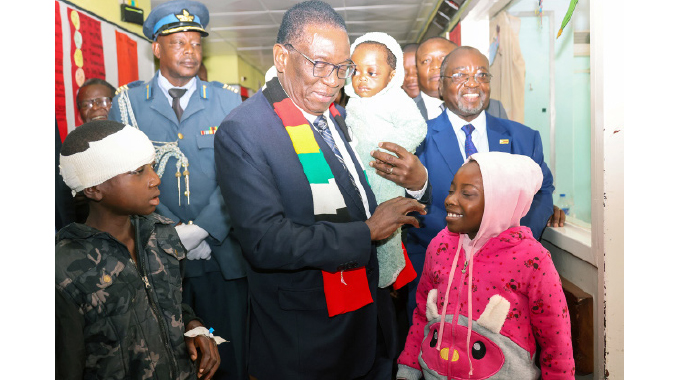
Fungi Kwaramba-National Editor
ZIMBABWE’s health sector is set for a major overhaul following President Mnangagwa’s unannounced visit to two major referral hospitals in Harare yesterday, where he saw first hand the dire conditions facing public health facilities.
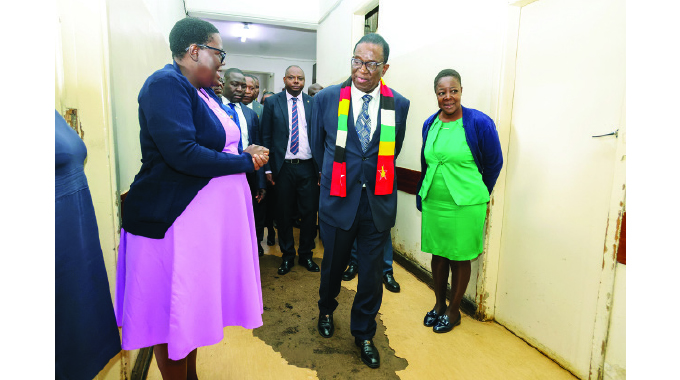
Using a private motorcade, the President made his way, first to Parirenyatwa Group of Hospitals and then later to Sally Mugabe Hospital, stopping even at traffic lights.
Unencumbered by bureaucratic red tape, President Mnangagwa made his way to Parirenyatwa Hospital Paediatric Unit, where life is supposed to begin but is being hampered or even prematurely ended because of a lack of essentials.
The President was accompanied by Chief Secretary to the President and Cabinet Dr Martin Rushwaya, Deputy Chief Secretary Reverend Paul Bayethe Damasane and Deputy Chief Secretary (Presidential Communications) Mr George Charamba.
In an interview last night, Mr Charamba, who is the Presidential Spokesperson, said going forward, President Mnangagwa will make more such impromptu visits to get an appreciation of the reality on the ground.
“The President has indicated that there will be more and more of these unannounced, unscheduled visits to get him to see what happens on a day-to-day basis when things are not pre-arranged. Because when we do these visits through invites, there are lots of falsehoods. We are given a gloss which is not exactly what the President wants,” he said.
“The President wants to see reality which is faced by the patient. So one would say that from this particular experience, the President, for the first time, saw things from the point of view of the patient. It was so clear that our health system is designed in such a way that several people, distressed people, are being left behind. That is essentially what the President wants to correct”.
Mr Charamba said the President has been getting worrying reports on the state of the country’s health sector and decided to go see for himself in order to remedy the situation.
Apart from receiving reports from the Vice Presidents, the President also regularly receives updates from his deputy chief secretaries.
“But more critically, the First Lady has been paying some unscheduled visits to central hospitals. She brought back some very sad news in terms of the situation in the hospitals. Then from the media, from the members of the general public, we have been getting reports that are more or less negative. This is what in fact got the President to think of paying an unannounced, unscheduled visit to the two central hospitals serving Harare,” said Mr Charamba.
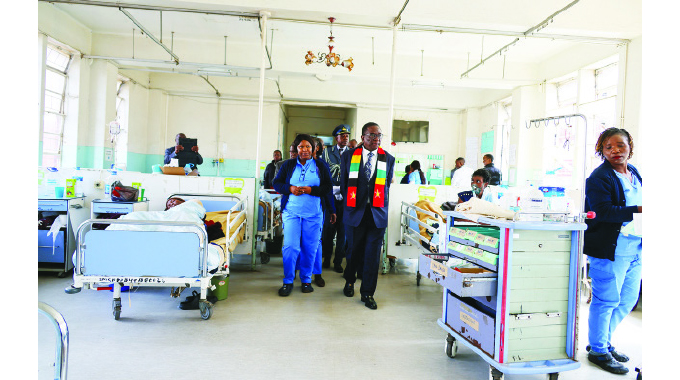
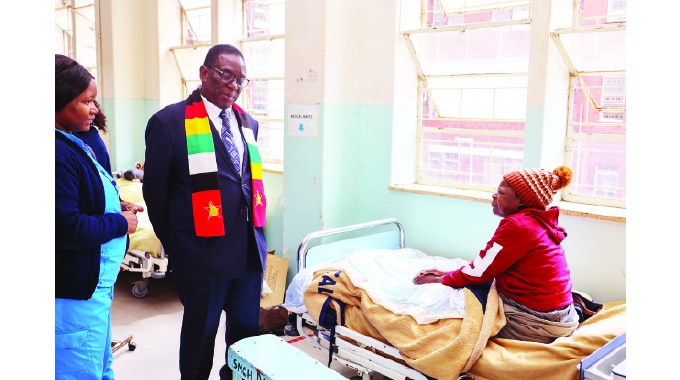
At the two hospitals, President Mnangagwa visited the paediatric wards and maternity wings, interacting with patients, nurses and doctors.
He also visited specialised units like X-ray sections to understand how things are in those areas which are so critical to diagnostic medical examinations.
“You might appreciate the outpatient is that point of contact between the unwell and the caregivers. So really it becomes a key point in terms of telling you the state of affairs in the health sector,” Mr Charamba said.
“And when it comes to the maternity wing, that’s where life begins, right? This means it was very important for the President to get an appreciation of how that facility is running, lest you have life being nipped in the bud, as indeed we then established. When the President got there, he was quite shocked with the state of affairs in the health sector. Everything that can go bad did go bad. Everything that could break is broken.”
The imposing facades of Parirenyatwa Group of Hospitals and Sally Mugabe Central Hospital, once symbols of hope and healing, now stand as stark reminders of a healthcare system teetering on the brink.
Inside their crumbling walls, a silent crisis unfolds daily, where patients battle not only their ailments but also a system struggling under the weight of neglect, resource shortages, and a chronic lack of investment.
“It’s suggesting a state of general neglect, which has been getting the facilities to deteriorate over a long period without anyone taking concern or care. You go to the state of equipment, you have equipment that has long been broken, equipment that is so critical but is unavailable because it’s broken or the numbers are just too small for the numbers that need the services of that equipment. So that was a key area, and it’s across the board. It was very evident we need to not just repair but also bring in new high-tech equipment to make sure that we are well equipped for health delivery,” said Mr Charamba.
However, there is a paradox in terms of drug availability at the hospitals and at the source, NatPharm.
“You go to the supply of drugs, there the President met with a paradox. In the wards, in hospitals, where drugs are needed and used on patients, the supplies were threadbare. But beyond that, there were certain item lines which were just not available, including basic things like paracetamols. If you consider that, I mean, these are referral hospitals. It means all the shortcomings you will have had at the primary level in clinics must not replicate themselves at a referral hospital, which is in fact where the buck stops,” Mr Charamba said.
He said that was the situation that the President came face to face with.
“And I said it was a paradoxical situation because when he then visited NatPharm, he discovered there was a glut of drugs. Yeah, the essential drugs and other consumables that are short in hospitals yet they are abundantly stocked and warehoused at NatPharm.
“We ask what is the real problem, and then we are told part of the consignment at NatPharm belongs to donors who release these on the basis of their own priorities, but not on the basis of the priorities felt by the administrators of health institutions. More critically, we are also told that there are certain items which are not a priority to donors, which in fact should be met from the national budget, but which are available. So you have financial prudence operating in conflict with the urgency that is expected in hospitals. And that creates a very, very negative situation from the point of view of the patient who deserves the best and must be served,” Mr Charamba said.
Apart from the slow movement of drugs, another concern was overcrowding.
“The basic things like screening curtains, in the case here, there was nil, nil, nothing. You only saw rails that suggested that once upon a time we used to have screening curtains to enhance the privacy of a patient when they are being attended to. Those rails show that they were last used maybe some years back, indicating that this is really a problem that has been building over the years without anyone ever worrying,” Mr Charamba said.
Further, he said the President also interacted with a depressed workforce.
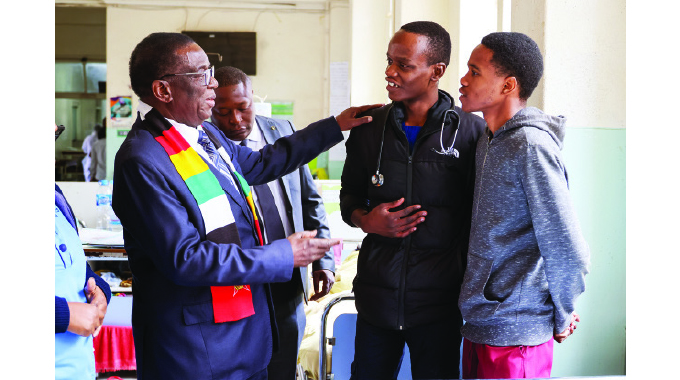
“Not just depressed because of the conditions of service, but also depressed because they just don’t have sufficient tools of the trade. Some of them actually spoke about how their own consciences were weighed down by the fact that patients they could have saved were lost simply because certain basic and simple tools of their trade were unavailable. Yes, it was a very sad state of affairs and the President couldn’t just believe what he was watching, but he was able to get an appreciation. He was also able to get to know weak points in the overall health matrix and the health delivery system,” said Mr Charamba.
He said it was clear the problem even goes beyond the Minister of Health and Child Care.
“It relates to the Ministry of Finance (Economic Development and Investment Promotion) and how promptly it responds to requirements. It is also clear that there is an over-bureaucratised health delivery system”.
Unardoned by Ministry of Health officials, the President wanted to put his finger on the pulse of the country’s health delivery system.
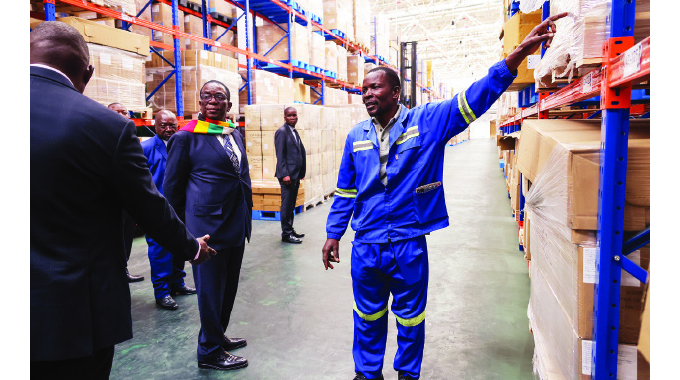
In this picture collage, President Mnangagwa engages staff during his impromptu visits to Sally Mugabe Central Hospital, Parirenyatwa Group of Hospitals and NatPharm Warehouse in Harare yesterday. Improved healthcare services are among the Second Republic’s priorities. During his visit to Belarus recently, the President witnessed the signing of an agreement to upgrade the country’s major hospitals. – Pictures: Presidential Photographer Mike Muswere.
“I think because he bypassed the bureaucratic structures, he was able to get a peek into how our systems function or do not function as was the case in this case. Clearly, we need to fire on all cylinders and make some interventions which are far-reaching and really that’s the picture which the President had today.
“On a lighter note, the President used a private motorcade. No sirens, no outriders. It was just a small cade and we all fitted in. For the first time and I have been in Government since 1986, I saw the motorcade of the President obeying traffic rules. In fact, when we got to Southerton, the private cade ran into a traffic jam and this driver with a big truck was trying to push his way through the motorcade without even realising this was the Head of State. The President waited until this truck driver manoeuvred this huge truck into the other lane and then allowed the motorcade to pass,” said Mr Charamba.



Leading from the front