

 admin
admin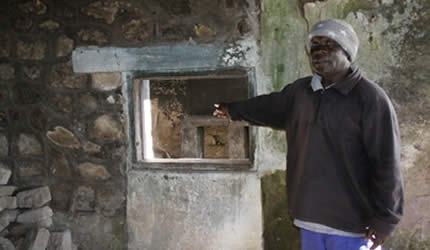
1975 into a museum.
The stone building was used as a girls’ dormitory where recruits would sleep in on their way to join the liberation struggle in Mozambique.
Speaking at the burial of the late Mbuya Tangwena on Thursday, President Mugabe, said they had to abandon their breakfast to escape from the Rhodesian law enforcement agents who were trailing them with the late national hero, Cde Edgar Tekere on their way to lead the struggle in Mozambique.
“When we arrived at Nyafaro, the message was conveyed to the late Chief Tangwena that we were in his area. He came and expressed his dissatisfaction about our stay at Nyafaro since Rhodesians would make constant raids at the place. Breakfast was prepared for us and it was just tea and buns.
“Ndakanga ndakabata bhanzi ndavakudya apo vakanga vakatichengeta vakangavakadyarana kubva kwaRusape kusvika Nyafaro vaiti vakaona mota ichiuya vaitumira shoko kune varimberi. Kungoti mota chete, whether a friendly car or not, it had to be reported to others. We were told that there was a vehicle coming to Nyafaro and had to abandon our breakfast.
Read More…
“Zvakanzi kwete hamuchabudi nekumberi asi nekuhwindo. VaTangwena vakabuda naVaTekere ini ndokubuda nepahwindo rakatarisa kumunda. Takanosanagana mberi tichienda kumba kwaVaTangwena avo vaigara pasi pechikomo pakanga pakahwanda,” said President Mugabe as he narrated his journey to Mozambique.
President Mugabe bemoaned the poor state of Nyafaro Secondary School and promised to intervene.
“I was told by Cde Mutasa (Didymus) that Nyafaro is in a sorry state and we will see how we can come in to assist. When we escaped through the window we never thought that we were leaving behind history that would inspire others to preserve the legacy of the liberation struggle,” said President Mugabe.
In an interview in the room President Mugabe escaped through the window, the headmaster of Nyafaro Secondary School, Mr Bernard Maoko, said as a school, they saw it befitting to renovate the building and turn it into a Robert Mugabe Memorial Library.
“The idea to have the building converted into a library was mooted in 1984 and due to lack of resources, the project failed to take off the ground. We even approached the late Vice-President, Cde Joseph Msika with our proposal and he was for the idea, only to be affected by the economic meltdown which hit the country. This time there in no going back on the project.
“We are happy to note that the Minister of Media, Information and Publicity, Cde Webster Shamu is also for the idea and he toured this place and advised us to be in touch with The Friends of Joshua Mqabuko Nkomo Trust.
“Our aim is to create a museum which will help to tell the history of the liberation struggle through pictures and other important books. We have since requested for the books which President Mugabe had when he came here that were hidden in the fields, but later picked up by the Rhodesians. We want them to be displayed in this museum,” he said.
Mr Maoko said they were mobilising their own resources to see the successful completion of the project.
“We have a budget of US$20 000 to complete this project. We have our own plantation where we will harvest timber to use. Well-wishers are welcome to chip in so that we can speedily complete this important project.
“It is our duty to preserve the country’s history for the benefit of future generations,” said Mr Maoko.
The following is the verbatim account of the crossing that President Mugabe gave during an interview with Power FM ahead of his 82nd birthday in 2006.
“It was on Saturday morning and we decided to leave in the afternoon of that day. Old Tangwena, late now, Chief (Rekayi) Tangwena at whose home we had slept was instructed by his wife to lead us. Mai Tangwena vaisvikirwa, vakati zvanzi izvo iwe Tangwena pachako tungamirira vana ava.
“So he accompanied us. There we were, we had two young men carrying our bags and I think there were five of us and we decided to cross the border.
“There was this big boundary road they called Bhinya. It was also called after the name of the person who was chief native commissioner . . . I will think of it.
“We had to cross the broad road, not tarred, but just a dirt road, gravel, not tarred because it was meant to facilitate the vigilance that the Rhodesians kept on the people.
“So we crossed, after looking at both sides of the road, we moved on and at night we had to cross rivers. There was a small river that we crossed and upon putting our shoes back, I could not distinguish the right from the left. Ndakaita saMbuya vangu vaimbouya kuchurch vakapfeka matennis vachiti yekurudyi yoenda uku (laughs pointing at his left foot).
“Ndakatozoona zuva ratobuda kuti that was the disaster that had attended my feet.
“You know the Tangwenas had been fighting for Gaerezi Ranch. It was that resistance, vaivingwa from time to time vachipfurwa. Ndiro chaidzo dzaiboorwa nemabullets kuti vabve, their children were all taken away to a school somewhere, but they resisted. We got to a village where two headmen vekwaTangwena decided to get away from this problem and settled on the Mozambican side, and two headmen had remained. So they were four.
“We were drenched, very wet and we needed fire, so early in the morning fire was lit for us outside. I noticed that my shoes had done harm to my toes and we were not prepared to continue. So we remained there for quite some time. Kwakanga kusina masoja eFrelimo akawanda, so we had to relay our presence to them, and from that place word was sent ahead that we were there and we then got to a base that was close to Tete, this place was called Vam-Vam.
“We were at Vam-Vam for quite some time, that’s where we met vana Mao and others who had been recruited in Highfield. From there we were taken along a road in the direction of a town yaimbonzi Villa Gouveia, now Katandika. It was while we were at Vam-Vam that Mozambique celebrated its independence. We stayed at Katandika for a month or two. From Katandika we were taken to Chimoio, and there we met many more and now we were moving with other comrades that we had met along the way.
“That is where we met vanaChamu (Oppah Muchinguri) vachiri vadiki and many others. We had some students from university, vana (Zororo) Duri, vana (Christopher) Mutsvangwa vana Gula Ndebele, vana (John) Mayowe, who had left university, we met them there.
“There were about 5 000 to 6 000 of us kuChimoio. It was a little outside the town, and then the governor decided that some of our cadres who had been trained who were in Tete should be informed about our presence. There were about three ladies and mukuru wavo akavatora ndiMai (Joice) Mujuru, and there were about four or five male cadres.
“So they came and saw us and came back, and we asked them to take control because they were trained cadres.
“So that was the journey, and all the while we were with Chief Tangwena, right up to the end taive naChief Tangwena, and when we came back, we came back with him also. He was quite a gallant cadre, very strong,” President Mugabe said.
The President was to gallantly lead the war effort from Mozambique for the next five years.
He participated in all the peace initiatives up to the Lancaster House Constitutional Conference where he tenaciously defended our right to holistic independence — only agreed to make some concessions when leaders of the Front Line States said their fragile economies could not continue sustaining the war effort where peace was an option.
On Sunday January 27, 1980, Cde Robert Mugabe made a triumphant return to Zimbabwe, five years after he crossed into Mozambique.
He and other cadres were welcomed by a crowd estimated at 1,6 million by the Zanu-PF information and publicity department, 200 000 by the BBC, 150 000 by the Rhodesian police, and 1 million — with a safety margin of 25 percent — by people who said they arrived at the figure by enlarging aerial photographs and calculating crowd density.


 Online Reporter
 dyton mupawaenda