admin
admin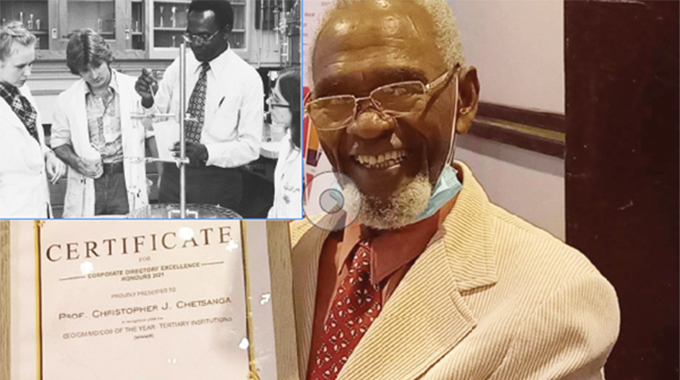
Eminent Zimbabwe scientist and academic Professor Christopher James Chetsanga (89) has served in various capacities in Government, private and other international bodies such as the African Academy of Sciences and The World Academy of Sciences and UNESCO among others.
He is widely remembered for discovering two enzymes involved in the repair of damaged DNA in 1979 and 1983. In this report, Sifelani Tsiko (ST) Herald Innovations Editor speaks to Prof Chetsanga (CJC) about his life, scholarly works and the country’s trajectory in science, innovation and technology development.
ST: Tell us briefly about your background – your Nhowe Mission childhood years and what drew you to study biochemistry?
CJC: I was born in Murehwa on 22 August 1935. I did primary education at Nhowe Mission, Junior Certificate (JC) at Old Mutare Mission and Matriculation Certificate at Tegwani Secondary Mission in Plumtree during 1956 to 1957. I got scientific research training in the US and Canada.
I was lucky to get student training fellowship grants.
My parents would not have had the money to fund my North American training costs. I taught at Nhowe Mission during 1958 and 1960. Nhowe missionaries sent me to do Bachelor of Science degree at Pepperdine University and University of California from 1960 to 1964 in the US.
ST: Can you tell us briefly about your journey to the University of Toronto, Harvard University and back to the University of Zimbabwe at independence?
CJC: I went to Canada to do a MSc degree at the University of Toronto in Biochemistry and Molecular Biology during 1965 to 1967. I also did a PhD degree at University of Toronto from 1967 to 1969 in Biochemistry and Molecular Biology. I did post doctoral research training at Harvard University in Biochemistry and Molecular Biology from 1969 to 1972, where I learned the gene cloning technology.
ST: Prof Chetsanga you discovered two enzymes involved in the repair of damaged DNA. Could you tell us briefly about the significance of this in the field of biochemistry?
CJC: It was when I was at the University of Michigan that I discovered two enzymes involved in repair of damaged DNA. I discovered a DNA glycosylase that releases a 7-methylguanine in DNA whose imidazole ring had been opened. I discovered a formamidopyrimidine DNA glycosylase that releases the opened imidazole rings of purines in DNA by gamma irradiation.
The end result of the action of these two enzymes is the repair of the damaged DNA. In this research I wanted to find out why this happens and how this happens to better understand what causes cell damage and how cancer in humans sets in. I conducted research for two years to find what enzyme is it that gets this off. A lot of researchers have taken a lot of interest in my works, they have cited my work, especially biochemists doing research in the field of cancer. I have received invites to various scientific forums to present my findings and this has sparked further research in the field of cancer research.
ST: Were there other discoveries that you made apart from this?
CJC: There are 60 other research publications that I made with other scientific colleagues published in other research papers. Most of my contributions are captured in these publications.
ST: How many awards have you received in your lifetime? In your view, what does this mean to you, your family and the country?
CJC: In my lifetime, I have received several awards. I have done publications of a number of gene cloning studies that I have done to produce genetically modified organisms (GMOs). I was also honoured by being made the inaugural president of the Zimbabwe Academy of Sciences (ZAS), fellow of the African Academy of Sciences and fellow of the Third World Academy of Sciences. In addition, I was also granted the UNESCO Gold Award (Paris) and the Presidential Award for Distinguished Cancer Research in Zimbabwe. Pepperdine University granted me the Alumni Medal of Honour of Outstanding Professional and Personal Achievement. I was also cited in the 2011 edition of Great Minds of the 21st Century by the American Biographical Institute in the US.
ST: Prof Chetsanga you have vast interests in the field of biochemistry, technology innovations, corporate management and science education. Apart from scholarly work, what else are you passionate about?
CJC: In addition to my vast interests in the fields of biochemistry, technology innovations, corporate management and science education, I have a great interest in promoting the economic advancement of Zimbabwe. I try to advise our leaders on wise national mentorship to promote university academics in research work that stimulates the accomplishment of industrialisation.
ST: What are your signature publications in the field of biochemistry?
CJC: I published 16 papers when I was at the University of Michigan. It was in late 1983 that I returned to Zimbabwe to do teaching and research at the University of Zimbabwe. I published 25 papers when I was at the University of Zimbabwe.
ST: Looking at the country’s thrust to promote science and technology development, in your view what are we doing right and what more can be done to improve on this?
CJC: I think, as a country we are on the right path promoting science and technology development. However, we need to provide adequate levels of research funding to help scientists carry out meaningful research. I am advising our national leaders to provide appropriate funding levels for academic research projects by universities.
ST: Funding research is critical for technological innovation. Is money essential for innovation to take place?
CJC: Colleagues, brains are our innovative engines. We need to keep our Zimbabwean intellectual innovative engines from fleeing overseas into the diaspora. Zimbabwe will benefit from retaining these intellectual magorokoteras or experts here at home.
ST: Where are you now? Have you retired?
CJC: I am not yet retired. I have now been assigned to the role of being university advisor at Zimbabwe Ezekiel Guti University (ZEGU). I am trying my best to give wise leadership to our staff to elevate ZEGU to higher levels of intellectual attainments. I want us to make Zimbabwe a hotbed of scientific innovation. Research funding at appropriate levels is critical for technological innovation.
ST: You are now 89 and what has been your source of strength behind your lifetime achievements?
CJC: My family has been providing me with effective encouragement. I am so grateful for the support I have been receiving from my family, colleagues and the nation as a whole. My wife takes good care of me and I am so grateful to her. I don’t drink and I don’t smoke and I am still going strong.



 Online Reporter