Online Reporter
For the best part of two decades since the turn of the millennium, which incidentally coincided with the seismic repossession of land from scions of white settlers to its rightful owners, Zimbabwe was locked in a bitter feud and diplomatic row with the United Kingdom — the former colonisers — which was thoroughly displeased by what it saw as a targeted and vicious attack on its kith and kin.
In this real-life drama and consequential epic clash, the personages of Cde Robert Mugabe, “Uncle Bob”, and Tony Blair became the main protagonists.
Having been known for his seeming petulance and hard-headedness, Uncle Bob would lampoon and tongue-lash Blair at every turn and fora for interfering in Zimbabwe’s internal affairs and actively campaigning for its isolation.
It did not help that the British prime minister bore the same name carried by rudimentary squat toilets dotted in our countryside. (Kikikikiki).
So, Blair became the human personification of what many Zimbabweans associated with a repository of human waste.
So, within the context of the combustible political climate that existed between Harare and London at the time, Blair became a human metaphor for a racist politician who was full of poo (For the sake of decency, Bishop Lazi had to use a benign word than is normally used with this expression).
Having been raised in the crucible of the liberation struggle, Uncle Bob typically and naturally had the stomach for a fight.
He was a political pit bull; when he sank his teeth into something, he could not let go.
He mercilessly teared into Blair every chance he got.
Bishop Lazi still remembers the time he went nuclear during a lunch buffet on November 12, 1999 at the Commonwealth Heads of Government Summit in Durban when he accused Blair’s “gay gangsters” of seeking to embarrass him a couple of weeks earlier.
You see, the British had incensed Cde Mugabe when they let loose a deranged so-called human rights and gay campaigner Peter Tatchell, who purportedly tried to effect a citizen’s arrest on him on allegations of torturing journalists.
Although Tatchell was arrested, Uncle Bob was not amused.
An audacious second attempt at the same cheap stunt by Tatchell on March 5, 2001, when Mugabe was in London on an official visit to meet a senior European Union commissioner, left him with a blooded nose after security details taught him a lesson or two on etiquette and respect. Kikikikiki.
Relations between the UK and Zimbabwe got so nasty that Blair even pressured the UK’s Field Marshal, Charles Guthrie, to try and convince South Africa’s then-president Thabo Mbeki to cooperate on joint British-South African military action to topple Uncle Bob.
“There is a retired chief of the British armed forces who said he had to withstand pressure from the then-prime minister of the United Kingdom, Tony Blair . . . Tony Blair who was saying to the chief of the British armed forces, ‘You must work out a military plan so that we can physically remove Robert Mugabe’,” Mbeki revealed to Al Jazeera on November 27, 2013.
The Bishop believes Blair might probably still be having nightmares about his bogeyman, Uncle Bob.
Smelling like goats
The Tatchell incidents were just mere manifestations of a much broader and vicious diplomatic brawl between Zimbabwe and the UK, which later involved the Americans, who are the British’s kinsmen from across the pond (North Atlantic Ocean).
Even when it was clear that the major cause of the diplomatic rift was Zimbabwe’s audacity to repossess the land — out of which all wealth comes — and redistribute it to its own people, the West, particularly the UK and the United States, spun a narrative that portrayed Zimbabwe as an outpost of tyranny that was presided over by a blood-thirsty villain with a penchant to needlessly abuse his own people.
Derisive terms such as “regime”, “dictator”, “land grabs” and “authoritarian” were continuously recycled in the dominant Western press to create a climate of opinion that cast Zimbabwe as a rogue and pariah state.
It is this narrative that was used to justify the isolation and sanctions against Zimbabwe. As Africans, we know this tactic all too well. Our forebears instructively coined the proverb “When a hyena wants to eat its children, it first accuses them of smelling like goats”.
Over the decades, we have seen the same script being played again and again in international politics, be the invasion of Iraq by a US-led coalition in March 2001 after it was accused of possessing “weapons of mass destruction”.
We have also seen it in the character assassination of Muammar Gaddafi in the years preceding his NATO-enabled overthrow and demise in October 2011.
This is what the West does.
Among the supposed egregious infractions by Harare were alleged State-sponsored intimidation and violence against the opposition, the media and society, as well as alleged restrictions on press freedom.
Armed with this charge sheet, the US Senate passed the Zimbabwe Democracy and Economic Recovery Act in August 2001.
In an interview on August 17, Stan Mudenge, who was the foreign minister, indicated that the US would not necessarily achieve its objective even if it proceeded with the coercive measures.
“Opposing is important but if (the Bill) passes through then we go to option two,” he said in an interview with ZBC on August 17. We will campaign against it, but if the intention is to stop us from continuing with the Land Reform Programme, it is an exercise in futility because we will complete the Land Reform Programme with or without the American Bill . . .”
This, however, did not stop the House of Representatives from passing the Bill four months later, on December 4.
George Bush Jnr, who was the US president at the time, hastily signed the Bill into law 17 days later, on December 21.
A whole president of a mighty country sledgehammering a tiny teapot-shaped Republic that did not pose any harm to Washington whatsoever.
Preposterous!
But Zimbabwe still stands.
If anything, over the past eight years, it has been growing in remarkable leaps and bounds.
In 2 Samuel 22:17-20, we read: “He sent from on high, he took me; he drew me out of many waters. He rescued me from my strong enemy, from those who hated me, for they were too mighty for me. They confronted me in the day of my calamity, but the Lord was my support. He brought me out into a broad place; he rescued me, because he delighted in me.”
Same script
Now, South Africa finds itself in the same unenviable situation that Zimbabwe once was, and Washington’s playbook remains the same.
The meddlesome US lawmakers have since proposed three separate pieces of legislation — US-South Africa Bilateral Relations Review Act of 2025; US-South Africa Bilateral Relations Review Act; and Extension and Bilateral Engagement Act of 2025 — that are meant to punish South Africa ostensibly for “genocide” against white Afrikaners.
Among its litany of sins, SA stands accused of ditching the ruling party ANC’s age-old policy of non-alignment in international affairs, as well as cavorting with Washington’s supposed adversaries such as China and Russia.
It is further criticised for its stance on the conflict in Gaza, as well as Ukraine.
But most absurdly, the overweening Americans accuse the ANC-led government of “substantially mismanaging state resources and has often proven incapable of effectively delivering public services” and “chronic mismanagement” at Eskom and Transnet, including causing outbreaks of cholera and “rampant state capture”.
It really boggles the mind why the Americans might be worried about ordinary wananchi grappling with cholera in Soweto.
How absurd!
But the Americans, South Africans and most of the woke world know, as we do, that Pretoria is being aggressively dissuaded from taking the same route Zimbabwe did of taking back its land.
It is not a coincidence that the aggression against SA heightened at the material time it passed the Expropriation Act 13 of 2024 in January last year.
Relations further frayed when SA filed a case against Israel at the International Court of Justice last year for the genocide against Palestinians.
And the pressure from the US has been incremental.
Plans are underway to also exclude the Southern African country as a beneficiary of the African Growth and Opportunity Act, which, however, expires this month. All this shows that Zimbabwe is not the villain that it was made out to be.
It is a lesson for fellow Africans to stand shoulder-to-shoulder with their compatriots in times such as these because we do not know who might be next.
And do not believe the rhetoric and narratives from the West when they turn on fellow African states and their peers in the Global South.
The Bishop is sure that South Africa, just like Zimbabwe, will weather this passing storm.
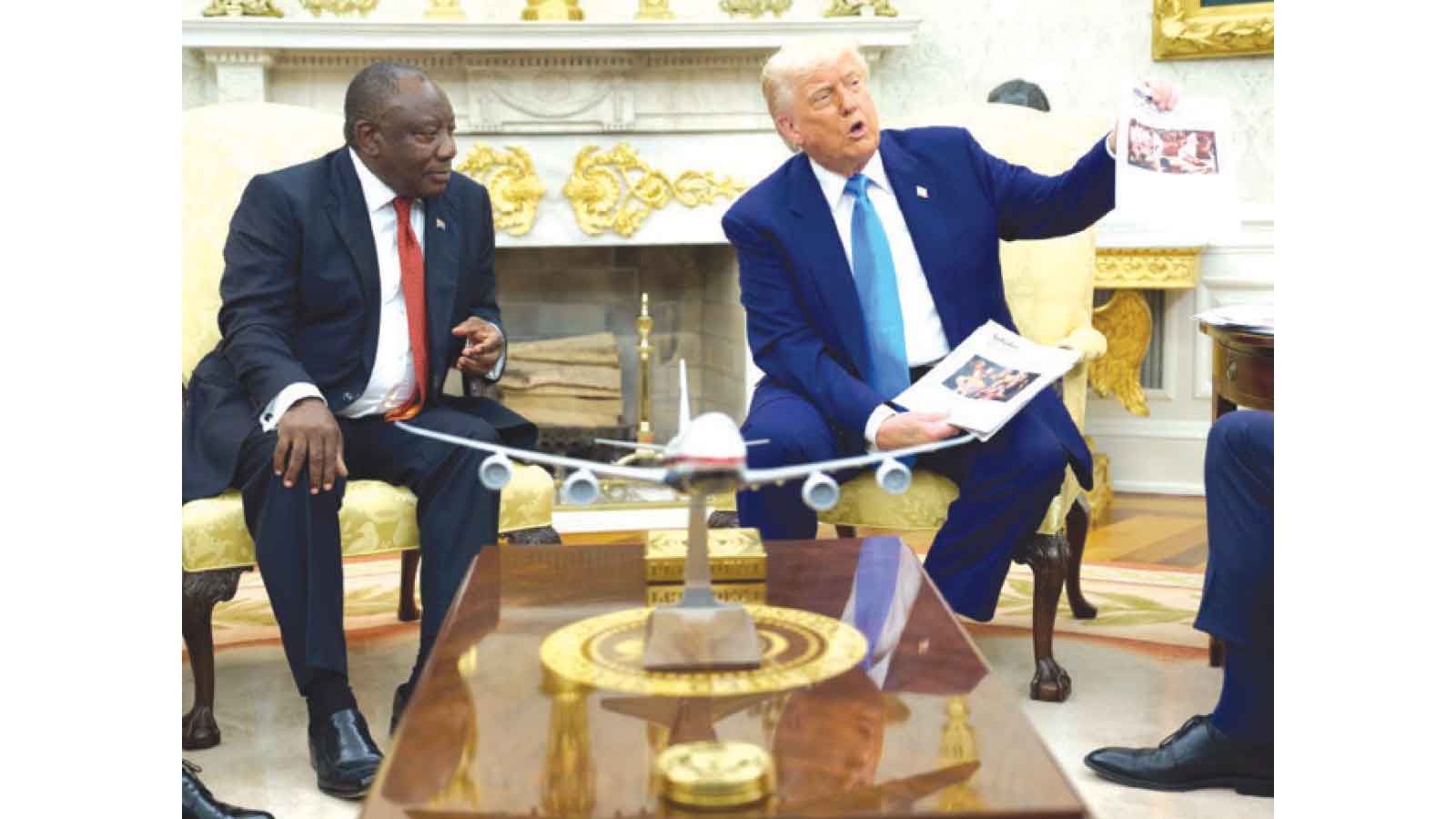
The way Ramaphosa remains unflappable under pressure from a menacing Trump in that White House meeting in May more than indicates that South Africa has the character to emerge unscathed from the souring relations with the US.
The world is now wiser than it was before.
In any case, a multipolar world is on the horizon.
Bishop out!