Online Reporter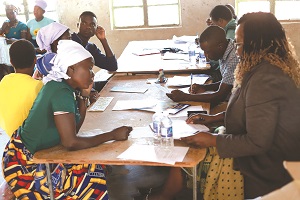
Langton Nyakwenda recently in BINGA
AT 17, Sarah Mumpande (not her real name) has never been to Harare, but she dreams of visiting the city every day.
The bustling capital, over 1 000km from her remote village of Sinamusanga in Binga district, Matabeleland North province, represents opportunity — a chance to go back to school, find work and build a new life. But until last week, that dream was just that, a dream. Without a national identity (ID) document, Sarah was invisible in the eyes of the law.
That all changed on Tuesday when she received her national ID card at a mobile registration centre set up at Sinamusanga Primary School.
To get there, she walked more than 10km through rough terrain.
“I am really excited. Finally, I have a national ID card, which I think is my gateway to a good life,” she said. “There are few opportunities down here in Binga, so my only hope now is to maybe go to Harare and seek better opportunities. But I couldn’t do that without obtaining a national ID card.”
Sarah is one of hundreds benefitting from a nationwide mobile civil registration programme targeting hard-to-reach communities.
Through a Government partnership with the United Nations Children’s Fund (UNICEF) and funding from Sweden and Switzerland, the initiative is bringing critical documentation services — birth and death certificates, as well as national ID cards — to rural Zimbabwe, one village at a time.
A place left behind
Sinamusanga, which is about 160km from Binga Centre, is one of the most isolated parts of Zimbabwe. Getting there is more than a 20-hour journey from Harare. Roadworks along the Bulawayo-Victoria Falls highway and impassable local roads make the trip gruelling.
In this marginalised region, basic services are scarce and residents must often navigate forests infested with wild animals to reach the nearest civil registry office in Siabuwa or Binga Centre.
Transport fares exceed US$20, an unaffordable figure for many. As a result, many people live and die without legal documentation, trapped in a cycle that locks them out of school, employment and healthcare. They also do not have the right to vote.
Honest Mudenda, a 28-year-old divorcee, cycled 15km to meet his ex-wife in Sinamusanga so they could jointly register their one-year-old child.
“We divorced, yes, but we have to combine forces when it comes to issues like a child’s documentation,” he said.
“Besides, there is an incentive because we can now access these services closer.”
Taking services to the people
Civil Registry Department deputy registrar- general for provincial operations Ms Christina Chikerema said the initiative is part of the Government’s drive to leave no one and no place behind.
“Our main goal is to fulfil the key priority area of provision of legal identity for all by 2030,” said Ms Chikerema.
“By targeting hard-to-reach areas, we are ensuring that we leave no one and no place behind. The documents that we issue have a direct impact on people’s lives. For people to participate in all national affairs, they have to be documented. So, our department is a cross-cutting enabler. We have to be there where the people are.”
Supported by UNICEF, the programme is not only mobile but increasingly digital.
Sub-offices in places like Kariangwe (Binga), Bubi (Matabeleland North) and Mpilo Hospital (Bulawayo) have been computerised, speeding up service delivery and reducing errors.
At Mpilo Hospital, mothers can now register their newborns just a few steps from the maternity ward.
“We envisage a situation where the Government of Zimbabwe would initiate this digital transformation of linking the health system and the civil registry system,” said Dr Nyasha Mayanga, UNICEF’s child protection manager.
“So, interoperability of the civil registration system and the health system can actually be a real game-changer in terms of birth registration. What it means is that you would have timely accurate electronic notification of births that occur at health facilities.”
According to Dr Mayanga, securing a birth certificate is far more than a bureaucratic formali; it is a gateway to every other right.
“A birth certificate is not just a piece of paper; there are attendant issues that are beneficial to the children of Zimbabwe,” added Dr Mayanga.
“This is part of the leaving no one and no place behind theme, which is a core strategy in the National Development Strategy 1, but also fundamentally a key theme of the social Sustainable Development Goals.”
A step towards dignity
Government data shows that, while 86 percent of births in Zimbabwe occur in health institutions, the remaining 14 percent — mostly in rural areas — often go unregistered.
The reasons range from distance and cost, to lack of awareness or documentation for the parents themselves. With initiatives like the one in Binga, the Government is not only closing the gap but restoring dignity to its most vulnerable citizens.
And for Sarah Mumpande, her new ID document is more than a card. It is a small document that could one day take her from Sinamusanga to Harare, and maybe even beyond.


 Online Reporter