Ray Bande
Senior Reporter
A GOVERNMENT ban on riverbed mining appears to be facing open defiance in Penhalonga, while a separate mining venture involving Chinese nationals at Sheni Mountain near Dangamvura has exposed glaring transparency gaps that have left communities demanding answers.
Investigations by The Manica Post reveal a troubling picture of weak enforcement, uncertainty and growing tension on both sides of Mutare.
In Penhalonga, illegal gold miners continue digging and extracting minerals from the Mutare River despite Government’s declaration of a State of Disaster, and the launch of the rehabilitation programme intended to reverse years of environmental destruction.
At Sheni Mountain, villagers said they are still not fully convinced about the true nature of a Chinese-operated mining project that has quietly taken shape over the past year, with some questioning whether the officially stated quarry mining activities tell the full story.
Government declared a State of Disaster for emergency riverine ecosystem rehabilitation under Statutory Instrument 91 of 2026, targeting 17 severely degraded river systems, including Mazowe, Save, Munyati, Umzingwane, Mutare, Haroni, and Nyamukwarara, among others.
Years of legal and illegal alluvial and riverbed gold mining have caused severe siltation, chemical pollution, destruction of river channels, and risks to aquatic life and water access
The intervention was necessitated by years of rampant legal and illegal alluvial mining that left rivers choked with silt, polluted by mining activities and stripped of their ecological integrity.
Yet on the ground in Penhalonga, illegal mining activities continue virtually unabated.
Far from retreating, illegal miners are reportedly fighting over access to lucrative mining grounds, even as contracted companies attempt to restore damaged sections of the river.
Sources told The Manica Post that clashes have become increasingly frequent as rival groups compete for shrinking mining space in areas earmarked for rehabilitation.
Environmental experts warn that riverbed mining and river rehabilitation cannot coexist.
While rehabilitation seeks to stabilise riverbanks, remove sediment build-up and restore ecological balance, riverbed mining involves the excavation and disturbance of river channels in pursuit of gold deposits.
Each mining operation effectively reverses restoration gains achieved through costly rehabilitation work.
However, concerns have also emerged that in some instances across the country, river rehabilitation projects can become a convenient cover for continued commercial mineral extraction under the guise of environmental restoration.
The distinction between genuine rehabilitation and disguised mining operations has become increasingly difficult for local communities to understand.
Even traditional leaders say they are struggling to separate rehabilitation activities from mining operations.
Senator Chief James Mutasa said decisions affecting Mutare River are being implemented without adequate community engagement.
“We are not really aware, as traditional leadership, whether it is river rehabilitation or riverbed mining that is going on. The decisions are made without our consultations, and we just see people coming to do whatever they are doing.
“However, we do not condone violence in our areas. We want those sanctioned by Government to carry out their work without interference,” he said.
The controversy deepened after businessman and Manica Diamonds Football Club benefactor, Mr Evans Kamombo, was implicated as being among individuals allegedly conducting mining activities within an area under rehabilitation by Nubia Investments.
It is alleged that heavy machinery was deployed into sections already undergoing restoration, potentially undoing rehabilitation work.
Repeated efforts to obtain comment from Mr Kamombo were unsuccessful.
His lawyer, Mr Chris Ndlovu of Gonese and Ndlovu Legal Practitioners, declined to discuss the allegations.
“Unfortunately, we cannot comment as the matter is still under investigation. It is subjudice for us to comment further.”
Tensions reportedly boiled over last weekend when a group of machete-wielding men allegedly invaded a rehabilitation site and ordered employees from Nubia Investments to cease operations.
Acting Manicaland provincial police spokesperson, Assistant Inspector Wiseman Chinyoka, said he was unaware of the incident.
Officials from the Environmental Management Agency and the Office of the Minister of State for Manicaland Affairs and Devolution could not provide immediate comment.
Acting Manicaland Provincial Mines Director, Mr Webster Mburundu, referred all enquiries on the Mutare River rehabilitation programme to the Provincial Riverine Ecosystems Rehabilitation Committee chaired by the Minister of State.
Mr Mburundu said: “In terms of Section 6 of Statutory Instrument 91 of 2026, Provincial Committees on Riverine Ecosystems Rehabilitation are chaired by the Minister of State for the province concerned.
“Therefore, I respectfully refer all related enquiries on Mutare River rehabilitation in Penhalonga to the Honourable Minister of State.”
Minister Mugadza was not readily available for a comment.
While authorities grapple with challenges in Penhalonga, another mining-related controversy is quietly unfolding south of Mutare.
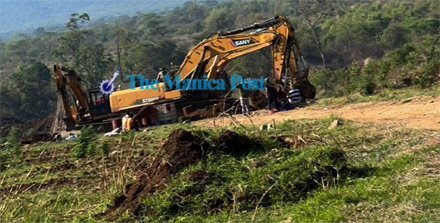
For nearly a year, Chinese nationals assisted by local partners have been establishing operations at Sheni Mountain near Dangamvura.
Officially, the venture is said to be a quarry mining operation supplying construction materials.
But the community remains unconvinced.
Locals point to the scale of equipment being assembled at the site and the presence of deep excavations on the mountain as reasons for their suspicions.
Some believe quarry mining could merely be a front for something else.
Mr John Sisimayi, a local villager, voiced the concerns shared by many villagers.
“We are not convinced that these Chinese are into quarry mining. This is just a cover-up to us. There is even a deep hole drilled into the mountain, and we suspect that is the one they are using to extract gold.
“We once undertook gold mining in that mountain and managed to get substantial amounts of the mineral before we were stopped,” he said.
The uncertainty is being amplified by conflicting levels of awareness among authorities.
Mr Mburundu said his office is investigating the matter, and noted that local authorities can issue quarry permits.
“We are currently checking on the specific issues that you have brought to our attention. However, local authorities (councils) also issue quarry permits, so we are engaging the relevant council in our review. Appropriate action will follow as needed.”
Mutare City Council Town Clerk, Mr Blessing Chafesuka, said he will dispatch officials to investigate.
“Let me send my team to investigate,” said Mr Chafesuka.
Mutare District Development Coordinator, Mr Tendai Kapenzi, also indicated that he needed to establish the facts.
“I am not aware, let me investigate,” said Mr Kapenzi.
Village head, Mr Nowel Bvirindi, said the community initially opposed the project when the Chinese nationals first arrived.
He said villagers were concerned because the mountain is regarded as culturally significant.
After engagements involving traditional leaders, Government departments and environmental authorities, the project was reportedly cleared to proceed as a quarry operation supplying material for the Christmas Pass Bypass Road project.
Mr Bvirindi said traditional ceremonies were conducted before the commencement of operations.
Yet despite these assurances, suspicions persist.
“When we saw the Chinese coming here and starting their operations, we were disturbed, and we instructed them to stop. This mountain is sacred, and in any case, they cannot just come and set up their operations without giving us any proper notification.
“We had a meeting with them, and they informed us that they were doing quarry mining, and their operations were sanctioned by the Ministry of Mines and Mining Development, EMA and the DDC’s Office.
“We consulted Chief Zimunya who told us that their operations were above board as they are extracting quarry to use in the Christmas Bypass Road project.
“We had a traditional ceremony to consult our ancestors so that they (Chinese nationals) can proceed with their operations. We had EMA and other official during that occasion.
“However, it is sad that people around here are now saying I was bribed with US$20 000 for the project to commence. Some sent petitions to the Zimbabwe Anti-Corruption Commission (ZACC) and other authorities,” said Mr Bvirindi.
When the Manica Post visited the Sheni Mountain quarry mining site at Chimbambaira Village early this week, a foreman, Mr Shadreck Museka, referred all questions to his superior, Mr Patrick Marco.
Mr Marco said: “I am not aware of what has been said so, I don’t want to clarify.”
River gold wars, Sheni mystery deepens