Online Reporter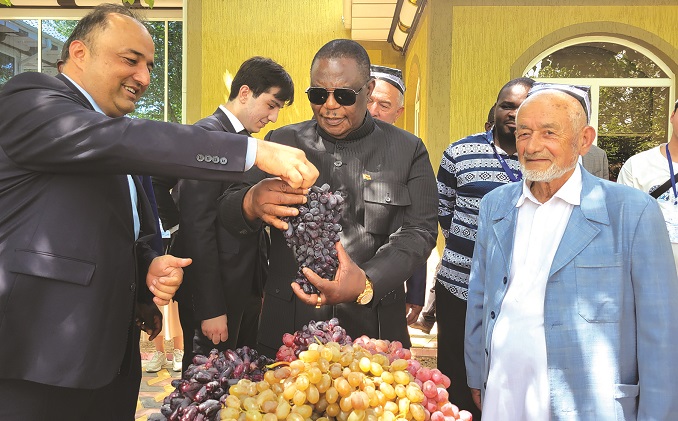
Mukudzei Chingwere in TURSUNZODA, Tajikistan
THE Government is keen on tapping into global best practices from Tajikistan to boost the ongoing rural industrialisation drive and promote local production, especially in agriculture.
Vice President Dr Constantino Chiwenga, who is on a working visit to the Asian country, yesterday toured smallholder plots here and came face-to-face with comprehensive, all-year-round economic activities by rural folk.
With impressive rice farming and value-addition activities, smallholder farmers in Tursunzoda are producing up to 30 000 tonnes of rice from tilling a combined 5 000 hectares.
This is a particularly impressive return, against a world rice production yield of approximately under five tonnes per hectare.
Rural industrialisation is expected to help Zimbabwe realise its agricultural potential, boost economic activities and inclusion, as well as speed up the achievement of an empowered upper middle-income economy, as envisioned by President Mnangagwa.
VP Chiwenga said he had been impressed by small, cost-effective milling machines capable of processing up to five tonnes of rice per day.
And with 120 of these machines already used here, small-scale producers are potentially generating up to 600t of rice daily.
“For any economy to grow, you need food security, with nutritious food.
“Zimbabwe can learn several key strategies from Tajikistan’s agricultural model that focuses on enhancing productivity for small-scale farmers,” said VP Chiwenga.
“We aim to empower smallholder farmers to enhance their productivity and achieve a sustainable standard of living through farming.
“Tajikistan employs methods like the system of rice intensification, which optimises plant spacing and water management.
“Zimbabwe can adopt similar practices to increase yields on limited land.”
Establishing better market linkages for rice producers, he said, can ensure farmers receive fair prices for their products, encouraging more investment in rice farming.
“We have seen that by promoting cooperative models, where farmers can share resources, tools and knowledge, can help in maximising the use of limited land,” VP Chiwenga added.
“I was particularly impressed by their rice milling machines. These compact and affordable machines yield impressive results, which is exactly what our farmers need.
“Here, crops are not sold as unfinished raw materials; instead, they are processed to create real value. Small-scale farmers engage in the entire value chain to maximise their revenue, and that is our goal.
“Additionally, I was thrilled to see that this is being accomplished on very small pieces of land compared to ours back home.”
Tursunzoda, the grape capital of Tajikistan, is a major hub for production of the fruit.
It is also home to the renowned Boghi Somon Vineyard Farm.
VP Chiwenga took time to visit the vineyards.
“The region has secured a contract with Kazakhstan to export US$500 000 worth of grapes.
“Farmers here harvest impressive quantities, particularly the shohon variety, collecting about 500kg daily from a 500-hectare vineyard,” he said.
“We have the land and the potential to achieve more than what is currently being done here. We envision each region focusing on its agricultural strengths.
“Here, various types of grapes are being grown; that is the model we aspire to, and we can accomplish it at an accelerated pace in Zimbabwe.”
In 2024, Tajikistan’s agricultural output was more than US$7 billion, reflecting a more than 10 percent increase compared to the previous year.
According to Tajikistan’s Agriculture ministry, agriculture accounted for 24,5 percent of the country’s gross domestic product (GDP).
In Tursunzoda, farmers Mr Usmanov Nematjon, a retired English teacher, and Mr Kamolov Mahmmadamin are achieving remarkable success through fruit farming. This is particularly so with grapes.
Mr Mahmmadamin said he invests approximately US$3 000 in preparing his farm, yielding an impressive annual income of around US$25 000 from his crops.
Both farmers emphasise the potential for small-scale farming without huge capital investment, encouraging their counterparts in Zimbabwe to explore similar opportunities.
They advocate for completing the value chain to maximise profits, demonstrating that fruitful results are achievable.



 Online Reporter