
LONDON. – Cheers rang out as Chris Brown walked out of Southwark Crown Court on Monday.
Moments earlier, a judge had told him that smashing a tequila bottle over a man’s head was “plainly dangerous”. But outside, a crowd waited with their phones raised, screaming as though he had just come off stag
He signed autographs, blew kisses and later posted a video from the back of his car, turning to the camera to give a thumbs up.
This was a man who had just been handed an eight-month custodial sentence, suspended for a year, for a violent attack on music producer Abe Diaw.
Yet he behaved as though he had won a Grammy – and his fans treated him as if he had.
Forgive me if watching a convicted man walk out of court to applause leaves me feeling sick.
What shocked me most was not the sentence.
It was the women waiting outside to cheer him.
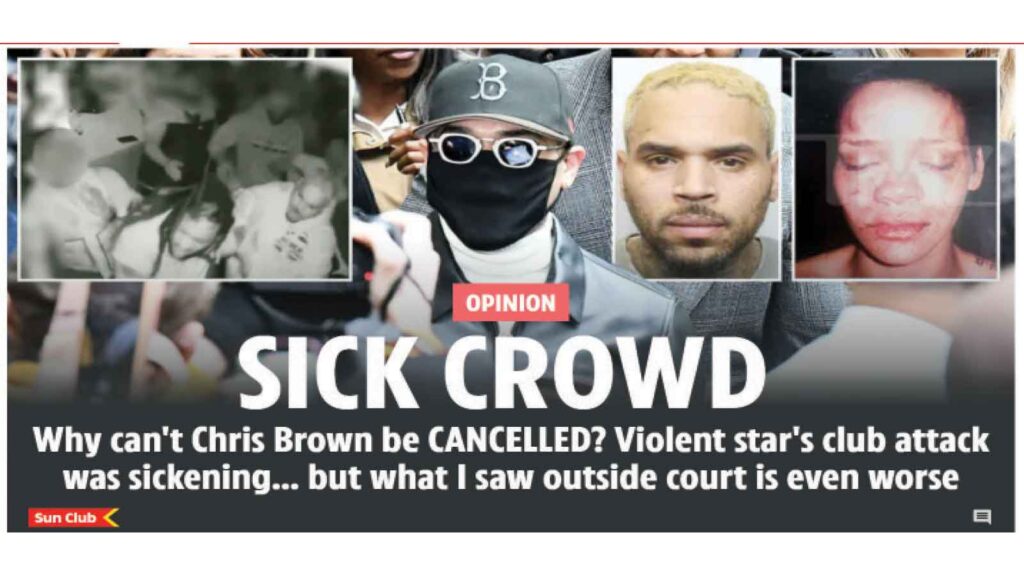
I was five when Rihanna’s battered face appeared in newspapers and magazines: a swollen black eye, bloody mouth and split lip.
Even then, I understood something terrible had happened.
When Brown, then 19, pleaded guilty to assaulting her, it seemed his career might be finished.
It is ASTONISHING that it wasn’t.
Sixteen years on, he has sold around 40 million albums and is worth £65 million.
He has 125 entries on the Billboard Hot 100, the tenth most of any act, including 54 top 40 hits and 17 top 10s.
His biggest hit, Under The Influence, has racked up more than 1.8 billion plays on Spotify.
He has three songs with over a billion streams, more than 50 million monthly listeners, and a pair of Grammys for Best R&B Album.
The fact this man is still a star is frankly mental.
After Brown was booed at the American Music Awards in 2022, Kelly Rowland said:
“We all need to be forgiven for anything that we could be doing.”
Of course we do.
But forgiveness is meant to follow remorse.
Where is it?
Because while Brown has shown none, we live in an age when people lose their jobs, their brands and their reputations over an ill-judged tweet.
Yet a man with a history of violence can still command a devoted crowd outside court. Chris Brown is uncancellable.
And I feel genuinely let down by the women who keep him that way.
These are women cheering a man who has been convicted of assaulting his girlfriend and has now admitted a brutal attack on another man.
They are celebrating him while countless women who experience domestic abuse struggle to be believed, supported or taken seriously.
To those fans, I ask: Where is the solidarity? How can you show up for this man after everything he has done?
Many were teenage girls when the Rihanna assault made headlines.
They are now grown women, with jobs, daughters, sisters and friends who may have experienced abuse themselves. Surely we should know better by now.
There are women who will happily champion female empowerment until it means giving up a man whose music they love.
Brown has become the poster boy for that hypocrisy.
When he was arrested last year, one fan told the BBC she had cancelled her plans to wait outside court. “I love his music, his voice,” she said. “Even my children are fans now.”
And there it is: the music, the nostalgia, the excuse.
The pleas are always the same: “He makes good music.” “He’s fit.” “There are worse people out there.”
There always are. That has never made a crime acceptable.
I understand the pull of songs that soundtrack school discos, first kisses and young summers.
But sentimentality cannot weigh more than a victim. A catchy chorus does not cancel out violence.
The old argument about separating the art from the artist has been wheeled out for decades, for Picasso, for Kanye and for anyone whose talent has made them too profitable to lose.
It is a comfortable idea for the person listening, and a far less comfortable one for the person on the receiving end.
Every stream, every ticket sold and every cheer outside a courtroom sends Brown the same message, whatever he does, we will still be here.
Yesterday, Brown got his sentence – and then he got his applause.
How far does he have to go before it is finally enough? – Sun Club