Sikhumbuzo Moyo, Senior Reporter
FOR a moment, the future of the Sigola chieftainship appeared uncertain following the death of Chief Zephania Sigola at the age of 96, coupled with the fact that he had outlived six of his seven children.
This left the traditional institution facing an unusual succession question.
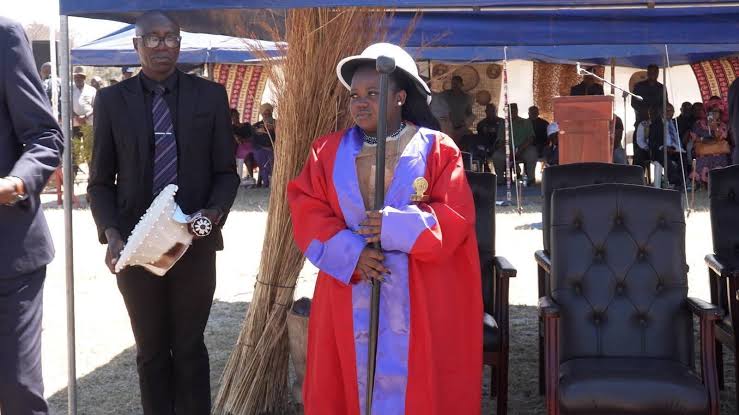
His only surviving child, Mrs Nomalanga Sithole, has now taken over the reins as the substantive Chief Sigola.
But while her installation has ushered in a new chapter for the Sigola chieftainship, it has also raised a fundamental question: what happens when her reign comes to an end?
The Sigola family says there is no cause for alarm.
According to the family, the chieftainship is firmly anchored in the Sigola clan and will not become extinct as the next Chief Sigola, will be selected from the brothers of the late Chief Zephania Sigola.

The clarification comes after Mrs Sithole was officially installed as Chief Sigola last Thursday, becoming one of only a handful of women holding traditional leadership positions in Zimbabwe.
For the Sigola family, however, her appointment does not represent a break with the clan’s succession traditions.
Family spokesperson Mr Bongani Sigola said the succession issue had been discussed at length and the family had reached a clear position.
“No, the Sigola chieftainship is not facing extinction. The family has a clear position that the next Chief Sigola will be chosen from among our uncle’s (the late Chief Zephania Sigola) brothers,” he said.
Mr Sigola said the family had no objection to Mrs Sithole assuming the throne, particularly because it was the wish of her late father.
He said the issue of succession beyond her reign had already been considered.
“Nomalanga’s children have Sithole as their surname, they are not Sigola, so they cannot assume a chieftainship that belongs to the Sigola clan,” he said.
The explanation effectively draws a distinction between the present chief’s right to occupy the throne and the family’s longer-term succession arrangements.
For now, Chief Sigola has the task of leading her people and carrying forward the legacy of her father.
Her installation was significant not only because she succeeded her late father, but also because of the circumstances surrounding the succession.
Chief Zephania Sigola died on May 1, aged 96, having lost six of his seven children.
That left Mrs Sithole as his only surviving child and the obvious heir to the chieftainship in terms of the wishes of her late father.
At the installation ceremony held at Sigola Primary School in Umzingwane District, Minister of Local Government and Public Works Daniel Garwe described the new chief’s journey as one marked by resilience, hard work and perseverance.
His speech was read on his behalf by Ms Sikhangele Ndlovu, director of coordination in the office of the Matabeleland South Minister of State for Provincial Affairs and Devolution.
Chief Sigola, born on May 25, 1979, at Phelandaba Clinic in Bulawayo, spent her formative years in Njube Township.
She attended Mtshede Primary School between 1985 and 1991, where she obtained her Grade Seven certificate, before proceeding to Mpopoma High School for her secondary education and Ordinary Level studies.
Her journey would later take her across the border to South Africa, where she worked from 1996 to 2013.
After 17 years in South Africa, she returned home to Zimbabwe, bringing with her years of work and life experience.
She is currently studying towards a Diploma in Business Management.
“Her journey is one of resilience, hard work, commitment and perseverance,” said Minister Garwe.
“From her humble beginnings in Njube Township, through her many years of professional experience in South Africa, and upon her return home to Zimbabwe, she has continued to develop herself and prepare for greater responsibilities.”
The new chief’s personal journey is now intertwined with the history and future of the Sigola traditional institution.
Her installation also adds another chapter to the growing presence of women in Zimbabwe’s traditional leadership structures.
She becomes the eighth female chief in the country, joining Chief Sinqobile Mabhena of Umzingwane, Chief Ketso Mathe of Gwanda, Chief Hikwa (Adelaide Tshuma) of Bulilima, Chief Mvuthu (Silibaziso Mlotshwa) of Hwange, Regent Chief Mabhikwa (Zanele Khumalo) of Lupane, Chief Chimukoko of Mashonaland East and the late Chief Ndube (Nonhlanhla Sibanda) of Insiza.
For the Sigola community, therefore, the installation of their new chief is not simply about filling a vacant throne but it is about continuity.
They said it is about preserving a family institution whose roots, according to the Sigola family, run deeper than one generation.
And while Chief Nomalanga Sigola begins her reign as the first woman from her immediate family to occupy the position, the family insists that the Sigola name and chieftainship have a future beyond her tenure.
Chiefs in Zimbabwe are appointed in terms of the Traditional Leaders Act (Chapter 29:17) and under Section 3 of the Act, the President appoints chiefs to preside over communities inhabiting communal land and resettlement areas.
The law, however, requires the President, when making such an appointment, to give due consideration to the prevailing customary principles of succession applicable to the community concerned, as well as the administrative needs of the area in the interests of good governance.
The Act further provides that, wherever practicable, the President should appoint a person nominated by the appropriate people in the community in accordance with those customary succession principles.