
Emmanuel Kafe
Check Point Desk
MY recent visit to the command centre at the Criminal Investigation Department headquarters to observe the new Zimbabwe Smart Traffic Management System left me with an unexpected revelation: my own vehicle had been flagged 18 times.
Eighteen!
The figure alone was startling, but what followed was even more unsettling.
As the records and footage were reviewed, I watched myself break traffic regulations without even realising it at the time.
There was no police officer stationed at the junction, no blaring siren behind me and no uniformed officer signalling me to pull over. I had simply continued on my journey, completely unaware that my driving had been recorded.
In an instant, the article I had set out to write transformed.
It was no longer merely a piece about cameras, technology or Government initiatives to improve traffic flow; it became a personal reflection on the decisions I make behind the wheel and the likelihood that thousands of other motorists are making similar careless mistakes every single day.
If a journalist on a familiarisation tour can discover 18 recorded infractions against his name, what might these cameras be capturing about those who treat Harare’s roads as though traffic rules were purely optional?
Consider the commuter omnibus surging towards an intersection, sounding its horn at smaller vehicles while forcing its way through a closing gap.
Then there is the driver who accelerates as the traffic light turns amber to beat the red signal or the motorist who gridlocks a junction simply because gaining an edge over the next car takes priority over keeping traffic moving.
For these drivers, the era of assuming an offence goes unnoticed in the absence of a visible police presence is coming to an end.
Zimbabwe’s Smart Traffic Management System, also known as the Electronic Traffic Management System, is fundamentally altering how traffic offences are detected, reviewed and addressed.
Yet my experience also highlighted a broader truth: one does not need to drive recklessly to end up on the wrong side of the law.
Often, a violation occurs during the haste of a routine journey, without the driver ever realising a mistake was made.
This is precisely why motorists must grasp how the system operates.
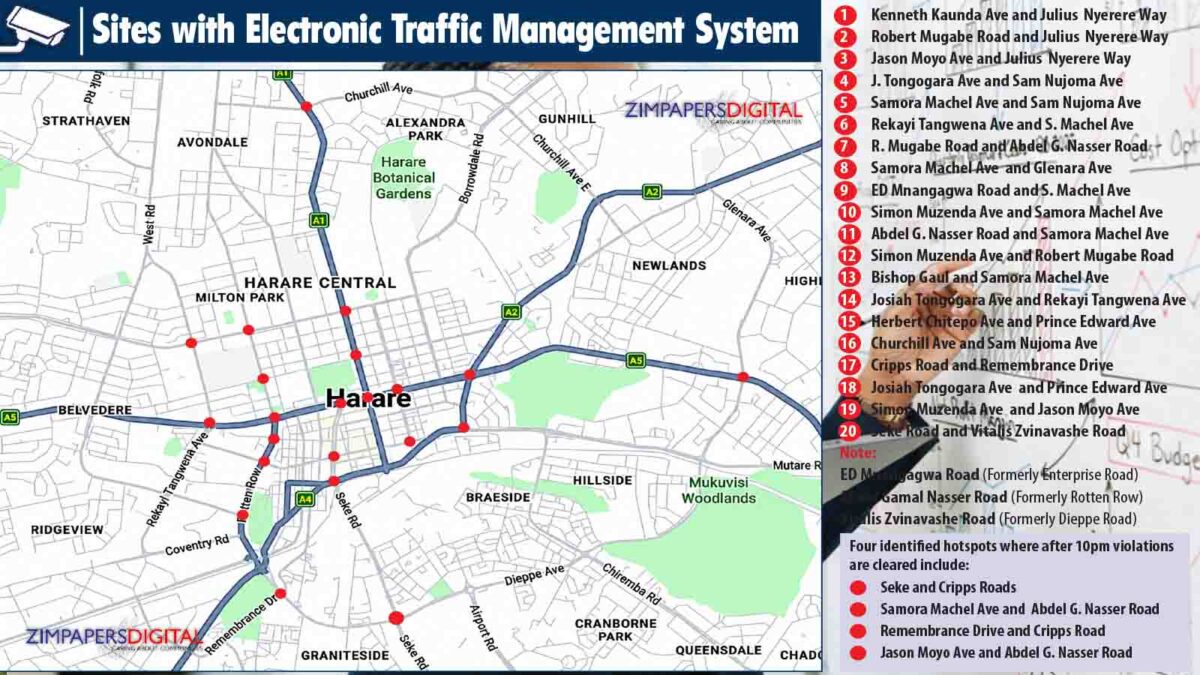
The network currently monitors 20 sites across Harare, with cameras linked directly to the command centre at the Criminal Investigation Department headquarters, where officers analyse potential violations captured on the road.
Crucially, the process does not automatically deem a driver guilty the moment a camera registers a vehicle. Instead, footage is meticulously reviewed by a team of 25 police validators before any formal notification is issued.
Zimbabwe Republic Police spokesperson Commissioner Paul Nyathi emphasised that the technology is designed to enhance policing rather than replace physical presence, noting that such systems are widely used internationally to assist law enforcement.
This human element is vital.
While a camera might record a vehicle crossing a stop line, the clip must be evaluated in context.
Was the traffic light functioning correctly?
Had the vehicle already entered the intersection?
Was the driver acting on instructions from a traffic officer?
Does the evidence definitively prove a violation occurred?
These nuances dictate whether a motorist has broken the law or whether the footage warrants further review.
Beyond road safety, the police note that the system also aids in tracking vehicles linked to serious crimes, including armed robberies and smash-and-grab incidents.
For the average motorist, however, the most direct implication is simple: a traffic violation can now be identified, scrutinised and processed long after the journey has ended.
The amber light question
Few moments on the road divide drivers quite like an amber traffic light.
One driver brakes, another accelerates and a third, with a commuter omnibus trailing closely behind, fears that stopping suddenly could cause a rear-end collision.
In Harare’s congested streets, a vehicle may also enter an intersection lawfully, only to find itself stranded in the middle as the signals change.
Does that automatically make the driver an offender?
According to Commissioner Nyathi, motorists are not penalised simply for proceeding through an amber light.
A red-light violation occurs when a vehicle crosses the stop line and enters the intersection after the signal has already turned red.
Assistant Commissioner Gajiwett Gomo, the Zimbabwe Republic Police (ZRP)’s director of information technology, further indicated that a driver who enters an intersection on green and is already committed to turning should be allowed to clear the junction safely.
Consequently, footage must be evaluated in context rather than treating every vehicle captured within an intersection as an automatic infraction.
That distinction is crucial in a city where traffic builds up quickly and drivers frequently find themselves caught between changing signals and dense queues.
The police have also acknowledged concerns regarding faded stop lines and traffic lights that fail to clearly indicate whether vehicles turning left or right are permitted to proceed.
Asst Commissioner Gomo noted that these issues are actively being addressed alongside technical partners and local authorities.
For motorists, however, the primary lesson remains simple: do not gamble on an amber light.
“Approach intersections cautiously, obey the signals and avoid accelerating in the hope of squeezing through before the light turns red,” he advised.
From camera to your phone
What happens when the system identifies a suspected violation?
Once police validators review and confirm the offence, an SMS notification is sent to the registered vehicle owner.
The electronic platform allows the recipient to view both a photograph and video footage of the alleged violation.
That evidence is crucial, as it gives motorists an opportunity to examine what was recorded rather than relying solely on a text message.
If a driver believes the allegation is incorrect, the platform provides an option to dispute it by submitting grounds for challenge. If a review establishes that an error occurred, the record can be invalidated.
However, where the police maintain that sufficient evidence exists, the matter may proceed to court.
Assistant Commissioner Gomo said this procedure is vital when a vehicle has been wrongly identified, a traffic signal was malfunctioning or the captured circumstances do not support the alleged offence.
“Receiving a notification should therefore prompt the motorist to examine the evidence and use the available dispute process if there are genuine grounds to challenge it,” he said.
This is where my experience becomes particularly relevant.
The discovery that my car had been flagged 18 times was a reminder that motorists should not dismiss a notification without examining the evidence.
Equally, a flag should not be treated as absolute proof: out of my 18 recorded offences, only one was validated, while the others remain pending review.
Consequently, I had to pay a US$30 fine, which I have already settled.
Figures released by the police highlight the scale of the operation.
By October 19, more than 4,8 million violations had reportedly been flagged and validated, with another briefing placing the total near five million since the system was rolled out in May.
Seven days to respond
Commissioner Nyathi said motorists have seven days to respond after receiving a notification, followed by a further seven days to pay the applicable fine.
Failure to resolve the matter within this 14-day period can lead to further action, including court proceedings and a warrant of arrest.
Fines under the first schedule of the National Deposit Fines Schedule range from US$5 to US$30 for offences that can be settled at a local police station, whereas more serious matters are referred to court.
Commissioner Nyathi confirmed that payments can be made via EcoCash, Mastercard or Visa as well as at designated police stations, including Harare Central Traffic, Warren Park Traffic, Avondale Traffic, Mabelreign, Marlborough, Mbare and Chitungwiza.
Motorists can also use the Pay My Fines platform to check for recorded violations.
In an update on the rollout, Commissioner Nyathi emphasised that no agents have been contracted to collect fines on behalf of the ZRP, either physically or electronically.
“The important point is not simply the size of the fine.
“It is that drivers need to take notifications seriously, examine the evidence and act within the stated timeframes.
“Anyone who receives a notification should also ensure they are using official platforms and payment channels rather than handing money to someone claiming they can make a case disappear,” he said.
What if you have sold your car?
The system has also highlighted problems for individuals who sell vehicles without ensuring change of ownership is officially registered.
Commissioner Nyathi said some former owners have received notifications relating to vehicles sold months earlier.
Until official records reflect the transfer, the person listed as the registered owner will continue to receive these alerts.
Police are urging motorists to update ownership records within the required two-week window.
“This advice is especially important for people who sell vehicles informally and assume that handing over the keys and registration papers is sufficient.
“If records are not updated, the former owner may be drawn into disputes over offences committed long after the sale,” Comm Nyathi warned.
The police have also clarified that drivers who are manually directed through an intersection by a police officer will not be penalised for following those instructions.
Junctions under watch
The cameras are not watching from a distant, unfamiliar highway; they are positioned at busy junctions that Harare motorists negotiate every day.
Among the monitored locations are Samora Machel Avenue and Simon Muzenda Street, where traffic flows through the heart of the central business district and Samora Machel Avenue and Glenara Avenue, a major arterial route connecting the city centre with the eastern suburbs.
Other key sites include Leopold Takawira Street and Herbert Chitepo Avenue, Robert Mugabe Road and Abdel Gamal Nasser Road, as well as Cripps Road and Remembrance Drive.
The network also covers intersections at Churchill Avenue and Sam Nujoma Street, Samora Machel Avenue and Bishop Gaul Avenue, Julius Nyerere Way and Jason Moyo Avenue, Sam Nujoma Street and Josiah Tongogara Avenue, and Glenara Avenue and Chiremba Road.
For a kombi driver who cuts across lanes, picks up passengers in the middle of the road, or drives against oncoming traffic to bypass a queue, the risk is no longer limited to being spotted by a physical traffic officer.
Police report that the system can detect a wide range of infractions, including red-light violations, speeding, driving against the flow of traffic, using a mobile phone while driving, failing to wear a seatbelt and picking up or dropping off passengers at undesignated locations.
Each suspected violation remains subject to human review before any enforcement action is taken.
Hotspots and crime monitoring
There is another vital side to this surveillance network: the cameras also assist police in monitoring criminal activity in busy public spaces.
Commissioner Nyathi highlighted Mupedzanhamo as one of the areas where authorities have noted rising concerns regarding muggings and smash-and-grab incidents, particularly after 10pm.
He explained that the team is actively mapping crime hotspots as part of this broader initiative.
Crucially, if a motorist breaks traffic rules at these specific signals after 10pm to avoid a mugging or smash-and-grab attempt, their violation will be invalidated upon review.
Jaywalkers, motorcyclists and pedestrians
It is not only drivers behind the wheel who need to exercise caution.
For years, crossing a busy Harare street wherever a gap appears has been a daily routine for many pedestrians.
Even with a designated crossing just a few metres away, the temptation to dash between moving vehicles often overcomes the patience to walk to the proper signal. That habit is now firmly in the police spotlight.
Commissioner Nyathi issued a stern warning against jaywalking.
“We want people to cross at designated points, and the laws are there to be applied to those who fail to adhere to this requirement.”
A pedestrian who suddenly darts into traffic can force a driver to brake sharply or swerve into an adjacent lane.
“While a motorist might be blamed for a collision, the physical consequences are often devastating for the pedestrian.
Motorcyclists are similarly reminded that they are not exempt from traffic laws.
Police have repeatedly raised concerns regarding riders travelling at excessive speeds, overtaking dangerously, weaving between moving vehicles, riding against traffic and ignoring signals.
Authorities have also warned against operating unregistered motorcycles, riding without a valid licence and failing to wear approved protective helmets.
Motorcycles are permitted to carry only one passenger, who must be properly seated and helmeted. Police confirmed that both pedestrians and motorcyclists are under continuous scrutiny.
Can cameras finally eliminate roadside bribery?
For years, a central frustration surrounding traffic enforcement has been the perception that motorists could escape penalties through quiet roadside arrangements.
A driver is stopped, a conversation ensues and what should be a standard legal process degenerates into an informal negotiation.
With cameras capturing violations and footage evaluated centrally, police argue there is significantly less room for offences to be settled at the roadside.
Comm Nyathi acknowledged public complaints regarding corruption, including allegations of officers misusing discretion or accepting bribes.
“People have been complaining that police officers are compromised because some end up using their discretion, while others accept bribes,” he said.
He emphasised that command centre monitoring directly addresses this vulnerability.
“With this system, which is fully monitored through the command centre, everything taking place is recorded. We are effectively eliminating the human factor and wiping out corruption.”