Online Reporter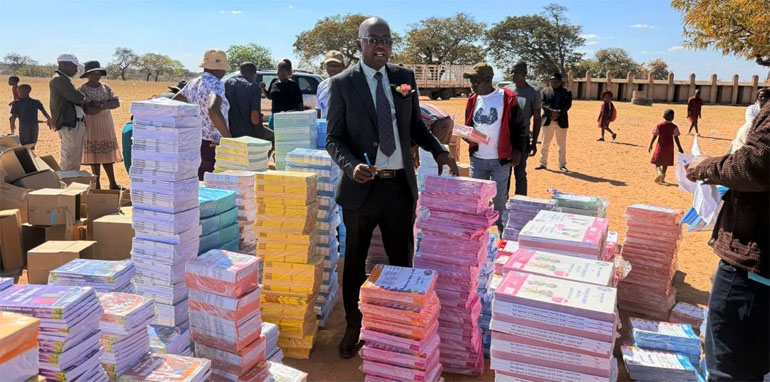
Samuel Kadungure
News Editor
AT Masocha Primary School last Friday, the most valuable item that passed from one set of hands to another was not cash or fine cloth – but the profound gift of a book.
Fresh from their boxes, their covers bright and pages crisp, more than 100 000 updated Heritage-based curriculum textbooks arrived on the dry, sun-baked soil of Buhera North like an unexpected rainstorm in a drought-stricken season.
The struggle for basic educational infrastructure is an everyday reality in the constituency.
This makes a textbook, not merely paper and ink, but a passport out of generational poverty, shield against early child marriage, and a quiet promise that a child’s location will not dictate their destiny.
For children accustomed to sharing worn-out books, copying long passages from blackboards, or waiting patiently for a classmate to finish reading before their turn, the sight of cartons filled with new learning materials carried a meaning far beyond monetary value.
The donation by ZANU PF legislator for Buhera North, Honourable Phillip Guyo, benefited 23 primary schools across the constituency.
The books, covering all six core learning areas, are valued at more than US$100 000.
In communities where the distance between a child’s ambition and the resources available to pursue it is impossibly wide, a textbook becomes a bridge. For many learners, it is the first book they can consistently call their own in the classroom.
Under the revised Heritage-based curriculum – which emphasises localised history, indigenous science, technology, and culture alongside core academic skills – updated textbooks are essential.
Yet, in many local classrooms, a single textbook was previously shared among upto 13 learners.
Lessons frequently devolved into marathon dictation sessions, with dedicated teachers writing entire chapters on pitted blackboards, while learners spent precious hours copying text rather than engaging in critical analysis or discussion.
Compounding this academic deficit is the grinding economic reality of the district.
Recurrent droughts and meagre harvests leave households with little disposable income. For most parents, raising a few dollars for termly school fees means making painful trade-offs between education, healthcare, and basic nutrition.
Children often arrive at school on empty stomachs, their minds burdened by the knowledge that their parents are falling behind on fee payments.
School fees, uniforms, and stationery become competing demands in households where financial resources are perpetually stretched. Poverty manifests in aging classroom blocks, crowded learning spaces, and inadequate furniture.
Yet, poverty does not diminish a child’s desire to learn – but simply makes the journey harder.
The atmosphere at Masocha Primary School reflected this reality with quiet dignity and relief.
Mothers in colourful headscarves sat alongside men and village elders, clapping in synchronized gratitude. Teachers thumbed through the pristine pages with visible emotion, recognising how these resources would immediately transform their daily lesson plans.
Honourable Guyo’s intervention extended beyond learning materials.
More than US$4 000 in cash was paid towards the school fees of two vulnerable and disadvantaged children per school across the constituency, removing financial barrier that often force young learners out of the classroom.
“I looked at our primary schools and saw brilliant, eager minds held back simply because they lacked the basic instruments of learning. Education is the greatest equaliser. My objective is to completely eradicate the textbook-to-learner deficit in Buhera North. We cannot talk about modern national development or Vision 2030 while leaving the rural child behind,” said Honourable Guyo, emphasising that targeting primary education was a deliberate strategic choice.
“If the foundation is weak, the entire academic structure will eventually collapse. Having now secured and strengthened the primary school foundation across these 23 schools, our immediate next step is to extend this empowerment drive to all secondary schools across the constituency,” he added.
However, he issued a passionate appeal to parents, urging them to match these material investments with structural support at home.
In communal setups, children – especially young girls – are frequently burdened with heavy morning and evening chores, from tending livestock and fetching water to working long hours in the fields during planting season.
“Books in the classroom are only half the equation. I appeal to our parents – please, create dedicated time at home for children to study. Do not overburden them with field labour and household chores at the expense of their homework. Give them the time and space to read, to dream, and to excel,” said Honourable Guyo, stressing that a child who arrives at school physically exhausted has little opportunity to revise or prepare for examinations.
He called for a balance between household responsibilities and academic needs, noting that an adult choosing to tell a child to put down the hoe and study can alter the course of that child’s life.
Buhera District Schools Inspector, Mr Tirivanhu Mutomba acknowledged the significance of the intervention, emphasising how access to learning materials transforms classroom instruction.
“For teachers, new textbooks change the rhythm of a lesson. Instead of writing every exercise on a blackboard while dozens of learners copy it into notebooks, children can engage directly with the material. Lessons become more interactive, teachers can assign reading beyond the classroom, and pupils can revisit concepts at home. The book becomes both teacher and companion,” he said.
Traditional leadership highlighted the community’s responsibility to complement these investments.
Headman Neshava expressed deep gratitude on behalf of his subjects, noting that while external assistance resolves critical resource shortages, parents must remain active partners in their children’s growth.
“Honourable Guyo has removed a mountain from our shoulders, but as parents, we must play our part. We must make every effort to pay the remaining school fees, no matter how difficult, to keep our schools operational. More importantly, we must protect our young girls. Let us shun early child marriages completely. A girl child’s place is in the classroom with these books, not in a matrimonial home before her time,” said Headman Neshava.
Children representatives reinforced the immediate impact of the support.
Buhera North Junior MP, Tafara Muchinjikwa, of Hande High School, framed the initiative as a practical lifeline for vulnerable students.
“The intervention is not an abstract development project. It is a school uniform that remains on the body, a classroom seat that remains occupied. It is another term completed. It is the ability to sit for an examination with the knowledge that an unpaid fee bill will not stand between the child and the opportunity to learn,” he said.
Buhera Rural District Council Ward 13 Junior Councillor, Kimberly Mushohwe, emphasised that children in the district seek opportunity rather than pity.
“The children of Buhera North do not need pity –they need opportunity. They need functioning classrooms, committed teachers, supportive families, adequate learning materials, and communities prepared to protect their right to education,” said Kimberly.
She noted that a new book placed in the hands of a child who previously lacked resources represents access – to information, examinations, qualifications, and choices.
“To many people outside, a textbook is just paper. To a rural child who has had to memorise blackboards or share one book with 13 classmates, this gift means dignity. It means we can study at our own pace and compete fairly with learners anywhere in the country. We promise to look after these books and work hard to make our community proud. The gesture will soon not be measured in dollars or the number of textbooks delivered, but in lives changed,” said Kimberly.